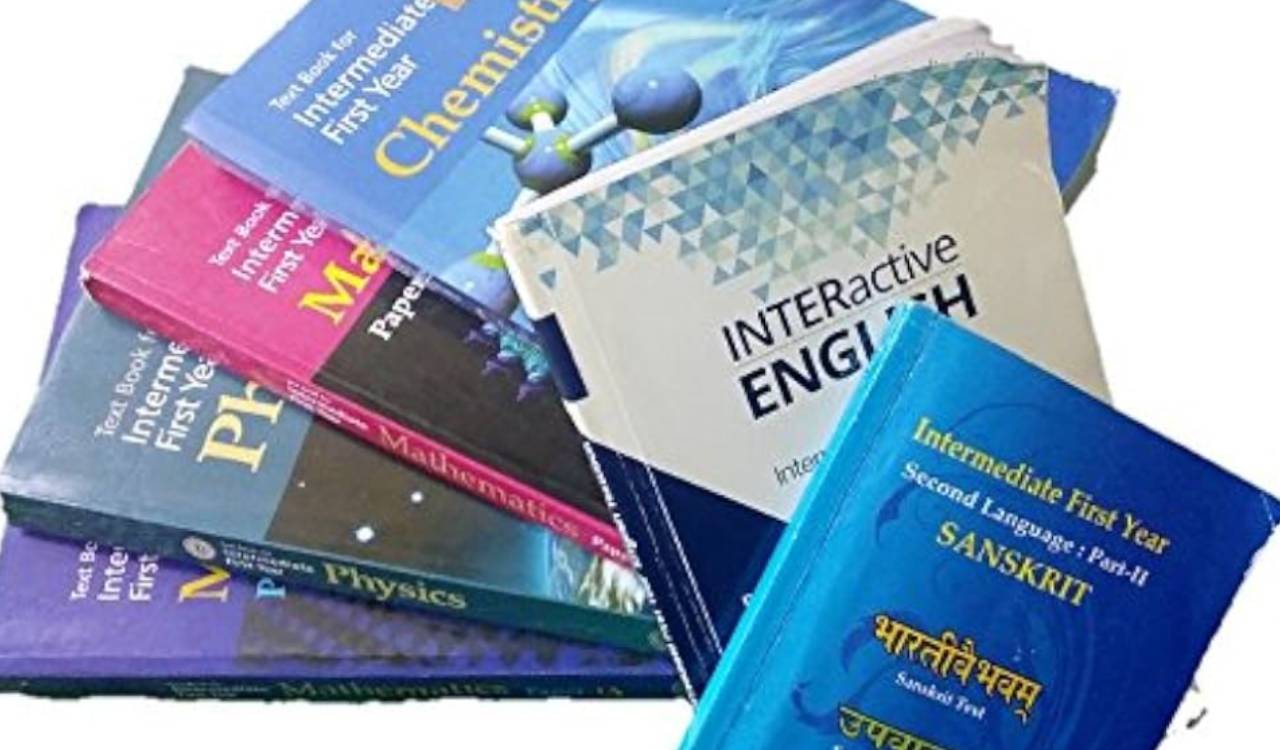
The Telangana Board of Intermediate Education has revamped the first-year intermediate syllabus for 2026-27, introducing AI concepts, reducing repetitive content, and adding Telangana-specific cultural lessons.
Published Date – 26 May 2026, 08:57 PM
Hyderabad: Featuring lessons on Telangana history, culture, festivals, and folk arts in accordance with Telangana’s dialect, introducing the concepts of AI to embedding quick response codes’ on textbooks, the first-year intermediate syllabus has undergone a major revamp for the academic year 2026-27.
The Telangana Board of Intermediate Education, which has taken up syllabus revision, has reduced repetitive problems and the number of pages in Mathematics – 1A. However, it added two chapters – sets and relations, and sequences and series. It will also feature famous Indian mathematicians.
Physics textbooks will now introduce students to concepts of AI with the addition of a title AI:Physics of Emerging Technologies to create awareness about recent advancements in science and technology.
The new lesson helps students understand modern fields such as artificial intelligence, robotics, renewable energy, space science, and communication technologies. The number of Physics practical experiments has been reduced to 10 experiments for better focus and effective hands-on experience. Similar changes have been made in the Chemistry syllabus.
The botany syllabus, which is aligned with the NCERT syllabus, will now feature glossary terms, diagrams and Indian scientists. Changes in Zoology include a new chapter-Economics, Zoology, the merger of biodiversity and ecology units, modification of the animal tissue chapter and improved connectivity among topics. The syllabus for humanities streams has also been changed.
As for languages, Telangana history, culture, festivals, folk arts, and notable personalities in accordance with Telangana’s dialect have been included prominently in the revised Telugu syllabus. In every chapter, activities, projects, and experiments are included to improve practical understanding. In addition, activities to improve communicative skills are incorporated.
Sanskrit, Hindi and Arabic textbooks will now have more Telangana specific content besides activities to improve communicative skills. As for French, Marathi and Kannada languages, the textbooks were adopted from the Common European Framework of Reference for Languages, Maharashtra and Karnataka Board respectively.
Except for mathematics, humanities and languages that have internal assessment, other subjects will have practical exams for 15 marks in the first year.
The internal assessment for 15 marks will be conducted in mathematics 1A and 1B, while 20 marks have been earmarked for internal assessment in languages and humanities streams.