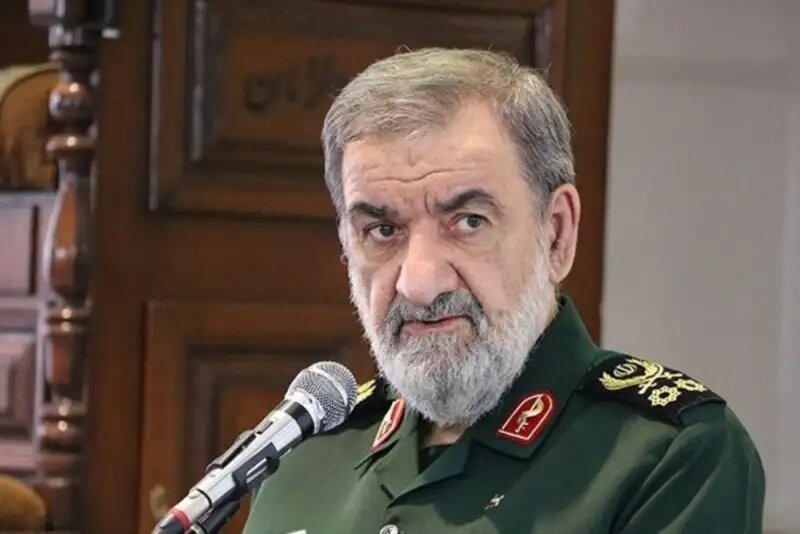
In remarks published on Sunday, Rezaei warned that any military action against Iran in the Strait of Hormuz could trigger a much wider regional conflict, saying Tehran may break what he described as a “naval blockade” and could even withdraw from the Treaty on the Non-Proliferation of Nuclear Weapons (NPT).
Speaking about tensions with the United States, Rezaei said Washington and the administration of Donald Trump are facing a “complete deadlock,” warning that any decision to enter a war with Iran would place the U.S. inside “a dark and endless corridor” stretching from the Strait of Hormuz to the Persian Gulf, the Gulf of Oman, Bab al-Mandab and the Indian Ocean.
He claimed the United States is simultaneously threatening military action while demanding during negotiations that Iran relinquish control over the Strait of Hormuz and hand over its enriched uranium stockpile.
Rezaei argued that Iran has “strong reasons” for maintaining control over the strategic waterway, saying Tehran’s objective is to prevent the Persian Gulf from becoming a center for military deployments and instability.
According to him, the Strait of Hormuz remains open to international trade, but restrictions are aimed at military activities and efforts that could fuel conflict in the region. He also claimed that during the Iran-Iraq war, as well as during what he referred to as the “12-day war,” large quantities of weapons and military equipment passed through the strait and were later used against Iran.
The former IRGC commander also addressed Iran’s nuclear program, stressing that Tehran remains a member of both the International Atomic Energy Agency and the NPT, and that its nuclear activities continue under international supervision.
He said inspectors from the IAEA have repeatedly visited Iranian nuclear facilities and claimed that even U.S. intelligence agencies have acknowledged there has been no diversion in Iran’s nuclear activities.
Rezaei further stated that what he called Washington’s “excessive demands” have failed so far and will continue to fail, adding that the United States is now left with two options: military confrontation or attempting to gain leverage through negotiations.
Discussing the military balance in the Persian Gulf, he argued that even if U.S. naval forces were able to pass through the Strait of Hormuz, they would still remain within the operational range of Iranian military capabilities.
He added that American military commanders are fully aware of the risks involved in entering the region, describing it as a “dangerous corridor.”
Rezaei warned that any military confrontation could spread beyond the Persian Gulf into the Red Sea, Bab al-Mandab and the Indian Ocean, adding that “the first to flee the scene would be the Americans themselves.”
He also said Iran has so far refrained from directly confronting what he described as a “naval blockade,” but warned that Tehran could change its approach if tensions escalate further. According to Rezaei, a possible withdrawal from the NPT also remains among Iran’s potential options.
He concluded by saying that despite deep tensions with Washington, Iran continues negotiations in what he described as an effort to defend the rights of the Iranian people, while warning that crossing Iran’s “red lines” would trigger a “decisive response” from Tehran.
MNA