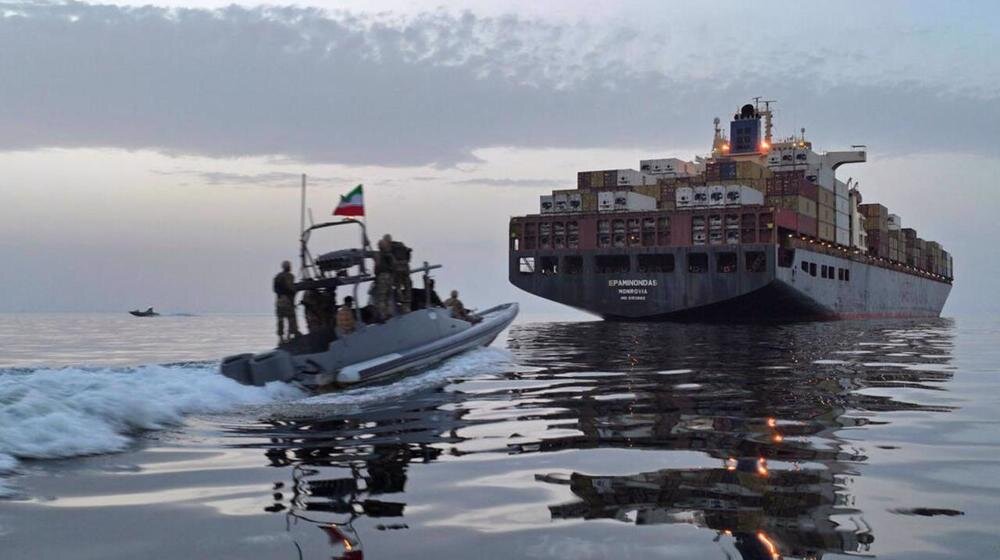
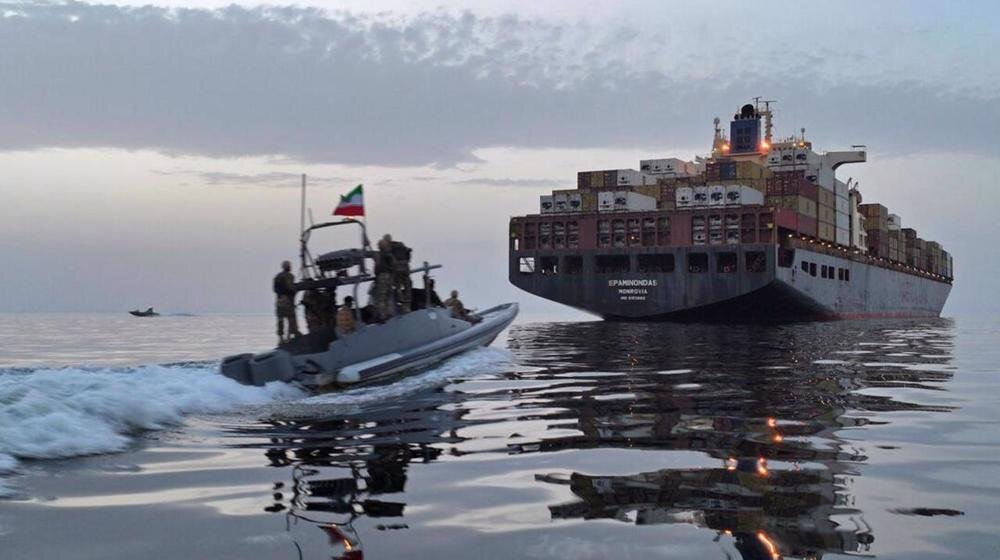
Despite unprecedented insecurity caused by the “terrorist US military” in the Persian Gulf region, the IRGC Navy announced that 31 commercial vessels, including oil tankers and container ships, have safely passed through the Strait of Hormuz over the past 24 hours under the coordination and protection of its Navy.
In a statement on Thursday, the Public Relations Office of the Navy of IRGC announced that during the previous 24 hours, 31 vessels, including oil tankers, container ships, and other commercial ships, passed through the Strait of Hormuz with the coordination and security protection of the IRGC Navy.
“Despite the aggression of the terrorist US military and the creation of unprecedented insecurity in the Persian Gulf, particularly in the Strait of Hormuz, the IRGC Navy sought to establish a clear and secure route for the passage and continuation of global trade,” read the statement.
The Iranian authority controlling the Strait of Hormuz in the Persian Gulf has defined the supervisory management zone of the waterway, announcing on Wednesday that movement through the strategic corridor requires coordination and a permit.
The Persian Gulf Strait Authority (PGSA) said the zone is “the line connecting Mount Mubarak in Iran and southern Fujairah in the United Arab Emirates, on the eastern side of the strait, extending to the line connecting the end of Qeshm Island in Iran and Umm Al Quwain in the United Arab Emirates, on the western side of the strait.”
Iran has consolidated de facto control over the Strait of Hormuz through military checkpoints, ship vetting, diplomatic arrangements and in some cases security fees for safe passage, Reuters reported, citing Asian and European shipping officials as well as Iranian and Iraqi officials.
The report said the IRGC plays a central role in a new multi-layered transit system that gives preference to ships linked to allies such as China and Russia, while other vessels may require government-to-government arrangements or payments to pass.
The IRGC reviews an affiliation document supplied by a ship owner or operator and during the process they may want to physically inspect the ship.
“The affiliation check is to identify if the vessel has any connection to the US or Israel,” a European shipping source told Reuters.
The IRGC requires ship owners to disclose details including the value of the ship’s cargo, the flag, its origin and destination, the registered owner and manager, and nationalities of the crew, according to documents sent to shipping industry sources by Iran’s Persian Gulf Strait Authority.
The vetting is carried out by Iranian state institutions including the Ports and Maritime Organization, the Ministry of Industry, Mine and Trade, the national shipping organization, and the security overseer of the Supreme National Security Council, according to the report.
MNA