
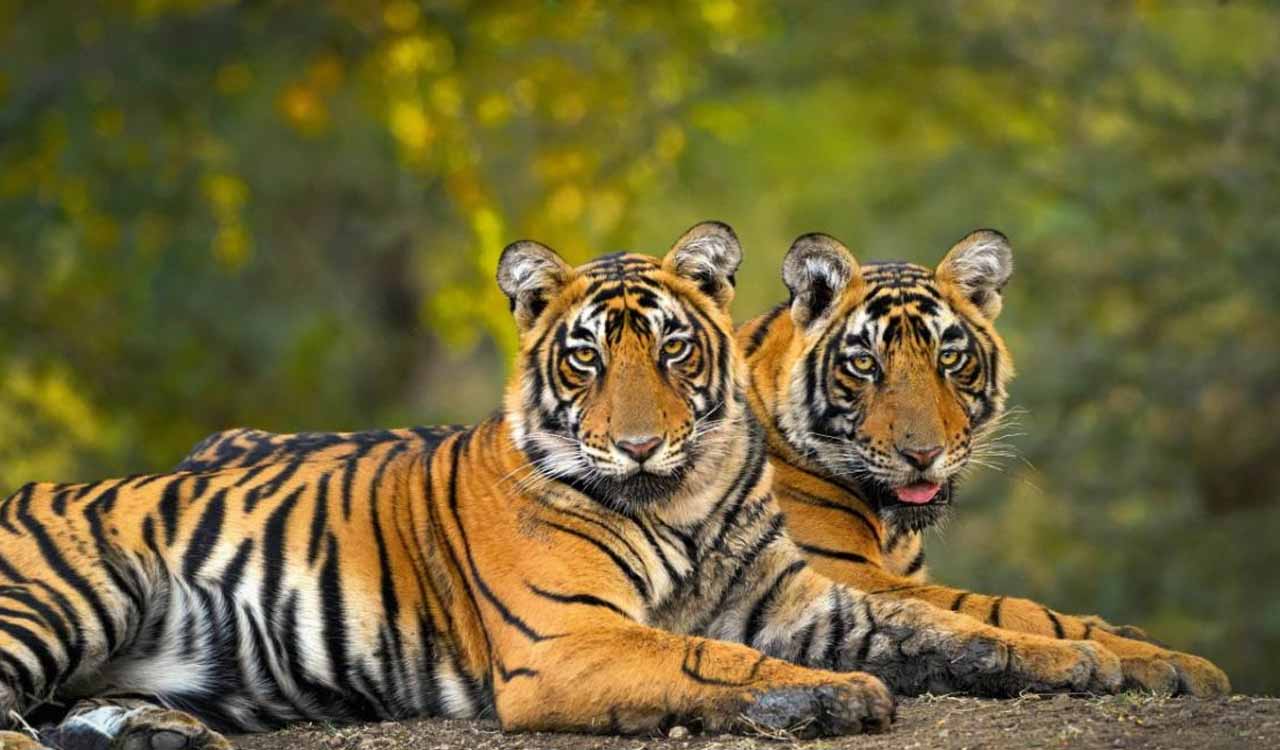
A new study finds that Telangana’s Kawal Tiger Reserve has enough prey to support over 35 tigers, but lacks a breeding population due to limited female dispersal and habitat fragmentation. Researchers stress the need for connectivity and conflict mitigation measures.
Published Date – 17 May 2026, 06:21 PM
Hyderabad: Though designated a Tiger Reserve in 2012, the Kawal Tiger Reserve in Telangana currently has no resident breeding tiger population.
Over the past decade, 15 tigers have dispersed into the reserve from a nearby source population in Maharashtra. But, only two of these were females, making the establishment of a breeding population extremely unlikely without intervention, points out a new study titled ‘Could prey support the recovery of a tiger population? Long-term prey density and carrying capacity assessment of a tiger reserve in India, published in Oryx — The International Journal of Conservation.
The study finds that Kawal Tiger Reserve holds sufficient prey to support a population of over 35 tigers, but that restoring tigers to the reserve will require addressing connectivity and human-wildlife conflict as much as ecological recovery.
This study was led by Imran Siddiqui (Centre for Wildlife Studies, Bangalore, and Hyderabad Tiger Conservation Society) and co-authored by Nilanjan Basu (Hyderabad Tiger Conservation Society), Dr Kathan Bandyopadhyay (Haub School of Environment and Natural Resources, University of Wyoming), Dr John L Koprowski (School of Natural Resources and the Environment, University of Arizona), and Dr Venkatesh Angandhula (Hyderabad Tiger Conservation Society).
Fragmented landscapes, highways, railway networks, open-cast mines, and dense human settlements are key barriers to tiger movement between Kawal and neighbouring source populations such as Tadoba–Andhari Tiger Reserve in Maharashtra.
“Preliminary tiger monitoring data from 2019 to 2025 suggest tigers are moving towards Kawal through multiple corridors, but dispersal is frequently hindered by infrastructure and conflict. Corridors, particularly through Kagaznagar Forest Division, need to be equipped with wildlife overpasses or underpasses to facilitate tiger movement,” said Imran Siddiqui.
The findings show that prey availability in Kawal’s core area could support over 35 tigers, suggesting the reserve has sufficient ecological capacity to host a viable tiger population.
However, protection on paper does not guarantee ecological recovery. “For landscapes like Kawal, success hinges on restoring functional prey bases, securing connectivity for dispersing tigers, and building trust and co-existence with local communities, who ultimately determine the future of wildlife,” he said.
The team of researchers recommended assisted dispersal of tigers, particularly females, alongside stronger corridor management, community engagement, and mitigation of human–wildlife conflict to restore Kawal as a viable tiger habitat.