
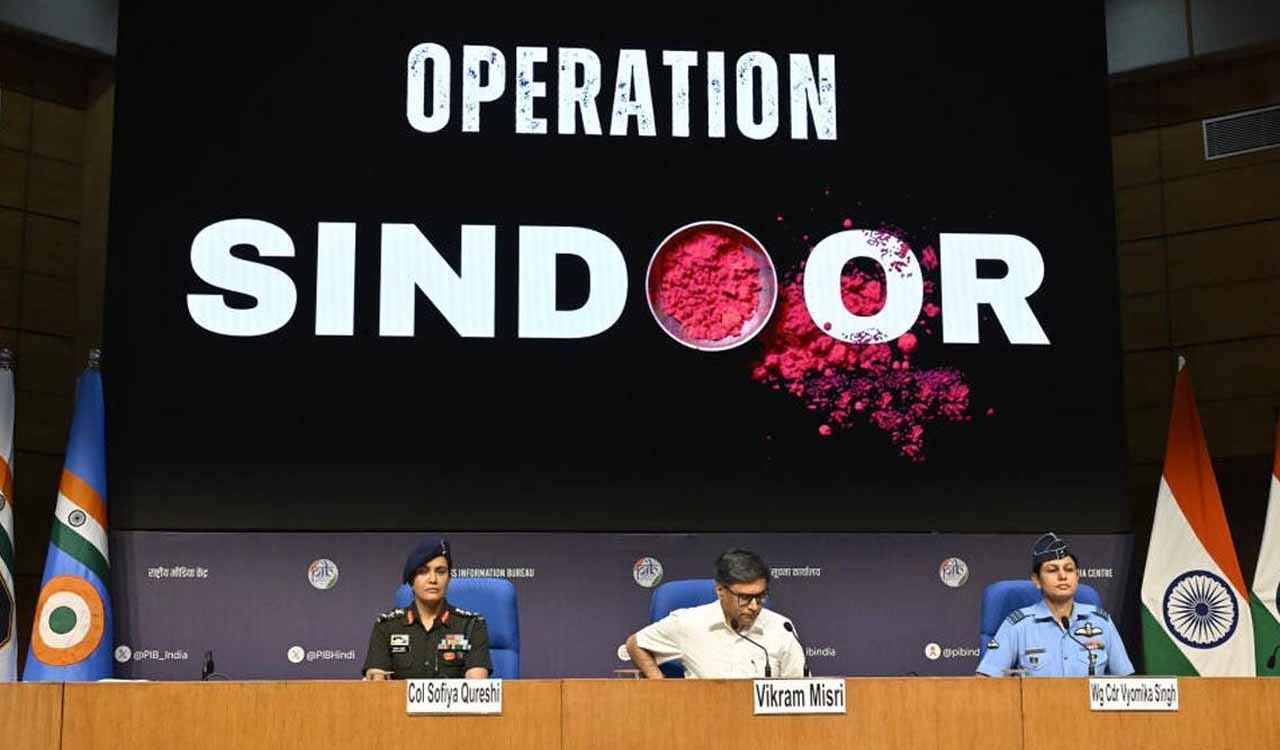
One year after Operation Sindoor, India’s precision strikes on terror infrastructure in Pakistan continue to redefine regional security dynamics
Published Date – 8 May 2026, 10:38 PM
As India observes the first anniversary of Operation Sindoor — the swift and precise missile strikes targeting terror training camps and military bases in Pakistan and Pakistan-occupied Kashmir (PoK) to avenge the Pahalgam terror attack —, the occasion calls for a sober assessment of counter-terrorism strategies and the drawing up of plans to ensure robust preparedness for the future. The success of the mission that destroyed terror camps deep inside Pakistani territory should not make India complacent. Efforts must continue to build much stronger capabilities because hard deterrence alone can guarantee peace. The 88-hour-long intense campaign was measured, proportionate and non-escalatory and was solely intended to dismantle terror infrastructure. By confining the mission to targeting the roots of cross-border terror planning and scrupulously avoiding military and civilian casualties, India demonstrated extraordinary restraint. The operation showcased India’s ability to employ calibrated force under a nuclear overhang, while retaining control over escalation. A standout feature of the operation was that it rewrote the rules of engagement between nuclear-armed neighbours and set a precedent that will shape South Asian security for the coming decades. It was the first time India fought — and prevailed — against what was effectively a one-front, two-country adversary. It is an open secret that China provided Pakistan with active satellite intelligence, electronic warfare support, cyber assistance, and frontline military hardware. India launched the operation with a clearly defined goal: neutralise terror infrastructure and its state backers, inflict maximum damage, and exit on its own terms — without civilian casualties on either side.
The nine targets selected by the national security establishment, with adequate intelligence inputs, were each chosen for their specific role in sustaining the terror ecosystem of Lashkar-e-Taiba, Jaish-e-Mohammed and Hizbul Mujahideen. The operation has clearly set new red lines and sent an unambiguous message that no terror sanctuary in Pakistan is beyond India’s strike capabilities. Apart from decimating nine terror camps, the Indian Air Force missiles destroyed 13 Pakistani aircraft either on the ground or in the air, while critical military installations, including Nur Khan Airbase, near Rawalpindi and the nuclear-vector base at Sargodha, were brought within India’s effective striking range. More than 100 terrorists were eliminated, including high-value operatives like Yusuf Azhar, linked to the IC-814 hijacking, and Abdul Malik Rauf and Mudassir Ahmad, associated with the Pulwama attack. Ten family members of JeM chief Masood Azhar were killed at the Bahawalpur headquarters. The strikes gutted the command hierarchy of the most dangerous terror organisations operating under Pakistani state patronage. Most significantly, Operation Sindoor called Pakistan’s nuclear bluff. For decades, Pakistan’s nuclear umbrella had been used to provide impunity for state-sponsored terror — the unspoken assumption being that India would never risk escalation. India shattered that calculation. Its willingness to strike deep and decisively, including at a base housing Pakistan’s nuclear air vector, demonstrated that this calculus has been permanently altered.