
Photographer D Ravinder Reddy recounts his journey shaped by Raghu Rai’s influence, from documenting historic events like Babri Masjid demolition to publishing acclaimed works, highlighting mentorship, inspiration and enduring professional camaraderie.
Published Date – 27 April 2026, 08:21 AM
By D Ravinder Reddy
My life as a photographer remains incomplete without a towering personality called Raghu Rai. I have no hesitation in admitting that my long association with him, and the photographs he took both during his stint with India Today and beyond, were instrumental in my professional growth and in earning me recognition as one of the successful photographers in the country. What I am today as an established photographer is largely due to the inspiration I drew from Raghu Rai in the early days of my career.
My association with Raghu Rai began in the early 1990s, when I was a regular contributor to India Today magazine. He was already a towering name in national media, and I would regularly study his photographs in the magazine, learning the nuances of photography. His images of the Bhopal gas tragedy (December 1984) had left an indelible impression on me.
Though I had no personal acquaintance with Raghu Rai—remember, those were not the days of mobile phones or digital cameras—he knew me as a budding photographer from Hyderabad through my contributions to India Today.
It was during the infamous demolition of the Babri Masjid on December 6, 1992, that I had the opportunity to meet Raghu Rai. He was already in Ayodhya, along with his son Nitin Rai, to capture the tense situation prevailing there well before the demolition.
I too was eager and enthusiastic to go to Ayodhya. More than capturing images, my real intention was to observe how Raghu Rai worked—the angles he chose and the moments he captured. So, I reached there on December 5 and began following him.
Interestingly, Raghu Rai was unaware that I was following him. While taking pictures of the unfolding events, I closely observed how he tracked developments, framed his shots, and instructed his son to follow kar sevaks and capture their images discreetly. Though I couldn’t take clear pictures of Raghu Rai and Nitin Rai in the melee, I managed to capture them together in one frame—a photograph I still treasure.
In the chaos that followed within hours, I lost touch with him. But the way he documented those historic moments filled me with renewed energy. Disguised as a kar sevak, I moved to the rear side of the structure and managed to capture some of the most striking images of the demolition. These photographs went on to become cover images in several national magazines, including India Today, bringing me widespread recognition. The credit, in many ways, goes to Raghu Rai.
Then came the devastating Latur earthquake in September 1993. I spent several days in the affected villages during rescue operations and captured some of the most memorable photographs of my career. One image—of an infant buried under debris—made it to the cover of India today . I must say, the inspiration behind that photograph was Raghu Rai, whose images from the Bhopal tragedy had earned him global acclaim.
It was perhaps in 1997 that I finally met Raghu Rai in person, when he came to Hyderabad to cover a meeting of Sonia Gandhi. He was staying at ITC Kakatiya Sheraton. I called him, introduced myself, and expressed my desire to meet him.
“Oh, I know you, Mr. Ravinder. You have already become a big name in Delhi. Your photographs of the Babri Masjid demolition and the Latur earthquake had become the talk of the nation. You are welcome,” he said.
Excited, I went to meet him. He received me warmly. I told him how I had become his “Ekalavya shishya,” learning the art of photography by closely observing his work in national publications.
I then showed him the photograph I had taken of him and his son in Ayodhya and narrated how I had followed them in disguise. He was extremely pleased. “I never knew that even a young photographer like you had such an eye for powerful images and the dedication to work so hard,” he said.
That remains one of the best compliments I have ever received.
That meeting marked the beginning of a friendship, rather than a conventional guru–shishya relationship. I became one of his favoured photographers in Hyderabad. Whenever he visited the city, he would meet me, visit my studio in Somajiguda, and even join me for meals. We travelled together to several places for photography, and each experience was enriching.
On one such occasion, I accompanied him to Medak district to photograph rock formations.
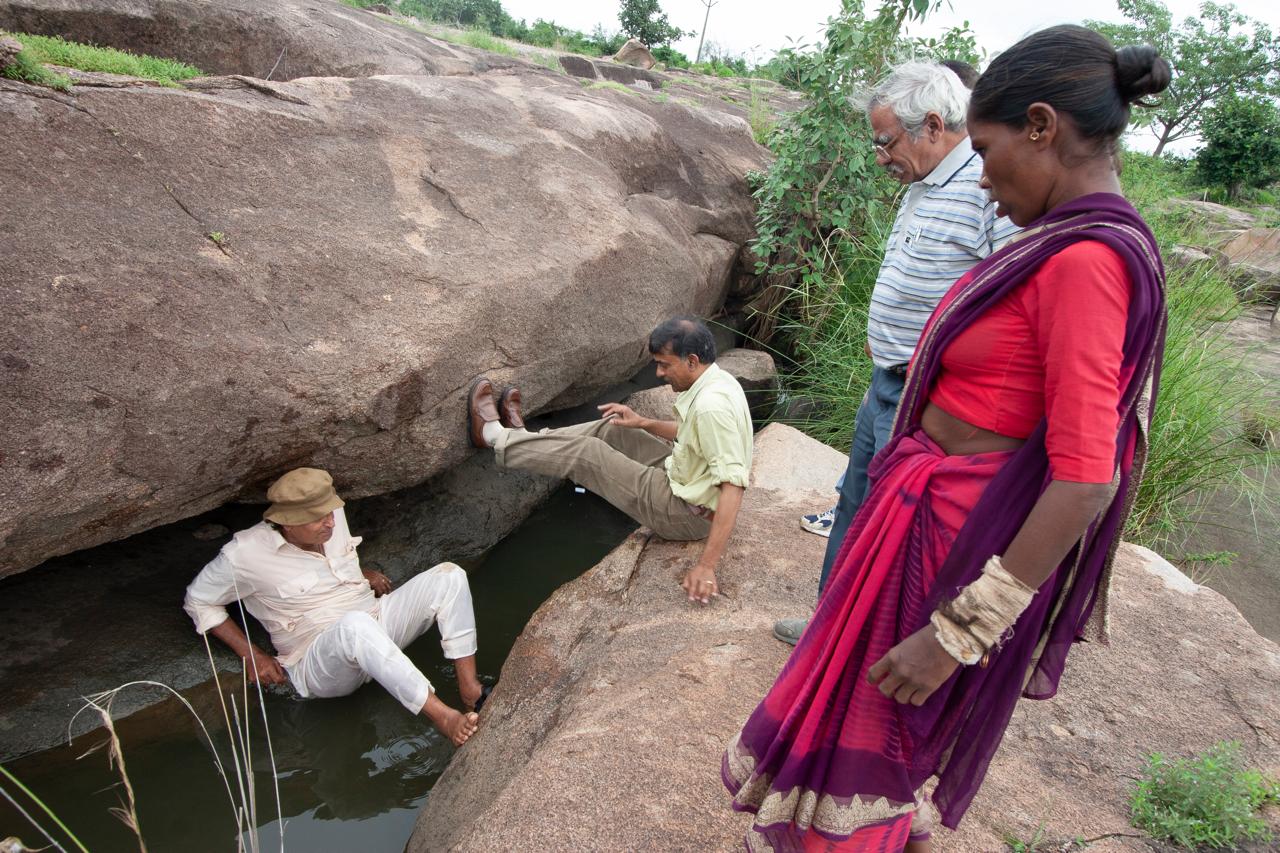
While moving between hillocks, he slipped and fell into a narrow, water-filled crevice. I immediately set aside my camera and rushed to help him. By the time I reached, an elderly woman—with her left hand fractured and bandaged—had removed her pallu and extended it into the crevice to pull him out. It was a deeply moving moment, but I couldn’t capture it immediately, as I had left my camera behind.
When I returned with my camera, she had already helped him out and seated him safely. I managed to take a photograph of her speaking to him as he regained composure. Even so, that image remains one of my most cherished works.
Raghu Rai was never diplomatic with me. He spoke candidly—sometimes critically—about my work and career, but I knew it came from genuine affection.
“Arrey Ravinder, you are wasting your talent in commercial and wedding photography just to make money. You have spoiled yourself. Otherwise, by now, you would have been among the finest photographers in the country,” he once told me.
I took his criticism positively. He was right. Commercial photography can become an addiction—a mire that pulls you in a different direction.
Yet, even after I moved into commercial work, Raghu Rai continued to inspire me. That inspiration led me to publish nine pictorial coffee-table books, some of which bear his imprint.
One such book was on the sacred Tirumala hills—the abode of Lord Venkateswara. It was entirely due to Raghu Rai that I undertook this project. Once, we travelled together to Tirumala, where he wanted to capture rare images.
He was particularly keen on photographing the tonsuring ritual at Kalyana Katta. However, cameras were strictly prohibited inside. Despite this, I suggested we drape towels around our necks and conceal our cameras beneath them. Amid heavy crowds, we quietly entered, took a few quick shots, and exited. He was astonished.
“Ravinder, tu bahut badmash hai re… tu aisa nahin dikhta,” he laughed. But he added, “You need to be street-smart and tactful if you want to get your work done. It is essential for a successful photographer.”
Within months, I published the Tirumala coffee-table book, which gained wide appreciation.
Another memorable book I produced—with his guidance—was on former Chief Minister Y. S. Rajasekhara Reddy. Shortly after his death, I compiled nearly 300 photographs and planned a publication. Around that time, Raghu Rai visited my studio. After reviewing the material, he appreciated the effort but pointed out repetitions. I requested him to edit the book, and he readily agreed. His contribution elevated the final output significantly, and I credited him as editor—something that made him very happy.
The book was later released in New Delhi in the presence of several prominent leaders and dignitaries. Though a seat was reserved for me on the dais, I chose not to take it and insisted that Raghu Rai should occupy it instead.
He felt honoured. In his remarks, he generously praised my work and said the book on YSR was no less significant than his own pictorial work on Indira Gandhi.
I felt deeply humbled.That was Raghu Rai. We remained in touch regularly. I met him just four months ago—he was still active and agile. I never expected that he would pass away so soon.