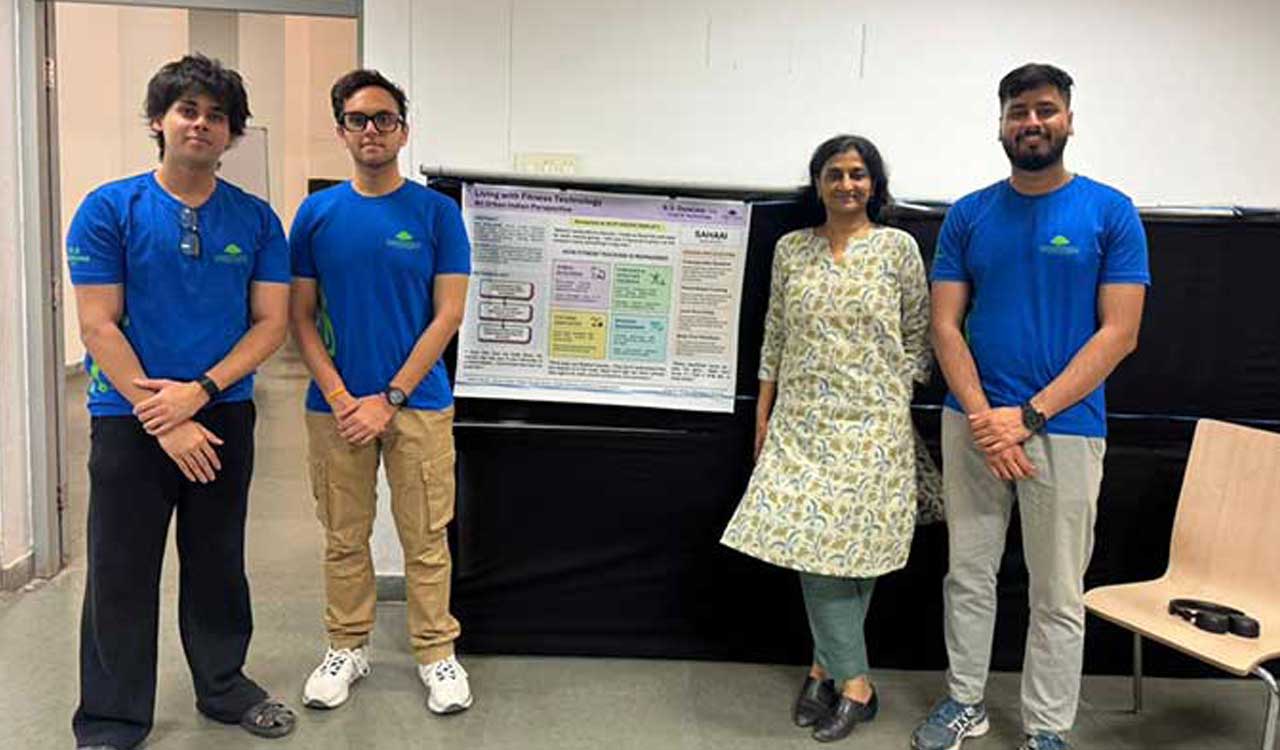
A study by IIIT Hyderabad reveals that urban Indians adapt fitness apps using personal judgment, cultural habits and daily experiences. Users often combine digital tools with manual methods, highlighting gaps in how global fitness technologies address Indian realities
Published Date – 24 April 2026, 06:20 PM
Hyderabad: Fitness applications and wearable technology have become part of daily life, particularly among the urban Indian population. However, an International Institute of Information Technology (IIIT) – Hyderabad study has revealed that users are not blindly following digital metrics but instead reshaping them through personal judgment, cultural habits and everyday improvisation.
Titled “Everyday HCI of Adaptive Fitness: The Bricolage of Self-Tracking in Urban India,” the research by Shivam Singh, Raagav Ramakrishnan and Chetan Mahipal under the guidance of Prof Nimmi Rangaswamy highlighted how people build their own systems of tracking, often combining digital tools with everyday improvisation.
In one instance, a gym-goer used a smart watch only to track steps but relied on a handwritten notebook to log workouts. Another participant took progress photos instead of trusting calorie counts. Some used phone timers for sets, while discussing routines with fellow gym members to gauge improvement. Rather than relying on a single app, people stitched together multiple methods, both digital and manual.
Participants, according to the researchers, pointed out that fitness apps fail to understand Indian realities. One user questioned calorie counts by pointing out that the app did not account for home-cooked meals. Another said the app could not possibly understand the impact of humid weather in cities like Chennai.
This user interpretation offered vivid glimpses of how people make everyday decisions about fitness. On particularly humid days, participants said they would reduce workout intensity because “sweating itself felt like exercise.” During festival or wedding seasons, routines shifted dramatically, often without guilt. In some cases, participants admitted they did not track anything at all but still believed they were maintaining fitness through awareness and habit. “The data is in their heads, they are constantly interpreting it,” explained Prof Rangaswamy.
Most fitness apps, the researchers said, are built in Western contexts, where users are expected to follow data precisely, such as step counts, calorie targets and workout plans. However, the Indian context operates differently. Fitness in India is influenced by climate, food habits, social life and even informal conversations at the gym. The study highlighted how these factors often clash with rigid app designs. The implication is clear: technologies designed for one cultural context cannot simply be transplanted into another, the researchers added. The study was recently presented at the prestigious CHI Conference on Human Factors in Computing Systems.