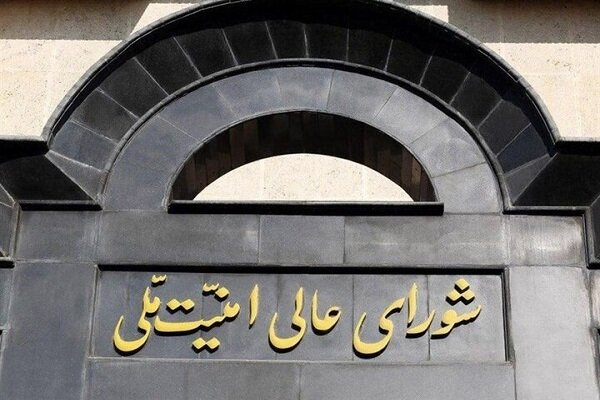
The SNSC stressed that Tehran will continue strict monitoring and control over the Strait of Hormuz until the US-Israeli war of aggression fully ends and lasting peace is achieved.
The statement of Iran’s Supreme National Security Council (SNSC) is read as follows,
Following the defeat of the invading enemies on the military battlefield thanks to the historic and unparalleled resistance of the Iranian people and armed forces, messages and requests from the Americans for a ceasefire and negotiations to end the war they started began on the 10th day of the war.
On the 40th day of the war, after the official announcement by the US President accepting Iran’s 10-point plan as the framework for ending the war, the Islamic Republic of Iran agreed to hold negotiations in Islamabad, with Pakistan acting as mediator.
The negotiations lasted 21 hours incessantly. The Iranian delegation seriously pursued the demands of the Iranian people with initiative, despite deep mistrust of the US.
Although the enemy had agreed to operate within Iran’s 10-point plan before the talks, during negotiations they raised new and excessive demands. They faced the Iranian delegation’s firm stance and realized Iran would not retreat, backed by its combatants, national pride, and vigilant people. This round ended without concrete results, to be resumed when the enemy abandons its excesses and aligns its demands with battlefield realities.
Recently, with the Pakistani army commander in Tehran as mediator, new proposals have been put forward by the Americans. The Islamic Republic of Iran is reviewing them and has not yet responded.
The Iranian negotiating team, relying on Almighty God, public support, steel resolve, and the firepower of its combatants, will not compromise, retreat, or show negligence by a single iota. They will defend Iran’s interests and the precious blood shed in this war—especially that of the dear Leader—for independence, dignity, and honor.
One of Iran’s essential preconditions for accepting a temporary ceasefire was a halt to fire on all fronts, including Lebanon. The Zionist enemy violated this from the start with brutal attacks on Lebanon and heroic Hezbollah.
Due to Iran’s insistence, the Zionist regime agreed to a ceasefire in Lebanon. It was stipulated that if the enemy observes a ceasefire on all fronts, the Strait of Hormuz would be conditionally opened temporarily until the end of the ceasefire, solely for commercial vessels (not military or hostile nations’ non-military vessels), under the control and permission of Iran’s armed forces and via routes designated by Iran.
Since most of the equipment for US military bases in the Persian Gulf is supplied via shipping through the Strait of Hormuz, which threatens Iran’s national security and the Persian Gulf region, Iran is determined to monitor and control traffic through the Strait of Hormuz until the war fully ends and lasting peace is achieved.
This control will be implemented by obtaining full information on passing vessels, issuing transit permits according to Iran’s announced rules (commensurate with war conditions), collecting fees for security, safety, and environmental protection services, and using routes announced by Iran.
As long as the enemy intends to disrupt vessel traffic or impose methods like naval blockades, the Islamic Republic of Iran will consider that a ceasefire violation and prevent the conditional, limited opening of the Strait of Hormuz.
The Secretariat of Iran’s Supreme National Security Council (SNSC), recalling the recommendations of the Leader, emphasizes that to fully consolidate military gains and succeed in diplomacy, the continued presence of the brave Iranian people in the streets, full vigilance on all fronts, and protection of national unity by officials, media, and political/social activists remain essential.
MNA