Inconsistent EV and trade policies are creating uncertainty, forcing potential buyers to defer their plans
Published Date – 7 April 2026, 11:05 PM
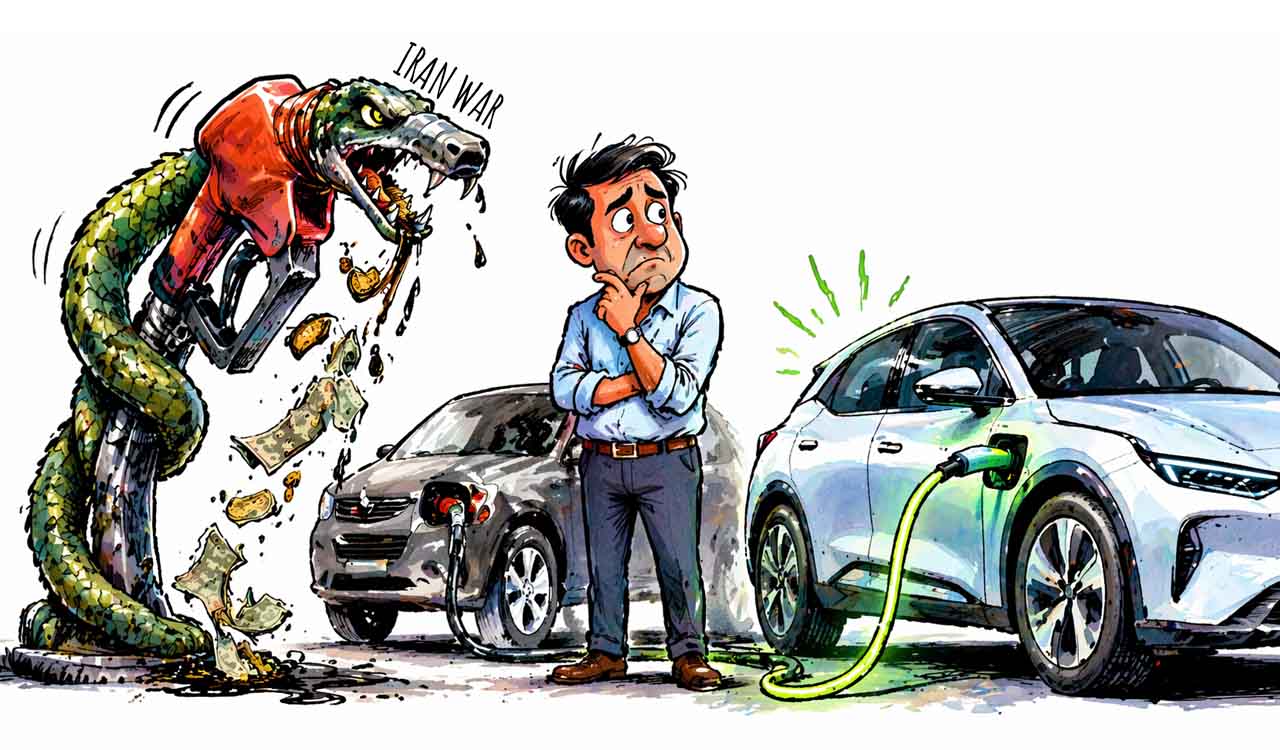
The ongoing war in West Asia has disrupted the global energy markets in many unpredictable ways. For India, whose transport sector remains heavily reliant on fossil fuels, the writing on the wall is clear and loud. It must accelerate the transition towards electric vehicles through appropriate policy interventions or be prepared to face a bigger crisis. India imports over 87% of its crude oil requirements, with more than a fifth originating from or transiting through the conflict zone, thereby exposing its vulnerabilities during turbulent times. Although the Centre had set an ambitious target to have 30% of all new vehicle sales be electric by 2030, aiming to save on crude oil imports worth over $14 billion annually, several challenges lie ahead. The availability of charging stations, especially outside of major cities, is extremely limited, making it difficult for owners of electric vehicles to charge their vehicles. Concerns about limited driving range and the fear of running out of battery charge, especially for long-distance travel, are a major barrier to adoption. Reliance on imported lithium-ion batteries increases costs and exposes the sector to global supply chain risks. Many potential buyers of electric vehicles in India are keeping their plans on hold because of the government’s flip-flops on EV and trade policy. In India, the EV adoption is closely tied to fiscal incentives, particularly tax concessions, to maintain cost competitiveness with the conventional ICE (Internal Combustion Engine) vehicles. Compared to India, China’s adoption of EVs has been faster and smoother, reducing its transport sector’s exposure to fuel shocks.
The Electric Mobility Promotion Scheme (EMPS), unveiled by the Centre nearly two years ago, was meant to boost electric two- and three-wheelers but did not include electric passenger vehicles and buses. EVs constituted only 6% of new car registrations this year so far, while in China, new-energy vehicles accounted for about 52.9% of passenger car sales in March. In the two- and three-wheeler segment, China sold more than 72 lakh electric vehicles in 2024, while India’s sales even in 2026 were only about 4.27 lakh. Also, there is a shortage of trained personnel in the country to handle EV maintenance, repair, and charging infrastructure development. Experts say that the countries with high EV adoption are less exposed to sudden increases in petrol and diesel prices because a larger share of transport runs on electricity. India needs to step up its strategies and set a clear-cut target for phasing out ICE vehicles. It is entirely possible to achieve 100% electrification of new sales of two- and three-wheelers by 2030. Several Asian countries, including Indonesia, Thailand, and Taiwan, have already established ICE phase-out timelines. India cannot afford to lag behind. It must now build capabilities across the entire battery value chain, from critical mineral sourcing and refining to cell manufacturing, pack assembly, and recycling.