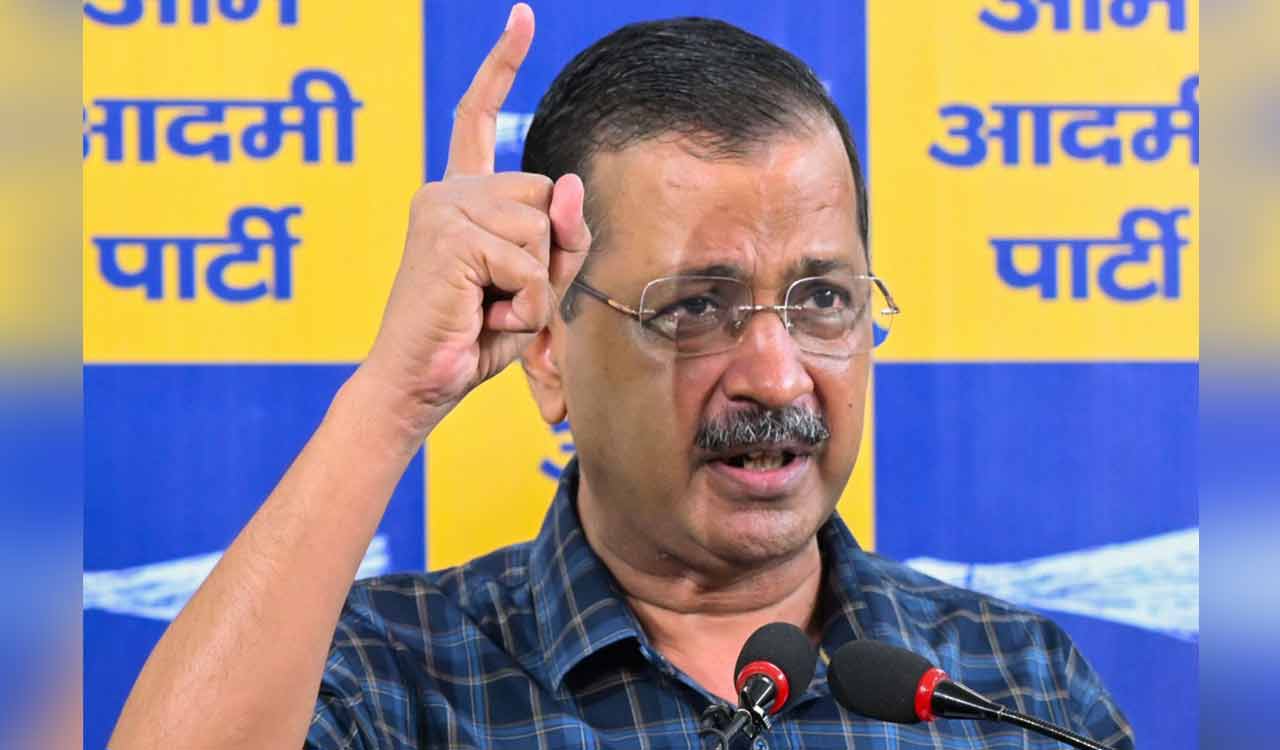
Arvind Kejriwal appeared in the Delhi High Court seeking recusal of Justice Swarana Kanta Sharma in the excise policy case. The court will hear the plea on April 13, while the Solicitor General termed the allegations frivolous and contemptuous
Published Date – 6 April 2026, 07:00 PM
New Delhi: Former chief minister Arvind Kejriwal on Monday appeared in person in the Delhi High Court seeking recusal of Justice Swarana Kanta Sharma from hearing the CBI petition challenging the discharge of the AAP convenor and all other accused in the liquor policy case.
Justice Sharma took Kejriwal’s application for her recusal on record and listed it for hearing on April 13, after she was informed that a plea for transfer of the case to another HC bench filed before the apex court had been withdrawn.
Solicitor General Tushar Mehta, appearing for the CBI, argued that the court was not a forum for theatrics and that Kejriwal should discharge his lawyer if he wanted to appear in person in the case.
He strongly objected to the recusal application and said Kejriwal’s allegations against the “institution” were frivolous and contemptuous.
“Some people in this country make a career out of making baseless allegations against everyone. That will have to be taken seriously. It is an allegation against the institution and we will have to support that institution,” Mehta said.
He also informed the court that a total of seven discharged accused have filed applications seeking the judge’s recusal as part of a “well thought out design”.
“If anyone else wants to file the application, please do it, so that I can decide it once and for all,” Justice Sharma said.
Justice Sharma also said that she would pass an order on whether to grant more time to Kejriwal and other respondents to file their replies to the CBI’s plea.
Kejriwal asserted that he would argue the recusal application himself and would exercise his “legal rights” on the aspect of being represented by a lawyer subsequently.
He requested the court to take his application on record as, being a litigant appearing in person, he was unable to e-file it on the high court portal.
Mehta said the agency’s response to the recusal application was ready in the form of a note.
He contended that, as “predicted” by him earlier, the pleas filed by Kejriwal in the Supreme Court regarding the present proceedings were still pending with the top court’s registry.
The court was informed by senior advocate Shadan Farasat, appearing for one of the respondents, that the petition filed in the Supreme Court for the transfer of the case to another judge had been withdrawn.
On February 27, the trial court discharged Kejriwal, Sisodia and 21 others and pulled up the CBI, saying its case was wholly unable to survive judicial scrutiny and stood discredited in its entirety.
On March 9, Justice Sharma issued notice to all 23 accused on the CBI’s plea against their discharge, saying certain observations and findings of the trial court at the stage of framing of charges prima facie appeared erroneous and needed consideration.
She also stayed the trial court’s recommendation on the initiation of departmental action against the CBI’s investigating officer in the liquor policy case.
Later, Chief Justice of Delhi High Court, D K Upadhyaya, declined Kejriwal’s request to transfer the CBI’s plea from Justice Sharma to another judge and said that a call for recusal has to be taken by the judge concerned.
In a representation made on March 11, Kejriwal, as well as AAP leader Manish Sisodia, along with other accused in the excise policy case, claimed there was a “grave, bona fide and reasonable apprehension” that the hearing in the matter before Justice Sharma would not be impartial and neutral.
Following the refusal, Kejriwal, along with former deputy chief minister Manish Sisodia, moved the Supreme Court seeking directions to transfer the CBI’s appeal from Justice Sharma’s bench to another bench.