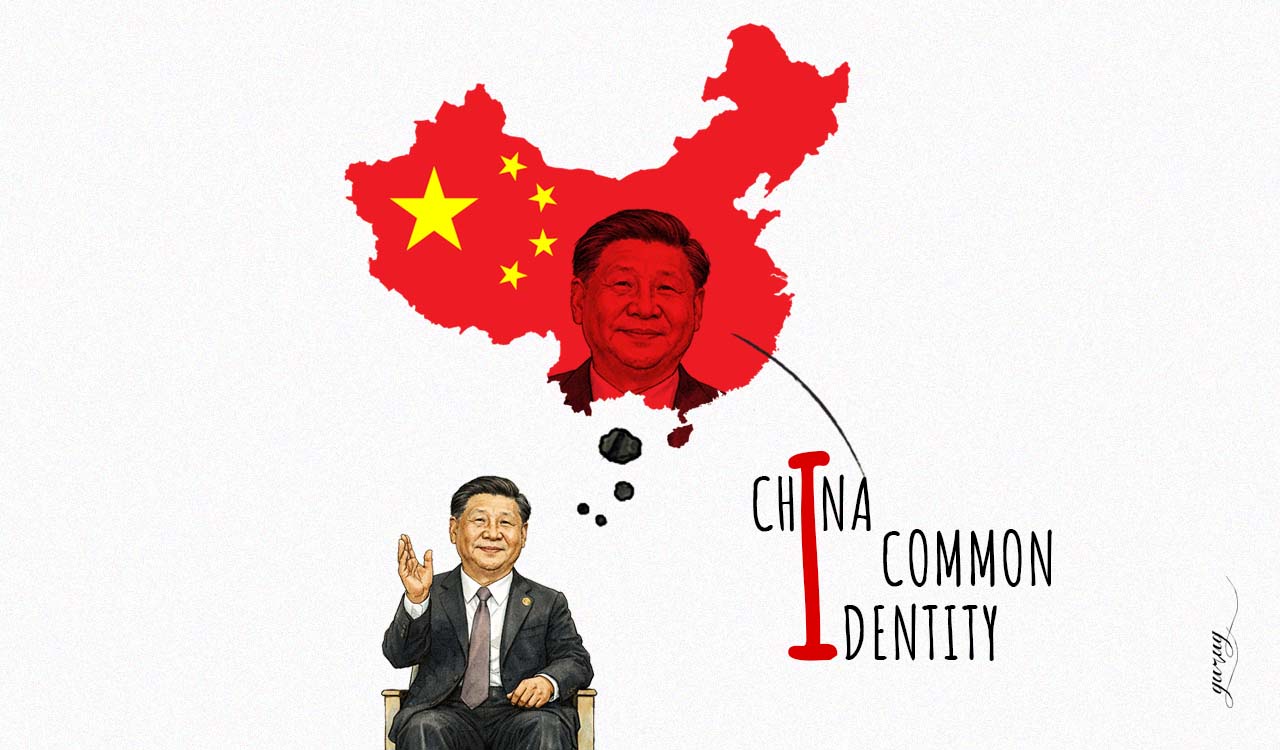
For China’s leadership, the law on ethnic unity marks the culmination of policies aimed at shaping a Han-centric national identity under the Communist Party
Published Date – 3 April 2026, 09:22 PM
By Dr Gunjan Singh
After becoming President of the People’s Republic of China (PRC) in 2013, Xi Jinping has been vehemently pushing the idea of the ‘China Dream’ and the ‘rejuvenation of the Chinese nation’. One major goal of the rejuvenation is achieving a common Chinese identity. A task made difficult as China is made up of 56 ethnic groups who speak more than 100 languages. However, the Han make up 90 per cent of the total population.
The push for assimilation is not new, but under Xi, it has gained an unprecedented momentum which finally culminated in the passing of the law to promote ethnic unity and progress, which provides a legal justification for the Sinicisation of the minorities, which, for Xi, is the same as Hananisation.
The law: Promoting Ethnic Unity and Progress
China’s National People’s Congress (NPC) 2026 approved the Law on Promoting Ethnic Unity and Progress. This law makes it mandatory that children “should be taught Mandarin before kindergarten and up until the end of high school”. The main goal of the law is to “forge national unity and advance the rejuvenation of the Chinese nation with the Chinese Communist Party (CCP) at its core”. It also has provision of punishing parents and guardians if they try to instil “detrimental views” in the children.
The law also requires “media, publishing houses, internet service providers, families, among others, to promote the Party’s ethnic policy”. It also talks about the outdated “customs and traditions and calls for promoting a new culture of civility and progress. It dictates almost all aspects encompassing the social, cultural and personal lives of Chinese citizens.
Other Measures
The 13th Five-Year Plan (2016–2020) also stated that, “We will channel great energy into advocating and standardising the usage of the standard Chinese language”. The CCP, under the guidance of Xi, did undertake major steps to control and command the three major minorities in China — the Uyghurs, Tibetans and Mongolians.
China is strengthening a unified identity through language, law, and religion, using the new ethnic unity law to assimilate minorities and reinforce party control
China implemented a Mandarin-only curriculum for Inner Mongolia in 2020. The change in textbooks was followed by massive protests. However, these witnessed a major violent crackdown. In response, Xi stated: “Inner Mongolia should unwaveringly promote the use of national common textbooks,” and this was done to correct “wrong ideas”. The government also shut the only Mongolian-language social media app in 2020.
A harsher approach was adopted towards Xinjiang. More than one million Uyghurs have been arbitrarily sent to ‘detention camps’, termed as vocational training centres by the CCP. As per the Chinese government, the task of these vocational centres was “to teach Mandarin, Chinese laws, and vocational skills and to prevent citizens from becoming influenced by extremist ideas by nipping terrorist activities in the bud”.
With respect to Tibet, Beijing has also implemented similar policies. It is increasingly getting difficult for Tibetan-speaking people to find jobs, while the government has even “banned” young people from looking for private tutors. The CCP has arrested numerous people associated with the ‘Language Protection Association’. The most prominent being Gonpo Namgyal, who died within days of being released from prison.
Control over Religion
Under Xi, it’s not only language but also religion which has witnessed Hananisation, especially in Xinjiang and Tibet. Xi chaired the 2016 meeting for party members and bureaucrats working on religion. In 2023, China released the Regulations for Religious Activity Site Registration, which is technically not a law. However, a lot was left to interpretation, and it is believed that, in any conflict or controversy between the Chinese state and religious organisations, the party state will have the last word.
Commenting on the rules, the United Front Work Department argues that, “No organisation or individual may use religious activity sites to conduct activities that endanger national security, disrupt social order [or] damage national interests”.
Xi, while presiding over a group study session of the Political Bureau of the CPC Central Committee in 2025, asserted, “the importance of ensuring that religions in China further adapt to the Chinese context”. He argued that “managing religious affairs in accordance with the law is a fundamental way to properly handle contradictions and issues in the field of religion, and underscored the need to improve relevant regulations and policies”.
In Tibet, worshipping the Dalai Lama or even carrying his photo is punishable. With respect to Xinjiang, the government has undertaken massive steps to completely erode its distinct identity. The CCP now appoints imams even as it has pushed for change in the architecture of the mosque. People are punished for sporting a beard, and the names of the children should also be approved by the party. As per a Chinese foreign ministry spokesperson, “Sinicisation of religion is not about restricting religious practice; rather, all religions must adapt to the social, cultural and historical context of the country.”
The End Goal
Xi Jinping’s idea of China’s ethnic minorities is that they should be “packed tightly together like pomegranate seeds.” As historian Aaron Glasserman notes, “That is, small, similar, and red.” For Xi, the law Promoting Ethnic Unity and Progress is the final culmination of all the policies the CCP has adopted under his leadership to build a Hanised Chinese identity.
To be Chinese is to speak Mandarin and follow the guidance of the CCP, in religious, personal and cultural spheres. A common language also helps in building a common history, which complements Xi’s aversion to historical nihilism. For now, this provides Xi with a legal mandate to further clamp down on protests and resistance, while eroding the essence of ethnic diversity.
For Xi, to be Chinese is to speak Chinese, function under the guidance of the CCP and be as Han as the party directs one to be.

(The author is Associate Professor, OP Jindal Global University)