The Rajya Sabha sought clarification on whether Prime Minister Narendra Modi’s visit to Israel in late February had any connection to subsequent military strikes on Iran. The Ministry of External Affairs clarified that no such discussions took place during the visit.
Published Date – 2 April 2026, 11:26 PM
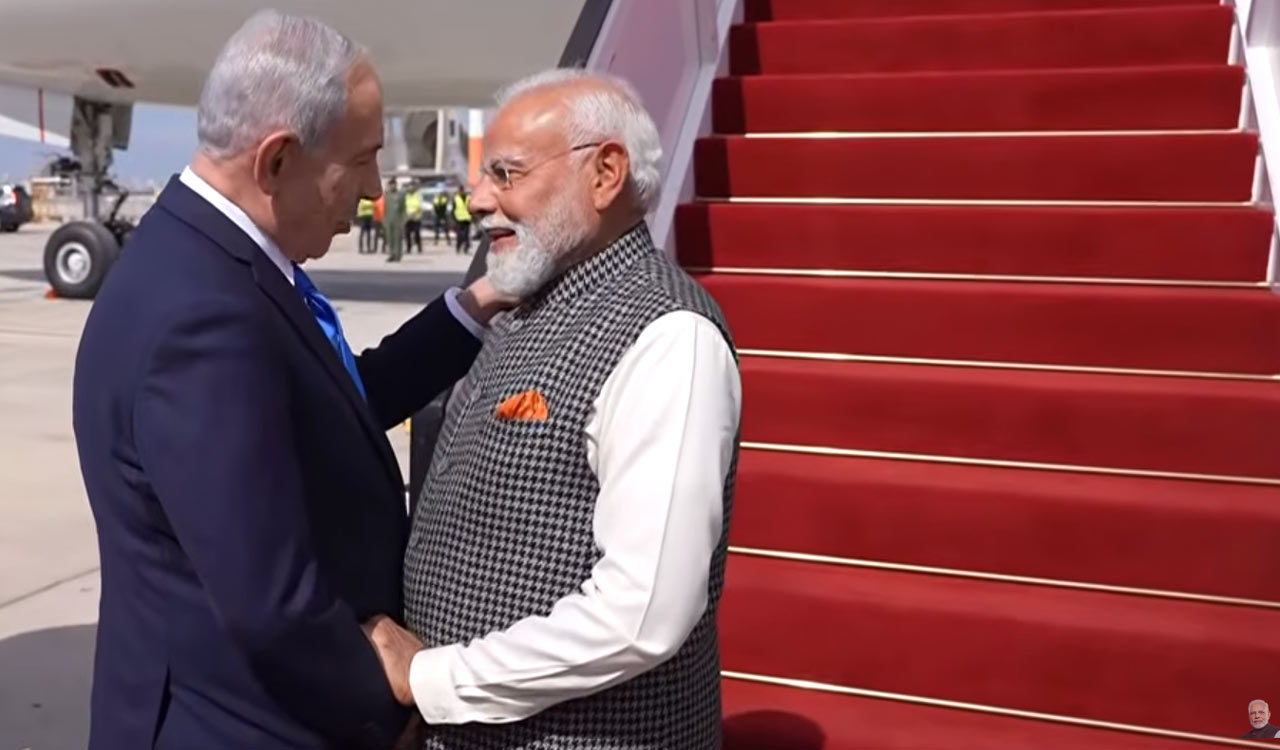
New Delhi: Citing the visit of Prime Minister Narendra Modi to Israel on February 25-26, the Centre was on Thursday asked in Rajya Sabha whether the government was aware of the military attack on Iran that took place days later, to which it replied that “no discussions took place related to the matter”.
The conflict began on February 28 after the US-Israel combine launched military strikes on Iran. Tehran retaliated by attacking countries in the Gulf, which host American bases.
Indian Union Muslim League (IUML) Rajya Sabha MP from Kerala, Abdul Wahab, asked the Ministry of External Affairs (MEA) for the details of agreements, MoUs and other pacts signed between India and Israel during Modi’s visit in February, including their purposes.
Part (b) of the question asked whether the government was “aware of the recent military attack on Iran the following day” and, if so, the details thereof.
“At the invitation of the prime minister of Israel, Prime Minister Narendra Modi paid a state visit to Israel on February 25-26. During the visit, the two prime ministers engaged in comprehensive discussions covering the entire gamut of the India-Israel partnership, as well as regional and global issues of mutual interest,” Minister of State for External Affairs, Kirti Vardhan Singh, said in a written response to the query.
During the visit, several agreements, MoUs, protocols, and letters of intent were signed, including in areas of artificial intelligence, cybersecurity, agriculture, fisheries and aquaculture, education, financial services, digital payments, mobility of workers and geophysical exploration, Singh said.
“No discussions took place related to the matter referred to in part (b) of the question,” the minister said.
The MEA was also asked what actions the government has taken to “manage and de-escalate the situation in the Persian Gulf and to protect India’s strategic, energy and citizen interests”.
“The government of India continues to closely monitor the evolving situation in West Asia. Since the start of the conflict, the prime minister has spoken to leaders of countries in the region, including Israel, Iran, Saudi Arabia, Bahrain, Kuwait, Oman, Qatar, the UAE, Jordan, as well as the USA,” Singh said.
The external affairs minister (S Jaishankar) also spoke with his counterparts in Israel, Iran, the US and the GCC countries, he said.
“The importance of pursuing dialogue and diplomacy to de-escalate, and prioritising the safety of civilians, was underscored during these conversations. The regional leaders have given assurance regarding the safety of Indians,” the minister said.
Since the beginning of the conflict, the MEA has proactively taken measures for the safety and well-being of the Indian community residing in the region, Singh said.
“All Indian missions in the affected countries are continuously providing help, issuing regular advisories, while 24×7 control rooms and emergency helplines have been established both in India and in our missions in the affected countries.
“Due to these efforts, more than 4,75,000 Indians have safely travelled to India since the war began. The government is making all efforts to diversify the sources of energy, fertilisers and other supply chains. India has also secured safe passage of LPG carriers and other ships to India, through the Strait of Hormuz,” Singh said.