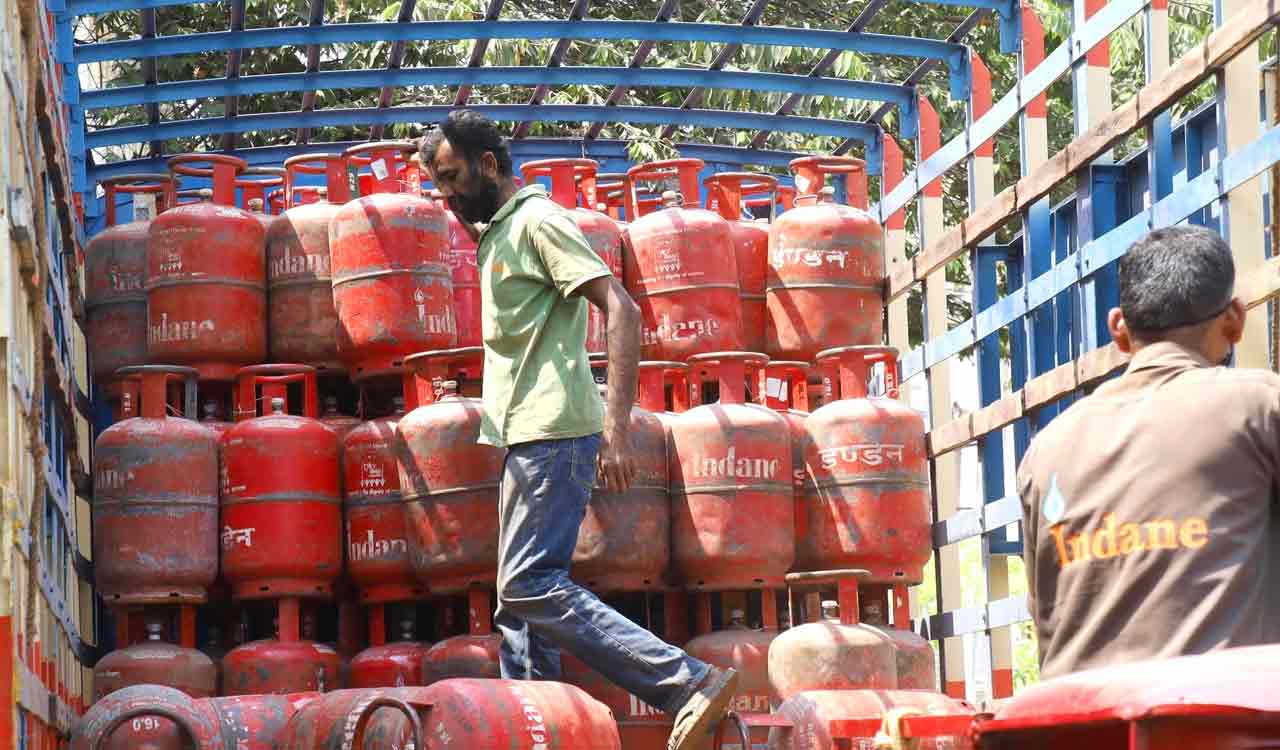
Authorities across several states launched raids against LPG hoarding and black marketing amid concerns over supply disruptions linked to the West Asia crisis. The issue triggered a political clash in Parliament while panic buying and long queues were reported in some regions
Published Date – 16 March 2026, 10:44 PM
New Delhi/Mumbai: Authorities in multiple states initiated a crackdown on Monday against hoarding and black marketing of LPG cylinders, even as the issue of the West Asia crisis affecting cooking gas supply was raised in Parliament, where opposition and ruling BJP members attacked each other.
The Leader of Opposition in Rajya Sabha, Mallikarjun Kharge, said the government had claimed that LPG supply was not affected by the Iran-US-Israel conflict but the ground reality was different.
“The LPG crisis has caused widespread panic across the nation. Its impact is severely affecting the poor and vulnerable sections, the middle class, ordinary households, restaurants, hostels and commercial users,” he said during the Zero Hour.
This evoked a sharp counter from Union Minister J P Nadda, who accused opposition parties, especially Congress, of not standing with the people but instigating them.
Nadda said the current West Asia conflict is not due to India and further claimed that a Congress leader has been caught hoarding LPG cylinders.
While the political slugfest was underway in Parliament, a protest march was taken out in Kolkata against the cooking gas crisis in West Bengal, where Chief Minister Mamata Banerjee claimed the problem was “artificially created”.
Meanwhile, to check illegal stockpiling of domestic gas cylinders, raids were conducted across multiple states.
As many as 84 illegally stored LPG cylinders valued at Rs 2.22 lakh were seized from a private premises in Bhiwandi town of Maharashtra’s Thane district, leading to the registration of a case against three individuals under the Essential Commodities Act.
An official said that out of the 84 cylinders, 34 were filled and the remaining were empty.
Giving details about the Maharashtra government’s crackdown on hoarding and illicit trading of gas cylinders, Food and Civil Supplies Minister Chhagan Bhujbal said 23 cases have been registered and 18 people arrested.
Replying to the issue raised by Congress’s Abhijit Wanjarri in the Maharashtra Legislative Council, Bhujbal listed steps undertaken by the state government to keep prices under control amid the West Asia crisis.
The state government has formed committees of collectors and superintendents of police at the district level, which carried out 2,129 raids and seized 1,208 cylinders and goods worth Rs 33,66,411, he said.
In Jammu, the administration conducted inspections at multiple LPG outlets amid panic buying and complaints of delivery failures of gas cylinders. Some gas cylinder dealers faced action after they were allegedly found violating norms.
Officials insisted there was no shortage of fuel and urged people not to fall prey to rumours. However, long queues were reported at several LPG outlets in Jammu over the past few days.
Though the central government said there are adequate crude oil and LPG supplies, Jharkhand’s minister said the state is facing a shortage of both domestic and commercial LPG, while Karnataka’s food and civil supplies minister urged hotels to switch to electric stoves temporarily and expressed hope that the situation would improve soon, as additional shipments are expected.
In Delhi, the students’ union at Jawaharlal Nehru University (JNU) gave a call for a march to the office of the dean of students as the food menus in the canteens on the university premises continue to be affected.
Conversely, the Gujarat government said it has an adequate stock of liquefied petroleum gas (LPG) and the supply chain remains uninterrupted.
Addressing a press conference, Mona Khandhar, Additional Chief Secretary, Food, Civil Supplies and Consumer Affairs Department, said the government has not imposed any restrictions on domestic or commercial use and is taking steps to ensure smooth availability of fuel across sectors.
“The district teams, police system, oil marketing companies and our state-level teams are in constant coordination to ensure there is no disruption in LPG supply. We are receiving LPG stock continuously and buffer stock with agencies is also increasing,” she said.
Meanwhile, a senior petroleum ministry official in Delhi said city gas distribution companies have rolled out incentives to encourage consumers to shift from LPG to piped cooking gas (PNG) to ease pressure on LPG supplies.
Indraprastha Gas Ltd (IGL) – the CNG and piped cooking gas (PNG) retailer in Delhi and adjoining cities – is offering domestic consumers free gas worth Rs 500 if they take a PNG connection and start using it before March 31, while Mumbai retailer Mahanagar Gas Ltd has announced incentives, including waiver of Rs 500 registration charge for domestic household consumers and Rs 1-5 lakh security deposit for commercial users. Similar promotional measures have also been introduced by GAIL and BPCL, said Sujata Sharma, Joint Secretary, Ministry of Petroleum and Natural Gas (MoPNG).
India imports about 88 per cent of its crude oil, 50 per cent of its natural gas and 60 per cent of its LPG needs. More than half of India’s crude imports, about 30 per cent of gas and 85-90 per cent of LPG imports come from West Asian countries such as Saudi Arabia, Qatar and the UAE through the Strait of Hormuz.
The conflict has led to a blockade of the Strait of Hormuz, the main transit route for Gulf energy supplies. While India has partly offset crude supply disruptions by sourcing oil from countries including Russia, gas supplies have been curtailed to industrial users, and LPG availability to commercial establishments such as hotels and restaurants has been reduced by about a fifth.