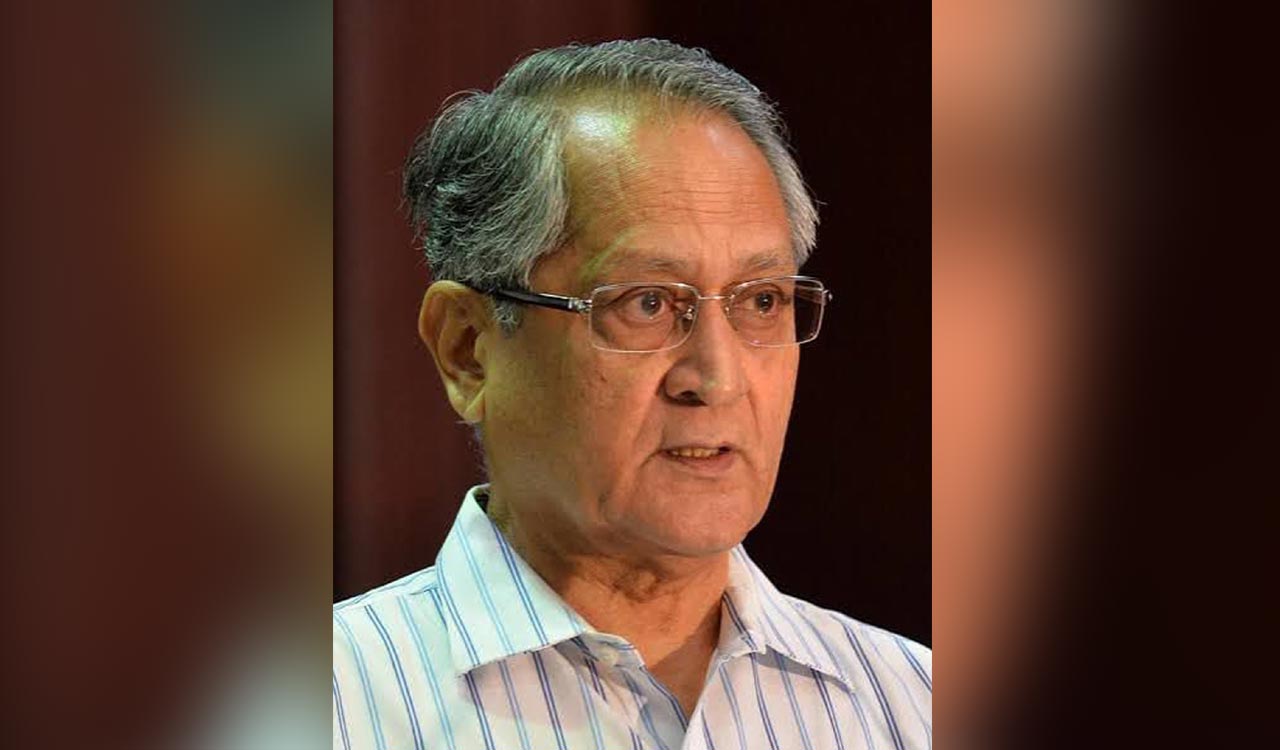
Former Andhra Pradesh police chief HJ Dora is remembered as a disciplined officer and inspiring leader who guided the force during the peak of Left Wing Extremism. His calm leadership, innovative counter-insurgency strategies and humane approach earned him lasting respect.
Published Date – 14 March 2026, 03:40 PM
If there was one police officer who commanded respect not because of the office he held but because of the man he was, it was Hanumanthu Jagannayakulu Dora, widely known as HJ Dora. His presence carried a quiet authority that came not from rank but from character. In the history of united Andhra Pradesh, Dora will be remembered as both an officer and a gentleman — a rare combination of firmness in duty and grace in dealing with people.
I had known Dora for many years and observed him in several roles — as Chief of Intelligence during some of the most difficult periods in Andhra Pradesh, as head of the state-run RTC, as Commissioner of Police of Hyderabad and eventually as Director General of Police. In every position he held, one quality stood out: meticulous discipline combined with remarkable composure.
Those who worked with him or watched him closely would attest to one distinctive trait — Dora never lost his cool in public. He rarely raised his voice. Instead, if he was displeased, a cold, measured stare would convey everything. Yet within moments, the sternness would fade, replaced by his familiar fleeting smile.
Taking charge in troubled times
Dora assumed charge as the head of the Andhra Pradesh police during one of the most turbulent phases in the state’s history. Left Wing Extremism had reached a dangerous peak. Cadres of the CPI (ML) People’s War were carrying out bold attacks across the state.
Two incidents shook the administration and drew national attention. Naxalite squads attacked the SirpurUtnoor police station in the then Adilabad district and the Karakagudem police station in the then Khammam district. In both attacks, the entire police station staff were killed and the weapons looted. More than thirty policemen lost their lives in those two incidents alone.
When Dora took charge as Director General and Inspector General of Police, the morale of the force had sunk. The extremists were striking almost at will, leaving policemen feeling vulnerable and helpless. Despite the presence of paramilitary forces, the security response seemed scattered and directionless.
The challenge before Dora was enormous. Yet he approached it with calm determination and a clear strategic outlook.
A message in uniform
During one of his field visits to heavily affected areas such as Mulugu or Eturunagaram, Dora chose to travel in his official white Ambassador car — in full uniform.
At that time, senior officers usually avoided such visibility in insurgency-hit areas. They preferred unmarked vehicles for security reasons.
When I later met him in Hyderabad, I asked why he had taken such a risk.
His answer remains etched in my memory even after three decades.
“My policemen move in those areas every day,” he said. “If I go incognito, what morale would they have? I must go in uniform and in the official car. That is the message I want to give my officers and men.”
True to his words, Dora never travelled in unmarked vehicles during field visits. Whether it was a police station, an encounter site, a landmine blast or a Naxalite attack, he would reach the spot in his official vehicle. His presence reassured the force that their chief stood with them, visibly and without hesitation.
A strategy that changed the game
Looking back today, Dora’s counter-insurgency strategies laid the foundation for the successes that followed in later years.
I recall one visit to the DGP’s office when a senior officer from the Central Reserve Police Force walked in. Assuming they would discuss sensitive matters, I quietly left.
Months later I began noticing a shift in operational strategy.
Until then, CRPF forces were largely deployed for patrol duties. Gradually, however, the deployment pattern changed. CRPF and APSP personnel were increasingly assigned static duties — guarding police stations, vital installations and buildings — while operational teams were restructured.
Dora introduced a new model for counter-insurgency operations: mixed teams.
Each team consisted of a section of CRPF personnel, a section of Andhra Pradesh Special Police and at least ten local policemen. The team would usually be led by a local sub-inspector.
The combination worked remarkably well.
CRPF personnel brought valuable field expertise — map reading, navigation with compass, handling heavy weapons such as light machine guns and identifying suitable camping locations. Local police and APSP personnel quickly absorbed these skills. Over time, the collaboration translated into greater operational efficiency and confidence in the field.
When I wrote an article in The Hindu describing the success of this mixed-team strategy, Dora was not particularly pleased. When we met again, he gently reminded me that such tactical details were better kept out of the public domain.
I replied that the People’s War leadership would have noticed the shift anyway. Dora simply smiled — a quiet acknowledgment that the point had merit.
The turning point: Pedda Kothapally
One of the defining moments in the anti-Naxalite campaign came during the attack on the Pedda Kothapally police station in the then Mahabubnagar district.
A large group of Naxalites surrounded the station and launched a coordinated attack in the evening. Automatic weapons were fired and explosives were detonated, damaging part of the building.
But the policemen held their ground.
The rooftop sentry lobbed grenades while those inside the station returned fire. Several policemen were injured, and a couple of Naxalites were also hit. Eventually, the attackers retreated.
For the first time, an attack of that scale on a police station had been successfully repelled.
I reached the station almost at the same time as Dora’s convoy. As I jumped out of the taxi, Dora noticed me and signalled the policemen to let me in.
We stood together as the officers described how they had defended the station.
Dora climbed onto the partially collapsed building to inspect the position from where the rooftop sentry had fought back. As the constable explained how he had thrown grenades to halt the advance, I was struck by his courage.
I spontaneously suggested to Dora that the sentry deserved immediate promotion.
Dora nodded. Before leaving, he announced that the constable would be promoted to head constable and that other personnel who defended the station would also be rewarded.
As he walked toward his car, Dora flashed his characteristic smile and thanked me for the suggestion.
A memorable moment in Bhongir
There were many occasions when I encountered Dora during field reporting.
After the attack on the Yadagirigutta police station in Nalgonda district, Naxalites had looted the entire armoury. Within days, the local police intercepted the group carrying the stolen weapons.
On hearing about the encounter and recovery of weapons, I rushed to the site in a taxi — coincidentally a white Ambassador.
By the time I reached, Dora had already arrived. He asked me to join him later at Bhongir police station where he would address the press.
I joked that I would rather not travel with his convoy, since it might attract a Naxalite ambush. He smiled and told me to start after half an hour, assuring me that the press conference would wait.
On the way to Bhongir, I saw Dora’s bulletproof car stalled in a small stream. Water had entered the engine.
Half in jest, I offered him a seat in my car. He declined and instead took the driver’s seat of a police Gypsy in his convoy, asking the officers to sit in the back.
I knew Dora enjoyed driving, but this was the first time I saw him behind the wheel during an official visit.
We reached Bhongir almost together. As my white Ambassador entered the police station compound, the guards assumed the DGP had arrived and saluted sharply.
Just then the Gypsy rolled in behind us, and the real Chief of Police stepped out from the driver’s side, unnoticed.
Seeing my embarrassment at receiving so many salutes, Dora burst into laughter and joked that the station must have got a new DGP.
A mentor beyond the uniform
My interactions with Dora were always enlightening. Despite my youthful enthusiasm and occasional arguments, he patiently explained the strategies and challenges involved in dealing with the People’s War movement.
It was at his initiative that the Special Intelligence Branch (SIB) began sharing Naxalite documents. Reading those documents provided a rare insight into the functioning of the insurgent groups and helped me write several analytical reports.
I also attended a number of workshops in Delhi alongside Dora. Even as a senior officer, he listened attentively whenever experts spoke about Left Wing Extremism.
Retirement did not diminish his interest in the subject. Whenever there was a development related to Naxalite activity, he would call and discuss it.
A legacy that endures
Officers like HJ Dora are rare.
He was a mentor to many IPS officers, a leader who inspired confidence in the police force and a public servant who believed in leading from the front.
Though he is no longer with us, his leadership, courage and humility continue to resonate with those who knew him or served under him.
HJ Dora will always be remembered not just as a police chief, but as a man who embodied dignity, discipline and compassion.
May he attain nirvana.