
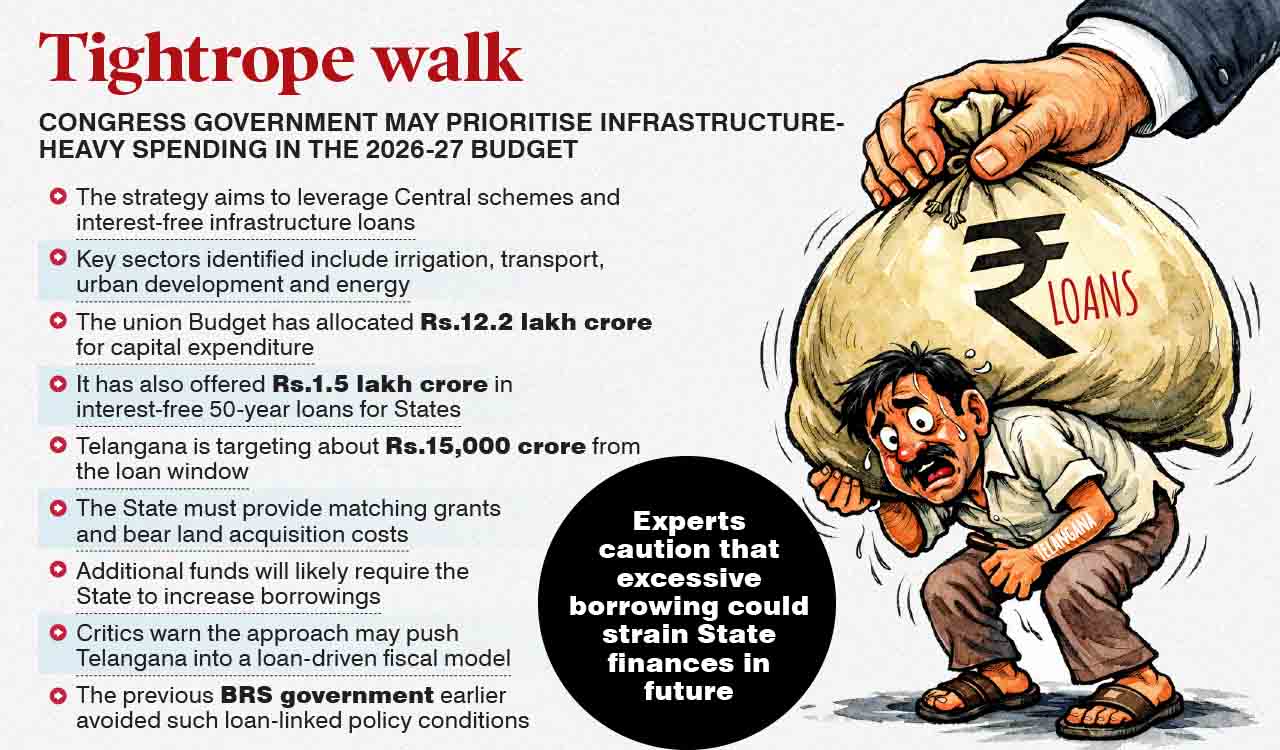
The Telangana government may prioritise infrastructure in the 2026-27 Budget to tap Central schemes and loans. Critics warn the strategy could increase borrowing and fiscal risks, while officials say several major projects depend on Central funding support
Published Date – 8 March 2026, 07:34 PM
Hyderabad: The Congress government appears to be aggressively pushing towards infrastructure-heavy allocations in the 2026-27 Telangana Budget, raising concerns that the State may be slipping into the fiscal template promoted by the BJP-led Union government, where Central grants are limited and States are nudged towards loans and matching fund commitments.
Chief Minister A Revanth Reddy recently directed officials to prioritise irrigation, transport, urban development, energy and mega projects such as Future City, the Regional Ring Road, Musi riverfront development, Hyderabad Metro expansion, radial roads and expressways, with the aim of maximising funds from Central schemes and interest-free infrastructure loans. Sources said the proposals were largely framed around how much could be leveraged from the Centre’s infrastructure push, even if it required additional borrowing.
The Union Budget has provided Rs 12.2 lakh crore for capital expenditure and Rs 1.5 lakh crore in interest-free 50-year loans for States. Telangana is learnt to be targeting about Rs 15,000 crore under this window, apart from nearly Rs 5,000 crore through centrally sponsored urban missions and highway funds. To qualify, the State plans to show matching allocations in advance, effectively shaping its own spending priorities around Central conditions. Funds are also expected to be sought under AMRUT, Smart Cities, PM Gati Shakti and similar programmes.
However, Central assistance comes with riders. Accordingly, the States are mandated to provide matching grants, bear land acquisition costs and mobilise the balance through borrowings. Introduced after the COVID-19 pandemic, this policy has gradually shifted the burden of capital expenditure onto States, forcing them to depend more on loans than unconditional grants. The key question being raised in political and administrative circles is whether the Congress government is walking into a fiscal trap that the previous BRS regime had consciously avoided.
During its tenure, the BRS government largely resisted loan-driven spending that offered immediate relief but added long-term liabilities. Instead, it focused on improving tax revenues to fund welfare and irrigation. A notable example was its refusal to install digital meters for agricultural power connections despite pressure from the Centre to avail additional loans amounting to 0.5 per cent of its GSDP, as doing so would have enabled additional borrowing tied to power-sector reforms but imposed long-term liabilities on the State.
In contrast, the current budget exercise appears aligned with the Centre’s framework, where aid is tied to reforms, matching shares and borrowing commitments. Officials admitted that several pending projects, land acquisition works and large urban infrastructure plans can move forward only if the State secures Central loans and additional borrowings.
Critics and financial experts argued that the Congress government was prioritising high-visibility infrastructure over fiscal stability at a time when Central grants are shrinking and States are being pushed to finance development through debt. They warned that such dependence could delay projects and increase liabilities if the expected funds do not materialise.
With budget preparations in the final stage, the Congress government seems to be betting on infrastructure-led growth backed by Central funds, loans and deferred liabilities. Experts cautioned that without a balanced fiscal plan that also strengthens revenue, the State’s finances could come under strain in the coming years. Instead, they suggested a balanced fiscal plan addressing welfare commitments and revenue realities.