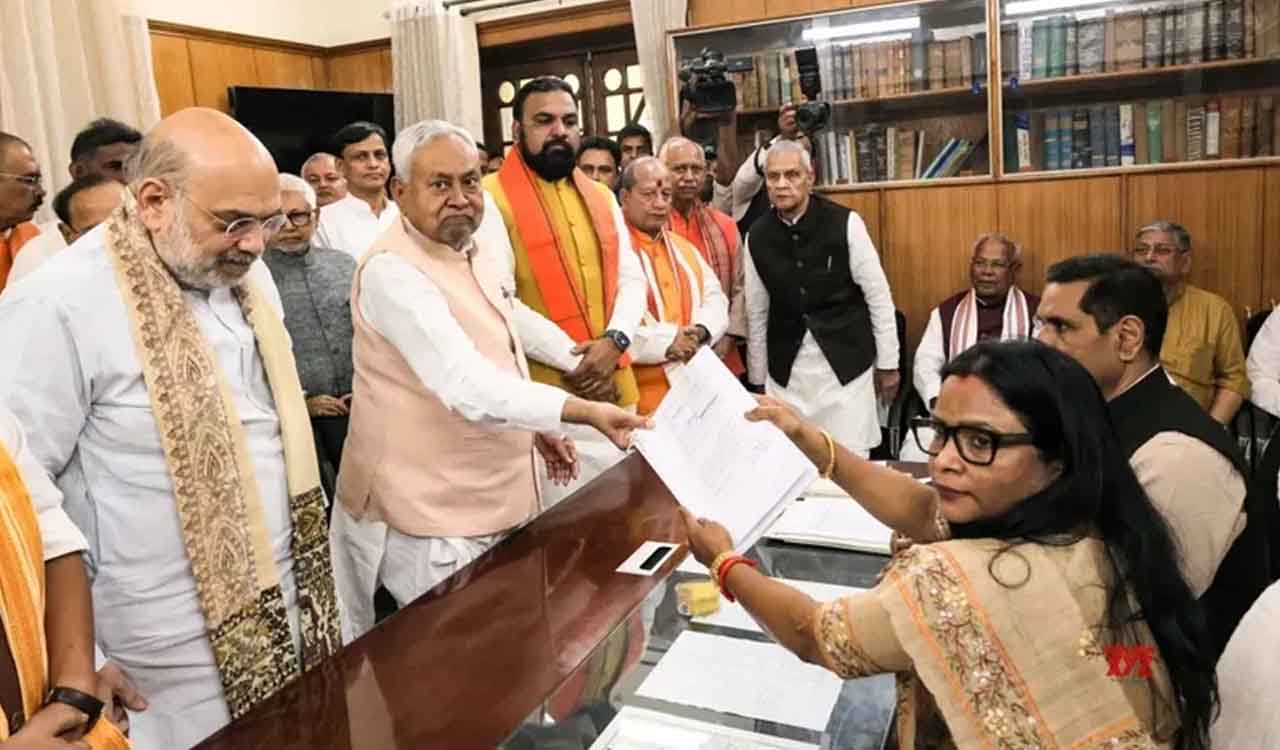
Nitish Kumar’s move to Rajya Sabha marks a defining moment in Bihar politics, bringing the curtains down on his two-decade-long tenure at the helm of the State
Published Date – 6 March 2026, 11:01 PM
A major political transformation is underway in Bihar. Nitish Kumar, a 10-time Chief Minister whose reputation as ‘Sushasan Babu’ remains intact despite his somersaults on alliances, is preparing for a quiet exit from State politics. His move to shift to the Rajya Sabha — vacating the Chief Minister’s chair for a nominee from his alliance partner, the BJP — marks a defining moment in state politics and brings the curtains down on his two-decade-long journey at the helm. The development will pave the way for the saffron party’s dominance in a State whose political identity was largely shaped by two icons — Lalu Prasad Yadav and Nitish Kumar; the former as the champion of Mandal politics and the latter as a reformer and architect of good governance. In the November 2025 Assembly polls, the BJP had emerged as the single largest party. It was only a matter of time before the ailing septuagenarian leader would step down — voluntarily or otherwise — making way for the saffron party to take control of the levers of power. Bihar is the only Hindi heartland State where the BJP has not had a chief minister of its own so far. The twist also opens an opportunity for Nitish’s son Nishant Kumar, who is expected to join the new government as deputy Chief Minister, despite being a rookie in active politics. Nitish’s election to the Upper House is a foregone conclusion, given the NDA’s comfortable majority in the Assembly.
As the Janata Dal (United) is poised to play a second fiddle to the BJP, the challenge for the ageing Nitish would be to keep his flock together and ensure that his party does not cede too much ground to its allies. His entry into the Rajya Sabha will present an opportunity to Lok Janshakti Party (Ram Vilas) chief and Union Minister Chirag Paswan to make deeper inroads into State politics. The turn of events is also significant for the RJD, which will look to exploit chinks in the ruling coalition’s armour. Nitish’s success lies in a rare blend of social coalition — uniting Extremely Backward Castes (EBCs), Mahadalits and non-Yadav OBCs — and good governance. The recent elections that saw him return to power for a fifth consecutive term established his unmatched dominance in State politics. He positioned himself as a technocratic reformer who could rescue Bihar from an era of administrative decay. The 1990s in Bihar were defined by the rise of Lalu Prasad Yadav, riding the wave of Mandal politics and a formidable social coalition of Yadavs and Muslims. His message resonated deeply with communities historically excluded from power. However, his rule — and later that of his wife Rabri Devi — also became synonymous with lawlessness, decaying infrastructure, and economic stagnation, with critics dubbing it “jungle raj”. A product of the socialist movement, Nitish presented himself as the sober alternative to Lalu’s reckless populism.