A year after the SLBC tunnel roof collapse that trapped eight workers, six bodies remain unrecovered and work on the irrigation project is yet to resume, raising concerns over delays despite government assurances and technical surveys to revive excavation
Published Date – 22 February 2026, 12:39 AM
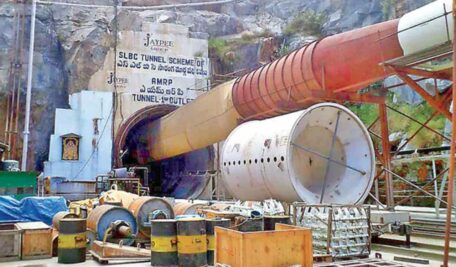
Hyderabad: It has been a year since eight persons lost their lives when the roof of the Srisailam Left Bank Canal (SLBC) tunnel collapsed, yet the bodies of six victims remain unrecovered and work on the crucial irrigation project is yet to resume.
Despite the Congress government claiming to accord top priority to the SLBC tunnel works, progress has remained elusive. Workers and a tunnel boring machine (TBM) were deployed and excavation had commenced, but the project came to a grinding halt following the roof collapse at Domalpenta on February 22 last year.
Of the eight persons trapped under the debris, only two bodies were recovered. After rescue operations continued for over two months without success, the government declared the remaining six persons as ‘presumed dead’ and subsequently suspended further rescue efforts, leaving families without closure.
Several months later, the Irrigation Department dismantled the damaged TBM from the accident site, acknowledging that continuing excavation using the same machine was not feasible. Officials then proposed adopting alternative tunnelling methods involving technical experts, but tangible progress on the ground has remained slow.
Following multiple rounds of deliberations, authorities decided to adopt the Drilling and Blasting Method (DBM) using advanced technology from both ends of the tunnel. Of the total 43-km tunnel stretch, nearly 11 km remains incomplete, with one end located at Devarakonda and the other at Domalpenta, where the collapse had occurred.
As part of preparatory measures, the National Geophysical Research Institute (NGRI) conducted an Aerial Electromagnetic (AEM) survey to assess geological conditions along the remaining tunnel stretch.
Irrigation Minister N Uttam Kumar Reddy recently stated that the survey yielded encouraging results, providing critical geological data to assess tunnel support requirements and identify vulnerable zones in advance. He also announced the creation of a dedicated SLBC Division and issued orders for the appointment of a Chief Engineer to oversee the works.
The government has proposed resuming tunnel excavation by creating a bypass of approximately 300 metres around the collapsed section at the Domalpenta end. However, even a year after the tragedy, the absence of visible progress has raised serious concerns over delays in completing the project and recovering the remaining victims’ bodies.