The Delhi High Court ruling in the Unnao rape case exposes troubling legal gaps and raises questions about survivor justice
Published Date – 18 February 2026, 09:53 PM
By Nayakara Veeresha
On December 23, the Delhi High Court in the case of Kuldeep Singh Sengar Vs Central Bureau of Investigation (2020) ruled that Section 21 of the Indian Penal Code (IPC) does not cover or apply to a Member of the Legislative Assembly (MLA) in the definition of ‘public servant’. Therefore, the submission that MLA would be comprehended in clause (7) of Section 21 as a public servant must be rejected.
Clause (7) of Section 21 reads “Every person who holds any office by virtue of which he is empowered to place or keep any person in confinement”. Subsequently, the Supreme Court stayed this High Court order on Dec 29, 2025, citing substantive questions of law in the Special Leave Petition (SLP), including the definition of ‘public servant’.
Unclear Definition
The Delhi High Court rejected the trial court’s adoption of the definition of public servant from the Prevention of Corruption Act, 1988. The High Court reasoned that “in the opinion of this Court, the definition of ‘public servant’ in the Prevention of Corruption Act would be of no use in the present case, for the reason that Section 2 of the Protection of Children from Sexual Offences (POCSO) Act does not include the Prevention of Corruption Act.”
The high court inferred that “Public servant has not been defined in the POCSO Act, Section 2(2) of the POCSO Act reads as under: ‘(2) The words and expressions used herein and not defined but defined in the Indian Penal Code (45 of 1860), the Code of Criminal Procedure, 1973 (2 of 1974), 2[the Juvenile Justice (Care and Protection of Children) Act, 2015 (2 of 2016)] and the Information Technology Act, 2000 (21 of 2000) shall have the meanings respectively assigned to them in the said Codes or the Acts.’”
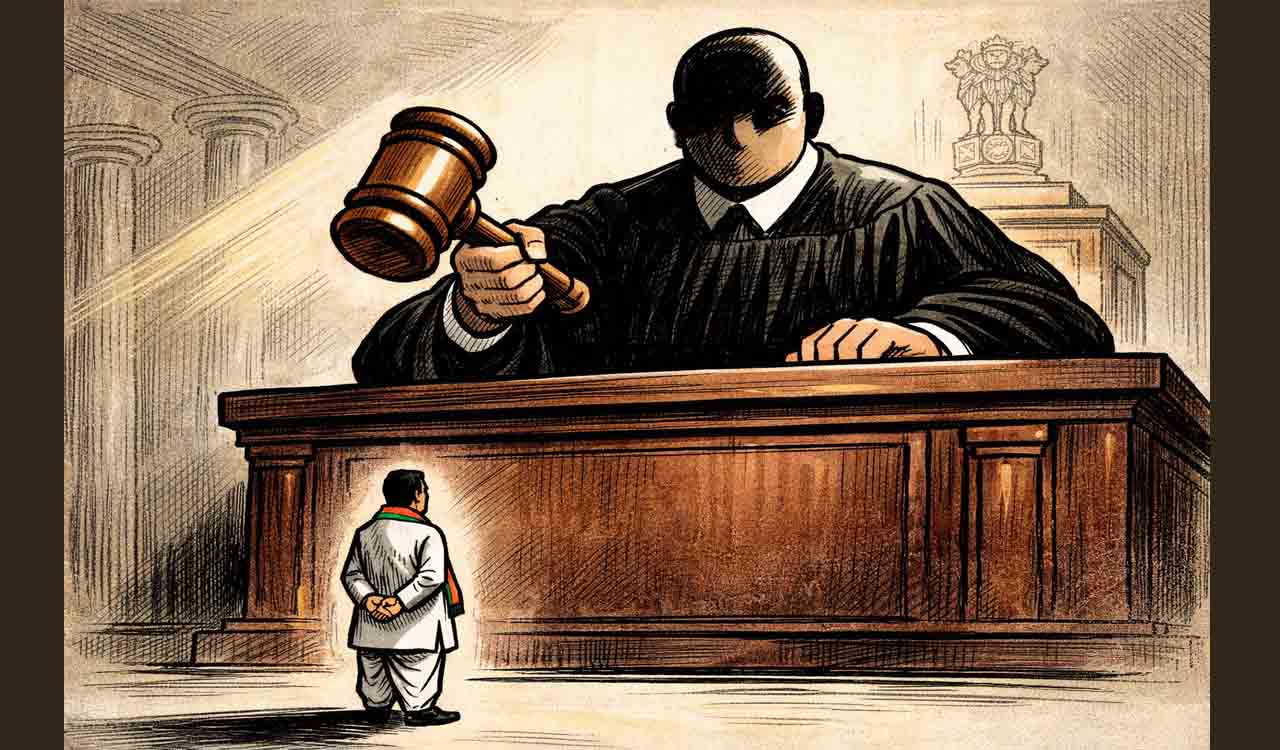
By confining itself to a technical reading of statutory definitions, the court’s ruling risks deepening the travesty of justice and weakening public confidence in India’s criminal justice framework
How does the lack of definition in a particular law become grounds to provide the benefit of the doubt to a convict, irrespective of holding the position of an MLA or MP? Yet, this is what happened in the said ruling, wherein the appellant Kuldeep Singh Sengar, convicted in a rape case, was serving a life sentence following the trial court verdict in 2019.
Troubling Questions
The deeply disturbing concern is the court’s simplifying statement. It stated: “In view of the specific inclusion of IPC, CrP C, JJ Act and IT Act in Section 2 of the POCSO Act, this Court cannot take aid of definition of “public servant‟ on any other Act other than IPC, CrPC, JJ Act and IT Act. Notably, CrP C, JJ Act and IT Act do not provide for the definition of “public servant”.
Therefore, this court “is inclined to come to the conclusion that Appellant cannot come within the scope of Section 5(c) of the POCSO Act, and the same reasoning applies for the Appellants conviction under Section 376(2)(b) of the IPC”. The court confined itself to the definitional aspect of ‘public servant,’ aggravating the travesty of justice for the Unnao rape survivor.
Another disturbing aspect is the High Court’s retrospective application of the POCSO Act, 2012, to Sengar, concluding that “the appellant has already undergone about 7 years and 5 months under incarceration, which is more than minimum number of years under Section 4 of the POCSO Act prior to its amendment in 2019. This court is inclined to suspend the sentence of the appellant”. The court considered the earlier provision of POCSO, 2012, to argue that the appellant has already served the prescribed term, justifying suspension until the appeal’s finality.
The court failed to acknowledge the threat to the survivor and her family while refuting the argument for keeping the appellant in custody. Extending the benefit of Section 389 CrPC to the appellant, it held: “Courts cannot keep a person in custody being apprehensive that the police/paramilitary may not do its job properly. Such an observation or such a thought process would undermine the laudable work of our police/paramilitary forces”.
Critical Issues
The court granted the benefit of the doubt to the appellant rather than the survivor and overlooked the gravity of the crime. Discrepancies around the survivor’s date of birth in government and private school records, and medical statements, worked in favour of the convict rather than the survivor’s justice. The absence of a definition of ‘public servant ‘ in the IPC cannot become a ground to suspend a life sentence to a rape convict.
It is the duty of the court to identify an appropriate law defining ‘public servant’ when a lacuna exists in clause (7), Section 21 of the IPC. The high court’s reasoning for declining the trial court’s Prevention of Corruption Act definition negates well-settled principles of natural justice and criminal law. Legal gaps should not allow future criminals and rapists to escape punishment. The government of India must act quickly to rectify such loopholes by bringing elected representatives within the ambit of the Bharatiya Nyaya Sanhita, 2023, the Bharatiya Nagarik Suraksha Sanhita, 2023, and the POCSO Act, explicitly including MLAs, MPs, and local government members.
Retrospective application of POCSO, 2012, to suspend Sengar’s life sentence erodes public confidence in the courts and has serious implications for the criminal justice system and investigative agencies such as the CBI. The court failed to uphold the morale of both the CBI and the survivor. While Article 21 and the right to liberty are important, these rights must be exercised with utmost restraint. This seems to be missing in this verdict.
(The author Assistant Professor, Symbiosis Law School, Pune. Views are personal)