
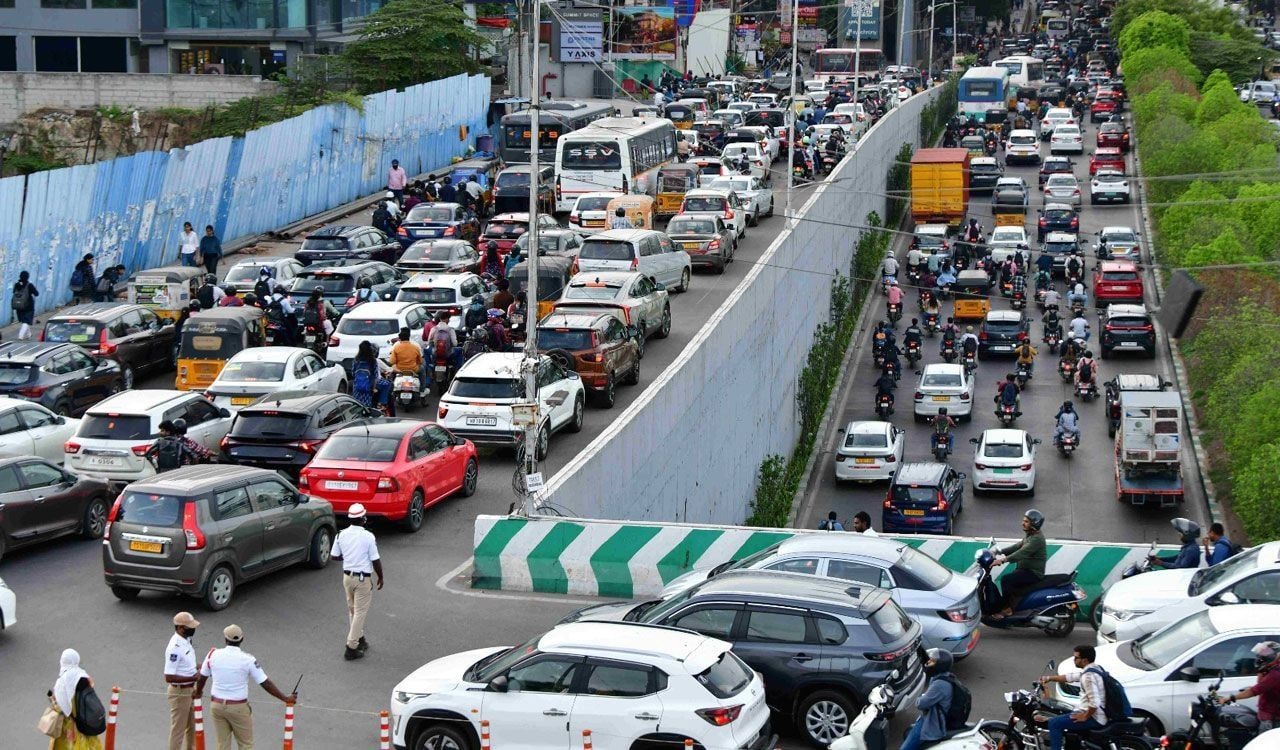
Commuters in Cyberabad continue relying on private vehicles despite appeals to use public transport. Inadequate bus services, overcrowded Metro trains, limited MMTS connectivity and poor last-mile links make daily travel difficult, prompting calls for more frequent and reliable public transport.
Published Date – 26 November 2026, 06:30 PM
Hyderabad: Despite repeated appeals from the Cyberabad Traffic Police, civic authorities and NGOs to reduce private vehicle usage, thousands of commuters continue to depend on cars and two-wheelers for their daily journeys.
The growing preference for personal vehicles is just not a mere convenience but also reflects the shortcomings of public transport in the region.
Public transport does not meet commuter needs
For employees travelling to Hitec City, Gachibowli, Madhapur, Nanakramguda and the Financial District, public transport remains an uncertain option. Inadequate bus frequency, unpredictable arrival timings, limited MMTS connectivity and overcrowded metro trains make daily commuting difficult.
Missing a bus or train can result in considerable delays, while overcrowded coaches make peak-hour travel uncomfortable. Commuters say the available services are yet to match the growing demand.
Uncertainty over timings of RTC buses
Although TGSRTC operates buses across the IT corridor, several commuters complain about inadequate frequency on several routes and the lack of direct connectivity to some office campuses and residential areas. They want more buses and dependable schedules, particularly during office hours.
Packed coaches, limited capacity of Metro
The Metro Rail has become an important commuting option, but overcrowding during peak hours does not make it a better option to many passengers. Commuters want increased train frequency and additional coaches to accommodate the growing passenger load. Last-mile connectivity to office campuses also remains a concern.
MMTS connectivity remains limited
Limited MMTS connectivity to major IT employment centres has prevented the suburban rail network from becoming a convenient option for many employees. Better route coverage, increased frequency and timings aligned with office schedules could attract more passengers.
Commuters say personal vehicles are a practical choice.
Sunny, a resident of Chikkadpally working for a MNC said commuters cannot be expected to abandon their vehicles without reliable alternatives.
“Everyone talks about reducing traffic, carpooling and using public transport. But what happens when buses do not arrive on time, MMTS connectivity is limited and Metro trains are already packed,” he says.
Stating that working professionals cannot afford to be late to work every day, Sunny said under the present circumstances, taking our own vehicle is a more practical option because commuters have better control over their travel time.
Carpooling needs practical support
Cyberabad Traffic Police and the Society for Cyberabad Security Council (SCSC) have been encouraging carpooling, staggered office timings and greater public transport usage. However, differences in working hours, residential locations and commuting schedules make vehicle sharing difficult. IT companies could encourage participation through employee carpooling platforms and incentives.
Last-mile connectivity issues
Poor connectivity between transit stations, residential colonies and office campuses further discourages public transport usage. Feeder buses, shared electric vehicles and pedestrian-friendly infrastructure could make commuting easier.
Unless public transport becomes frequent, reliable and accessible, citizens say appeals to abandon personal vehicles may have limited impact.
*Greater Hyderabad has an estimated 80-90 lakh registered vehicles.
* Traffic across Cyberabad’s IT corridor averages roughly 24.66 lakh to 25 lakh vehicles per day.
*Nearly nine lakh employees work in the IT/ITES sector, with over 1,500 companies operating across major technology hubs.
*Congestion is particularly severe along the Hitec City-Gachibowli corridor, Financial District, Kokapet, Miyapur and Kukatpally.
*TGSRTC operates around 450 buses in the IT corridor, including 200 electric buses.
*Metro extensions, additional buses, improved feeder services and better pedestrian facilities are also among the proposed measures.