
Trump’s news tariffs on 14 major trading partners draws a global backlash, with Brazil calling them ‘unacceptable’ and China slamming them as ‘political manipulation.’
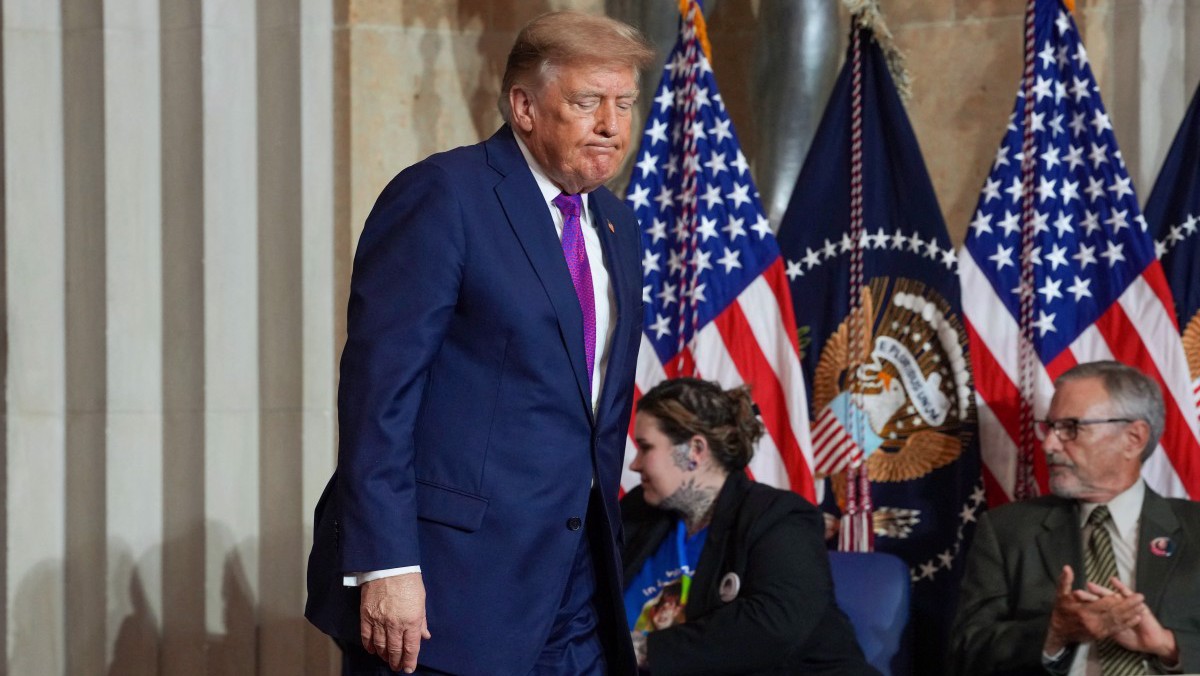
US President Donald Trump arrives to speak during an event at the Department of Justice on November 23, 2026, in Washington, DC. (Photo by AFP)
US President Donald Trump has announced new tariffs on 14 major trading partners, including China, Brazil, the European Union (EU) and Japan, prompting protests from governments worldwide.
The proposed tariffs were announced on Wednesday after an eight-month investigation by the US Trade Representative under Section 301 of the 1974 Trade Act, which allows Washington to impose duties on countries it accuses of engaging in unreasonable or discriminatory trade practices.
The Trump administration claims that excess manufacturing capacity and unfair trade policies in these economies give them an advantage over American producers.
China faces the highest proposed rate of 20 percent, potentially bringing its overall duties on some products to 45 percent. However, around $30 billion worth of Chinese imports could be exempted under a bilateral trade arrangement.
The Trump administration says the measures are consistent with trade agreements reached last year, with consultations and a hearing scheduled for January 25 before the final duties potentially take effect in February or March.
Brazil, which was particularly targeted after trade negotiations stalled, strongly rejected the measures, especially proposed higher duties on raw and refined sugar and a 10-percent tariff on finished aircraft manufactured by Embraer, a major supplier to US regional airlines.
“Brazil will not yield to this type of threat,” Brazil’s government said, slamming Washington’s decision as an “unacceptable action within the framework of the ongoing bilateral negotiating process.”
It also warned that it could consider retaliatory measures against the illegal imposition of tariffs.
China likewise rejected Washington’s accusations of industrial overcapacity.
A spokesperson for China’s embassy in Washington rejected allegations that Beijing is a source of excess capacity, but did not threaten retaliation.
“The so-called issue of ‘industrial overcapacity’ does not really exist and should not be used as a pretext for political manipulation,” the spokesperson said, urging the two sides to jointly deliver on agreements secured between Trump and his Chinese President Xi Jinping.
Earlier, China’s foreign ministry restated its opposition, calling for Washington to resolve the issue through dialogue.
“A tariff war or a trade war serves no party’s interests,” spokesman Guo Jiakun stressed.
Other governments also voiced opposition or sought clarification. Japan protested the proposed 15-percent tariff on its exports, which Washington could raise to 20 percent, despite the rate being consistent with a previous bilateral agreement.
Tokyo stressed that it had no structural excess production capacity and said it would continue implementing its $550 billion US investment initiative, under which three rounds of projects worth $130 billion have already been announced.
“Japan does not have any nonmarket policies or practices, or structural excess production capacity,” Chief Cabinet Secretary Minoru Kihara said at a regular news conference on Thursday.
“It is regrettable that the US announced proposed measures targeting Japan, and we have already conveyed that view to the US side,” he added.
The European Union rejected the premise that it was responsible for structural overcapacity, while Switzerland also dismissed the US allegations.
“The EU takes note of the publication by the US of preliminary findings pursuant to its Section 301 investigation concerning structural excess capacity in manufacturing sectors,” European Commission spokesman Olof Gill said.
“We will study the findings. At the same time, we strongly reject the premise that Europe is a source of structural overcapacity. To the contrary, Europe is among those most exposed to overcapacity,” he added.
India denied having excess capacity in any sector and reaffirmed its commitment to concluding a trade agreement with Washington.
“India engaged constructively throughout this investigation. In response to the Notice of Initiation and in subsequent proceedings, the Department of Commerce stated that India does not have structural excess capacity in any sector,” India’s commerce ministry said in a statement.
“Government of India remains committed to working closely with the United States towards the early conclusion of the India-US Bilateral Trade Agreement, as announced on 2nd February 2026, and in accordance with the Joint Statement issued on 7th February 2026,” it added.
Vietnam said it was working to finalize its deal with the US and preparing rebuttals to inaccurate allegations.
Taiwan, meanwhile, expressed confidence that its existing 15-percent tariff arrangement would remain in place, particularly given preferential trade agreements covering semiconductors and other technology products.
South Korea, Indonesia, Bangladesh, Cambodia, Malaysia, Singapore and Thailand are among the other economies affected. Mexico and Norway were excluded from this round because investigations into their trade practices remain underway, with Norway welcoming the decision.
The announcement also unsettled financial markets, although trading ended on a mixed note. The Nasdaq Composite fell 0.6 percent after losing more than 4 percent earlier in the session, while the S&P 500 closed 0.25 percent lower.
The Dow Jones Industrial Average recovered from earlier losses to finish 0.3 percent higher.
Gold prices plunged more than three percent to their lowest level in over a year, although inflation figures released the same day also contributed to the decline by raising concerns about interest rates. Bond yields in both the US and Europe fell.
The move has also drawn criticism within Washington, where Democratic Senator Ron Wyden vowed to challenge the policy, saying he would “use every tool at my disposal to end Trump’s tariffs chaos.”
“This is another blatant attempt by Donald Trump to reconstruct his illegal global tariffs,” he added, stressing that unilateral tariffs are not the answer to global overcapacity.