
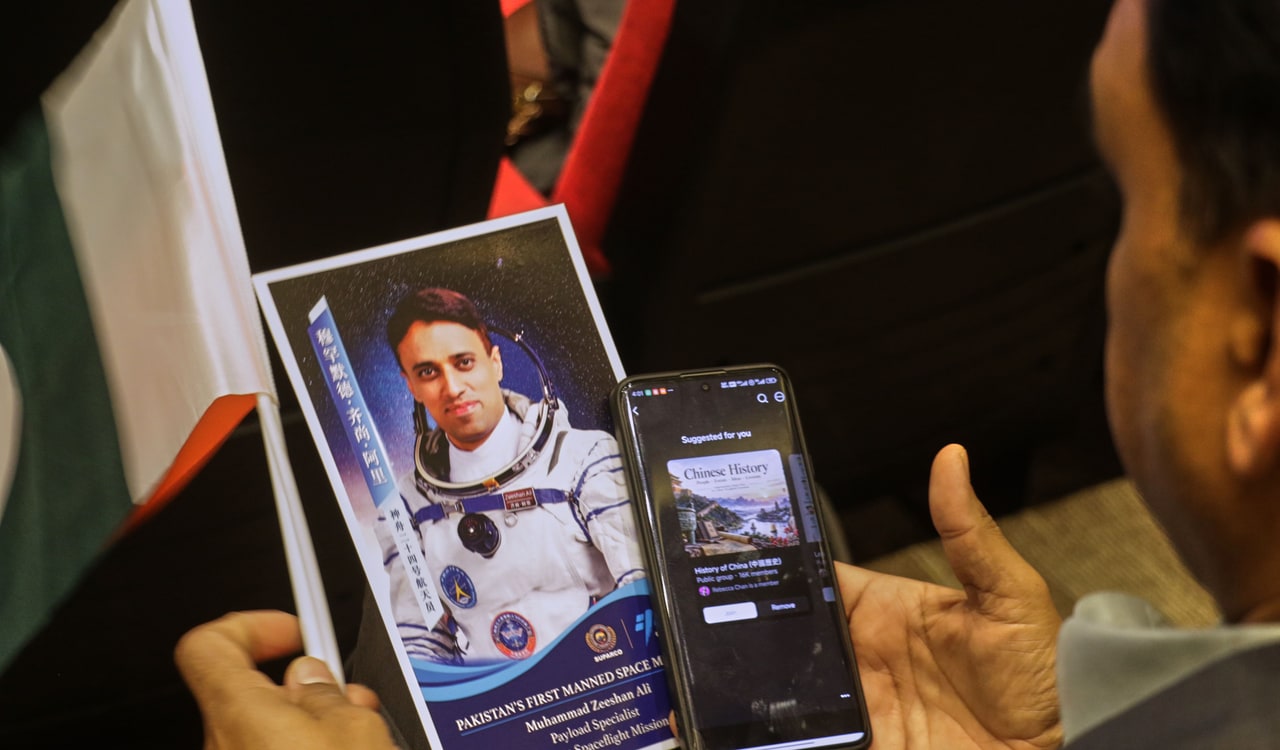
China launched the Shenzhou-24 spacecraft carrying Pakistani astronaut Muhammad Zeeshan Ali and two Chinese crew members, with the mission docking at the Tiangong space station after liftoff from Jiuquan.
Published Date – 25 November 2026, 01:57 PM
Beijing/Jiuquan: China on Wednesday successfully launched its Shenzhou-24 crewed spaceship carrying three astronauts, including Pakistan’s Muhammad Zeeshan Ali, the first foreign national to participate in the country’s crewed space programme.
The spaceship, atop a Long March-2F carrier rocket, lifted off from the Jiuquan Satellite Launch Centre in northwest China. Officials declared the launch successful minutes later.
The Pakistani astronaut’s participation in China’s space mission is part of celebrations marking the 75th anniversary of China-Pakistan diplomatic ties. The two all-weather allies have close defence and economic ties.
Chinese President Xi Jinping and his Pakistani counterpart Asif Ali Zardari exchanged congratulations on Wednesday on the joint spaceflight mission carried out by astronauts from the two countries.
“The joint space exploration of astronauts from China and Pakistan is a vivid embodiment of the deep-rooted friendship between the two countries, as well as another important achievement in bilateral cooperation,” Xi said in a message, according to state-run Xinhua news agency.
Xi said China stood ready to work with Pakistan and other countries to champion the peaceful use of outer space and deepen space cooperation, Xinhua reported.
About 10 minutes after the launch, which was telecast live, the spaceship separated from the rocket and entered its designated orbit, the CMSA said, adding that the astronauts were in good condition.
After a few hours, the Shenzhou-24 crewed spaceship successfully docked with the Tiangong space station.
The crew, including Ali, who has been designated as payload specialist, later entered the space station and joined three other astronauts who have been manning the station for the past six months.
The crew comprises mission commander and spacecraft pilot Tang Hongbo, flight engineer Wu Yi and Ali, who will become the first foreign astronaut to visit China’s orbiting Tiangong space station.
Ali, a Pakistani Air Force pilot, will return to Earth aboard the Shenzhou-23 spacecraft along with the two other Chinese astronauts after a short stay of about a week in orbit.
Chinese astronauts typically stay at the station for about six months and are replaced by three others. This time, one member of the previous crew, Zhu Yangzhu, will stay for another six months.
By the time he returns, Zhu will hold the record for the longest single stay in orbit by a Chinese astronaut.
China built its own space station after it was reportedly excluded from the International Space Station (ISS) over concerns about the involvement of its military, the People’s Liberation Army (PLA), in its space programme.
China is currently the only country operating its own space station, which became operational in 2022.
Tiangong is relatively small compared with the football pitch-sized ISS, where astronauts from several countries have conducted more than 3,000 experiments since its launch in 1998.
NASA plans to retire the ISS in early 2031, using a dedicated deorbit vehicle being developed by SpaceX to guide it into a controlled re-entry over the South Pacific, according to reports.
The Shenzhou-24 mission’s main objectives include completing an in-orbit crew rotation with the Shenzhou-23 crew, maintaining routine station operations, conducting scientific research and carrying out maintenance, public outreach and payload tests, Chinese officials said.
More than 90 scientific experiments and technology tests are planned during the mission.
These will cover space life sciences, materials science, microgravity fluid physics, combustion science, fundamental physics, space medicine and new space technologies, the officials said.