The case concerns the martyrdom of 168 children, teachers, and others killed in a US missile strike on the Minab school on February 28.
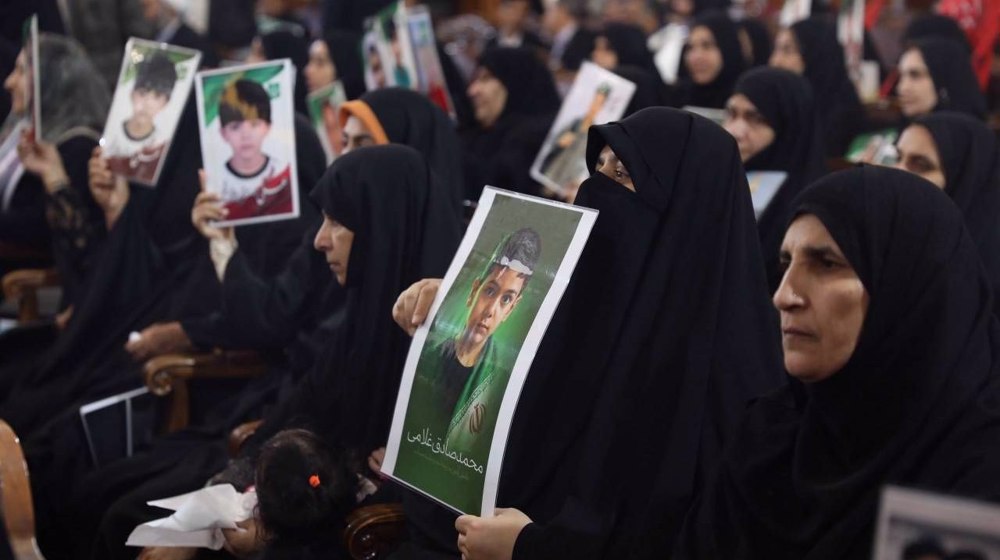
Family members of victims hold up pictures of schoolchildren killed in a US missile strike on an elementary school in the southern Iranian city of Minab at a trial examining the massacre in Tehran on November 24, 2026. (Photo by Mizan News Agency)
Iran has vowed “neither to forgive nor forget” the US massacre at an elementary school in the southern city of Minab on the opening day of the American-Israeli aggression in late February, as a Tehran court began hearing testimony from bereaved families, survivors and witnesses.
“The trial examining the crimes committed by the United States and the Israeli regime at the Shajareh Tayyebeh School in Minab is currently underway,” Kazem Gharibabadi, deputy foreign minister for legal and international affairs, said in a post on X on Tuesday.
“Let everyone know: We will neither forgive nor forget!” he added.
The case concerns the martyrdom of 168 children, teachers, and other victims at the school on February 28, when the United States and the Israeli regime began their unprovoked aggression against the Islamic Republic.
The hearing took place at Branch 55 of the International Court of Tehran, presided over by Judge Hosseinzadeh, and attended by senior judicial officials, international lawyers, media representatives, and families of those either martyred or injured.
Opening the proceedings, Hosseinzadeh said the families had filed claims against the US government, its president, and senior Israeli officials, seeking punitive damages and compensation for material and moral damages.
He maintained that Iranian courts had jurisdiction under domestic legislation and international legal instruments, citing constitutional provisions guaranteeing access to justice, the principle of reciprocity, and international protections for the right to life and security.
Hassan Abdolianpour, head of Iran’s Central Bar Association, said the proceedings had to establish the identities of those responsible and the evidence linking them to the attack.
He stressed that the decisions behind the attack needed to be examined through targeting records, intelligence assessments, command documents, and technical evidence.
Abdolianpour also called for the issuance of summonses to nine US Navy destroyer commanders to examine their responsibility for the losses.
Lawyer Hossein Tanhaei presented documents showing that the school complex, comprising separate elementary schools for boys and girls and a preschool, operated under the supervision of Iran’s Education Ministry since October 2015.
According to the evidence submitted, 403 children were enrolled at the institution when it was attacked, alongside 36 staff members. Academic records, report cards, photographs, and satellite imagery were presented to establish its continuous educational activities and civilian character.
‘Why did they tear students limb from limb?’
The court also heard testimony from Reyhaneh Mahdikhah, a surviving student whose sister was martyred.
“Our school was not a military facility. And even if it had been, would that have justified tearing its students limb from limb? They had no weapons. They went to school carrying nothing but their schoolbags and stationery,” she said.
Sixth-grade teacher Atefeh Zakeri described multiple explosions that destroyed the school, saying she pulled injured children from beneath the rubble, despite suffering injuries herself.
Eyewitness Jafar Ghassemi said he heard three powerful explosions and rushed to the scene. He said the school was deliberately targeted and that the location was struck again at around 2:30 p.m. (local time).
Bereaved families demand accountability
Several fathers recounted the devastating loss of their children and the difficulties of identifying their remains.
Hassan Salari, who lost his wife and two children, said his son was identified through his pencil case and his wife through her wedding ring. His eight-year-old daughter was subsequently identified at a morgue.
Other parents described finding their children’s remains days after the attack, including through DNA testing.
The plaintiffs’ legal team also invoked the Geneva Conventions, the UN Charter, and customary international humanitarian law, calling for investigations into the weapons used, targeting decisions, and chain of command.