
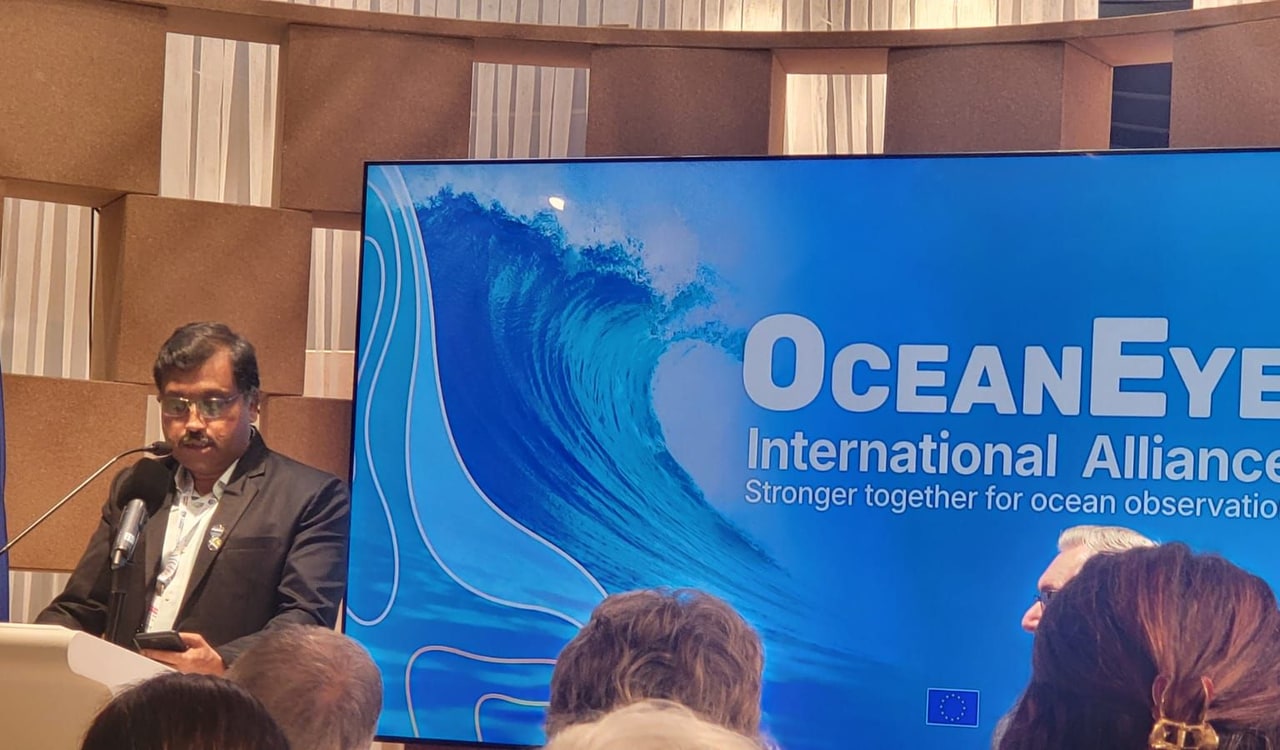
Hyderabad-based INCOIS will double its Indian Ocean monitoring network after India joined the Ocean Eye International Alliance in Turkey, expanding ocean data-sharing, weather forecasting, disaster preparedness and sea-safety capabilities.
Published Date – 21 November 2026, 05:24 PM
Hyderabad: Scientists in Hyderabad will soon track twice as much data on ocean conditions, weather shifts and sea hazards in the Indian Ocean after India formally joined the Ocean Eye International Alliance, a global marine-monitoring alliance, in Turkey on Saturday, INCOIS said.
The Hyderabad-based Indian National Centre for Ocean Information Services (INCOIS) will lead the expansion under the Ocean Eye International Alliance for the Global Ocean Observing System (GOOS).
INCOIS Director T.M. Balakrishnan Nair announced India’s entry alongside fellow new members Albania and the Monterey Bay Aquarium Research Institute (MBARI) during a session, ‘Ocean, Seas, Nature, and Land Use Day’, at the UN Climate Change Conference (COP31) in Antalya.
As the country’s main hub for ocean data, cyclone tracking and tsunami alerts, INCOIS will execute India’s new pledges to the alliance, which is co-chaired by the European Union and Canada.
Under the new roadmap, India plans to double its current network of ocean sensors and tracking systems across the Indian Ocean to plug critical data gaps. INCOIS and other Indian agencies will share technical know-how, including tracking Essential Ocean Variables (EOVs), following global data standards, managing complex ocean data and researching tropical ocean patterns.
Addressing delegates at the event, Nair said GOOS is essential for accurate weather and climate forecasts, disaster preparedness and safety at sea. “We must work collectively to make the Global Ocean Observing System more resilient and fit-for-purpose for both national and regional operational delivery,” he said.
Mercator Ocean tie-up
In a separate development at the event, Pierre Bahurel, chief executive officer of Mercator Ocean International, announced a formal cooperation agreement between Mercator and INCOIS.
He said the tie-up would link regional digital ocean systems and cross-check marine data, helping scientists build next-generation “Digital Twins of the Ocean” — virtual models used to test and predict how oceans respond to climate shifts.



