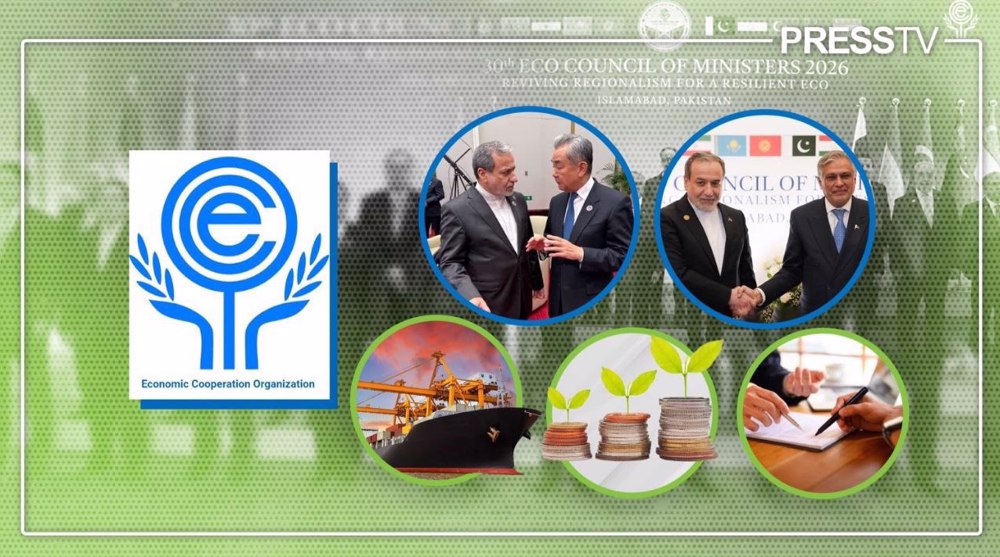
The latest ECO ministerial meeting in Islamabad, attended by Iranian Foreign Minister Abbas Araghchi, offered important insights into Tehran’s vision for the organization’s role in the evolving regional landscape.
By Press TV Website Staff
The 30th meeting of the Council of Ministers of the Economic Cooperation Organization (ECO), held in Islamabad on November 16, highlighted Tehran’s efforts to strengthen regional self-reliance and collective security alongside economic integration, transport connectivity and energy cooperation.
This approach has gained greater significance in the aftermath of US-Israeli aggression against Iran.
The latest ECO ministerial meeting in Islamabad offered an important indication of how Iran views the organization’s potential role in the evolving regional landscape.
Addressing the gathering, Iranian Foreign Minister Abbas Araghchi called for trade, transportation and energy to serve as the three strategic pillars of cooperation among ECO member states. He noted that stronger regional connectivity could help countries reduce their vulnerabilities to external pressures.
“Our region needs not only an independent security framework but also a reliable and sustainable regional energy mechanism to safeguard energy flows, ensure stable supplies, reduce external vulnerabilities and enhance collective resilience against geopolitical shocks and disruptions,” he said.
His remarks reflected Iran’s broader approach to regional cooperation, which has gained greater urgency following the unprovoked and illegal US-Israeli war of aggression.
Tehran maintains that the imposed war exposed the vulnerability of regional economic and energy infrastructure to external military aggression, underscoring the need for neighboring countries to strengthen their own mechanisms of cooperation.
In this context, Tehran increasingly views the ECO as a platform through which economic cooperation can contribute to a broader regional framework of self-reliance and collective resilience, rather than remain confined to commercial exchanges.
Why does ECO matter to Iran?
Established in 1985 by Iran, Pakistan and Turkey, the Economic Cooperation Organization (ECO) expanded in 1992 to include Afghanistan, Azerbaijan, Kazakhstan, Kyrgyzstan, Tajikistan, Turkmenistan and Uzbekistan.
Its ten member states span West, South and Central Asia, giving the organization a geographical reach that links several important economic and transportation corridors.
Iran is not only a founding member but also hosts the organization’s headquarters in Tehran.
For Tehran, this geographical dimension is particularly significant. Iran occupies a strategic position connecting the Persian Gulf and the Sea of Oman with the Caucasus, Central Asia and Turkey.
Stronger cooperation within the ECO could therefore help Iran expand its role as a regional transit hub, facilitate access to neighboring markets and deepen its economic ties with surrounding countries.
The importance of this approach has become more pronounced in the aftermath of US-Israeli aggression against Iran. Strengthening regional connectivity is therefore not merely an economic objective but also part of Tehran’s broader effort to build resilience against external pressures and reduce dependence on vulnerable external routes and networks.
This is also why Araghchi’s emphasis on transportation goes beyond infrastructure development. Improved transport links, more efficient customs procedures and coordinated transit arrangements could make regional trade less dependent on routes and commercial arrangements outside the region.
The importance of this approach was reflected in the Islamabad Communiqué, which called on member states to fully implement the ECO Transit Transport Framework Agreement (TTFA) to improve connectivity and facilitate trade. It also underscored the strategic importance of the organization’s Sustainable and Resilient Transport Strategy for 2026–2035.
The communiqué further called for increased investment, the development of free economic zones, joint manufacturing ventures and regional value chains.
These proposals suggest that the ECO agenda is intended to move beyond diplomatic declarations towards more practical forms of economic integration.
How is it moving from economic cooperation to regional security?
Perhaps the most significant aspect of Iran’s position at the latest ECO meeting was its effort to link economic integration with regional security.
The US-Israeli war of aggression has further reinforced Tehran’s longstanding argument that economic development and regional stability cannot be separated from security arrangements independent of external military intervention.
Speaking at the summit, Araghchi called for the establishment of a security framework led by regional countries themselves, stressing that regional security should not depend on the involvement of outside powers.
“One principle speaks loud enough: the territories, airspace and facilities of the regional countries must not be used as platforms for launching attacks against each other,” he said.
He also called for an “inclusive and regionally owned dialogue on security arrangements, particularly based on non-aggression and preventing any third party from using one country’s territory or facilities to commit aggression against another.”
This position reflects a recurring element of Iran’s foreign policy, which is an emphasis on regional ownership of security arrangements and opposition to external military intervention. Tehran maintains that regional countries should take collective responsibility for their security rather than rely on arrangements shaped by outside powers.
The significance of raising this issue at an ECO meeting lies in the connection between security and the organization’s economic mandate.
The recent aggression against Iran demonstrated how military confrontation can disrupt transportation corridors, energy supplies, investment and commercial exchanges, directly undermining the development objectives of neighboring countries.
In the final communiqué, participating ministers expressed concern over the regional geopolitical situation and emphasized dialogue, diplomacy and the peaceful settlement of disputes.
They also rejected unilateral coercive measures and sanctions, including their extraterritorial economic, financial and trade consequences.
How is it tied to energy security and the Strait of Hormuz?
Energy cooperation is another important dimension of Tehran’s proposed approach to the ECO.
The organization brings together countries with substantial energy resources, major transit routes and growing energy needs. Cooperation in this sector could therefore create opportunities for more coordinated energy policies, infrastructure development and enhanced security of supply.
Araghchi’s proposal for a regional energy mechanism is particularly relevant amid disruptions to energy markets and transportation routes. He explicitly linked the urgency of stronger energy cooperation to the consequences of US and Israeli aggression against Iran.
“Given the growing impact of US and Israeli regime aggression on regional energy security, strengthening energy cooperation has become an urgent strategic imperative,” he said.
The Strait of Hormuz lends this proposal additional significance. As a major international energy transit route, developments surrounding the waterway have implications extending far beyond the countries bordering it. Disruptions to shipping and energy flows can affect regional economies, international markets and the economic interests of ECO member states.
By placing energy cooperation alongside trade and transportation, Iran is seeking to promote a more coordinated regional approach to protecting economic infrastructure and ensuring the continuity of supply chains.
This also helps explain why Tehran has repeatedly emphasized regional dialogue and cooperation in addressing developments in the Persian Gulf.
Its position is that countries in the region share a direct interest in preventing their territories and infrastructure from being used as instruments in conflicts involving outside powers.
How can ECO become a platform for diplomatic support?
One of the most consequential outcomes of the Islamabad meeting was the position adopted by ECO foreign ministers on the war of aggression against Iran.
The joint communiqué went beyond general calls for restraint and diplomacy, explicitly expressing support for Tehran’s latest initiative to end the imposed war.
The communiqué stated that member states supported: “The recent initiative put forward by the Islamic Republic of Iran aimed at achieving a dignified resolution of the conflict and ensuring the complete and permanent termination of the current war.”
This language is particularly significant because it places Iran’s proposal within a collective regional diplomatic position.
Rather than limiting their statement to an abstract appeal for de-escalation, ECO members endorsed an initiative specifically put forward by Tehran to bring the US-Israeli war against the country to a permanent end.
The ministers also expressed support for mediation efforts undertaken by Pakistan and Qatar, while emphasizing the importance of dialogue, diplomacy, international law and the peaceful settlement of disputes.
They further recognized Iran’s important role as a founding member of ECO and its contributions to the organization’s development.
The communiqué therefore demonstrated that ECO’s role is not confined to economic coordination. Its member states have also used the organization as a platform to articulate common positions on regional developments and support diplomatic initiatives concerning regional security.
The diplomatic dimension of the meeting was reinforced by Araghchi’s consultations with Pakistani officials. On the sidelines of the summit, he met Prime Minister Shehbaz Sharif and Field Marshal Asim Munir, Pakistan’s army chief, discussing bilateral relations and regional developments.
Araghchi also addressed Pakistan’s mediation efforts in an interview with Pakistani television, expressing Tehran’s confidence in Islamabad’s role.
“We trust Pakistan as a good friend,” he said, adding that “Pakistan is doing its job. The issue is very complex and difficult.”
Pakistan’s foreign minister Mohammad Ishaq Dar, meanwhile, confirmed that Islamabad was awaiting Washington’s response to Iran’s latest proposal. He said the Iranian proposal had been accelerated from a seven-day plan to a two-day proposal.
“We have not given up hope or efforts,” Dar said. “We are still doing our best (so) that the situation gets sorted out.”
These developments illustrate how the ECO meeting provided an opportunity to advance diplomatic consultations alongside the organization’s formal economic agenda.
Pakistan’s mediation efforts, Qatar’s diplomatic involvement and the collective position expressed in the Islamabad Communiqué all helped bring regional diplomacy to the forefront of the gathering.
What lies ahead for ECO?
Iran is preparing to host the organization’s 18th Summit of Heads of State and Government in Tehran on December 4.
The upcoming gathering offers another opportunity for Tehran to advance its proposals and encourage member states to translate the commitments made in Islamabad into practical initiatives.
Ultimately, Iran’s approach to the ECO reflects an effort to expand the organization’s role beyond a framework for economic cooperation and turn it into a broader platform for regional coordination.
The US-Israeli aggression has reinforced this approach, making economic resilience, energy security and regional self-reliance increasingly urgent elements of Tehran’s foreign policy.
By placing trade, transportation and energy at the center of its agenda while advocating regional ownership of security arrangements, Iran is seeking to deepen its economic and diplomatic engagement with neighboring countries.
Whether this approach produces tangible results will depend on the willingness of member states to implement their agreements and overcome the political and economic obstacles to integration.
Nevertheless, the latest Islamabad meeting has demonstrated that the ECO remains an important platform through which Iran can pursue its vision of stronger regional connectivity, deeper economic cooperation and greater collective independence in addressing shared challenges.