
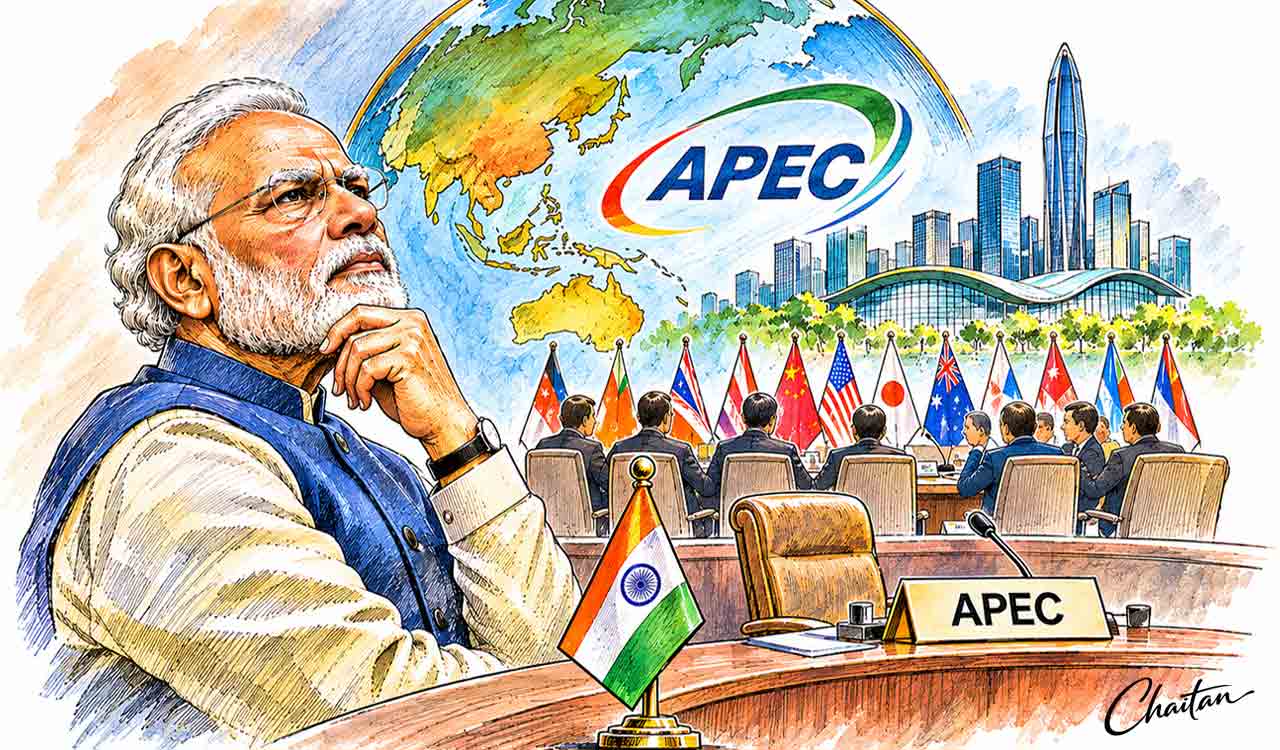
As Asia-Pacific leaders meet in Shenzhen, India’s evolving trade policy offers an opportunity to revive a conversation that has been on hold since 2010
Published Date – 17 November 2026, 11:32 PM
By Komal Karwa
When leaders of the Asia-Pacific Economic Cooperation (APEC) meet in Shenzhen, China, on November 18 and 19, one of Asia’s largest economies will once again follow the proceedings from outside the room. India, home to more than 1.4 billion people, has never been a member of the 21-economy grouping, despite showing interest for nearly three decades.
The timing of this year’s meeting makes India’s absence worth revisiting. China, the 2026 host, has chosen the theme “Building an Asia-Pacific Community to Prosper Together,” with priorities including supply chain resilience, digital cooperation, and progress towards a Free Trade Area of the Asia-Pacific. Each of these goals touches India directly. Moreover, India’s own trade policy has changed considerably since its membership bid was last seriously debated.
Forum Built on Pacific Rim
APEC was founded in 1989 as an informal forum of Pacific Rim economies. Today, its members account for about 62 per cent of world GDP and 48 per cent of global trade, according to the forum’s own figures. APEC currently has 21 member economies. Unlike the World Trade Organization, APEC does not negotiate binding agreements.
India first sought membership in the 1990s. Its hopes stalled in 1997, when APEC imposed a 10-year moratorium on admitting new members. When that freeze approached its end, India was among about a dozen economies with pending membership requests, alongside Mongolia and Colombia. The moratorium expired in 2010, but no new member has been admitted since.
The Door Stays Closed
Geography was never the only obstacle. Members have long debated how far the forum should expand beyond the Pacific Rim, and every new entrant requires consensus.
Trade policy weighed even more heavily. In a 2016 assessment, Amitendu Palit of the Institute of South Asian Studies at the National University of Singapore argued that India’s foreign policy had moved faster than its trade policy, and that the gap made it harder to secure support. Two years earlier, Alyssa Ayres of the Council on Foreign Relations noted that India’s position on the WTO’s Trade Facilitation Agreement had created doubts among some APEC members at a sensitive moment.
China has chosen ‘Building an Asia-Pacific Community to Prosper Together,’ as the theme for this year’s meeting on Nov 18-19. Its priorities include supply chain resilience, digital cooperation and progress towards a Free Trade Area of the Asia-Pacific—all issues with direct implications for India
Some subsequent decisions reinforced that perception among observers. In November 2019, India chose not to join the Regional Comprehensive Economic Partnership, citing concerns over market access and its trade deficit with China. In September 2022, it stayed out of the trade pillar of the US-led Indo-Pacific Economic Framework, while joining its other pillars. Each decision had sound domestic reasons. Taken together, however, they led some partners to wonder whether India was ready for open-ended regional trade commitments.
What has Changed Since
The picture in 2026 looks rather different. India has signed or implemented an unusually large number of trade agreements in a relatively short period, several with APEC economies.
The India-Australia Economic Cooperation and Trade Agreement has been in force since December 2022. On October 20, 2026, India’s free trade agreement with New Zealand entered into force, offering duty-free access for all Indian exports to the New Zealand market, according to Commerce and Industry Minister Piyush Goyal. India launched negotiations with Canada in March 2026, signed terms of reference for a trade agreement with Mexico on October 28 and is expanding its arrangement with Chile, according to an industry tracker. Talks with the United States on a bilateral trade agreement are also continuing.
Beyond the Pacific, India’s comprehensive agreement with the United Kingdom came into force in July 2026, and negotiations with the European Union were concluded in January. A country that once hesitated over trade pacts is now negotiating with several of APEC’s leading members at the same time.
This does not mean India has embraced every element of the APEC agenda. Agriculture and some manufacturing sectors remain carefully protected, and New Delhi remains cautious about commitments that could limit its policy space. Nevertheless, the claim that India is inherently reluctant to liberalise is harder to sustain today than it was a decade ago.
The Case on Both Sides
Supporters of Indian membership have long argued that APEC would benefit from its inclusion as much as India would. A 2019 report by the Perth USAsia Centre, with contributors from India and six APEC economies, concluded that the region had strategic and economic interests in India’s accession. Former Australian Prime Minister Kevin Rudd launched an Asia Society Policy Institute initiative on the subject in 2015.
For India, membership would offer a seat at discussions that shape regional standards on digital trade, customs procedures and supply chains, areas in which its exporters already operate. Analysts at the Confederation of Indian Industry have also pointed to APEC’s non-binding, voluntary approach as a better fit for India than rigid trade blocs.
The concerns are real too. A larger membership could make APEC’s consensus-based process slower. Some members may still question whether India would accept the forum’s direction on tariff reduction. Any expansion would raise the question of how to accommodate other applicants waiting in line.
Practical Path Forward
Full membership is unlikely to be decided in Shenzhen, and it need not be. A more modest approach could build trust over time.
India could seek to participate in selected APEC working groups, such as those dealing with small business, digital trade or customs cooperation, where its experience with digital public infrastructure could make a valuable contribution. Its new partners, including Australia and New Zealand, could encourage such participation as a natural follow-up to their bilateral agreements. APEC, for its part, could revisit its long-pending membership review and set out clear criteria for future entrants, so that applicants know what is expected of them.
India’s absence from APEC is less a judgment on its importance than a product of history and timing. Both have shifted. With the Asia-Pacific searching for ways to keep trade open in uncertain times, a conversation that has been on hold since 2010 may finally be ready to resume.

(The author is a public policy researcher associated with the Policy, Politics and Governance Foundation and South Asia Monitor. An appointed UGC NEP SAARTHI Ambassador and former Lok Sabha legislative researcher, she is currently a postgraduate scholar in Political Science)


