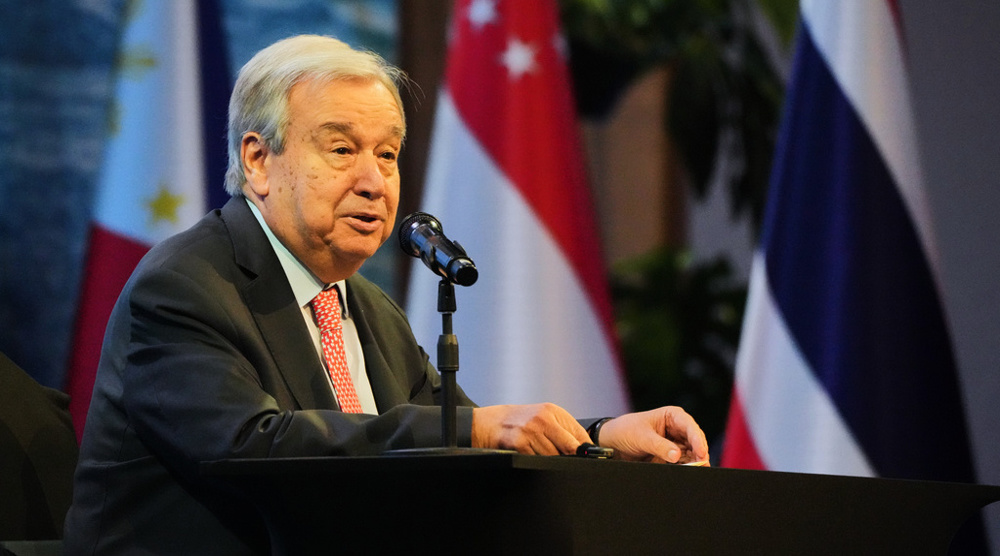
UN Secretary-General Antonio Guterres says the Rohingya are still waiting for a “safe” return to their homeland of Myanmar.
UN Secretary-General Antonio Guterres speaks to members of the media during a news conference at the media center on the sidelines of the 49th Association of Southeast Asian Nations (ASEAN) summit and related meetings in Manila, Philippines, Monday, Nov. 16, 2026. (Photo by AP)
UN Secretary-General Antonio Guterres has called for the “safe” return of Rohingya Muslim refugees to Myanmar.
Nearly a decade ago, around one million Rohingya in Myanmar were forced to flee to neighboring Bangladesh by the country’s military junta.
Currently, hundreds of thousands of Rohingya refugees are sheltering in Cox’s Bazar in southeastern Bangladesh, turning the port city into the largest refugee camp cluster in the world.
Before the Israeli regime launched its genocidal war against Palestinians in the Gaza Strip in 2023, the UN described the Rohingya as victims of genocide and considered them the most persecuted people in the world.
Speaking on Monday at the 16th Association of Southeast Asian Nations (ASEAN)-United Nations Summit, Guterres said the Rohingya in Cox’s Bazar are waiting for their “safe, voluntary, dignified and sustainable return.”
Guterres said the persecuted Rohingya are also seeking accountability for the “grave violations” that led to their forced mass displacement.
The UN chief voiced grave concern over “the continuing crisis in Myanmar,” saying human suffering has reached “epic proportions.”
He urged all parties to protect civilians, uphold international law, and allow “safe, sustained and unhindered” humanitarian access. “Until these conditions are met, states have a duty to protect those fleeing violence and persecution.”
The UN will continue supporting the implementation of ASEAN’s Five-Point Consensus and an “inclusive, Myanmar-led political solution” that addresses the “root causes” of the crisis, ends violence across the country, ensures “the immediate and unconditional release of all those arbitrarily detained,” and guarantees that Myanmar’s people can exercise their rights freely and peacefully, he added.
Guterres warned that the world is currently faced with “strong headwinds, raging conflicts, unchecked climate change, soaring humanitarian needs, a cost-of-living crisis, and rising tariffs and energy costs.”
He cited the impact of the Russia-Ukraine war and the conflict in West Asia, particularly in the Strait of Hormuz, as other crises causing global disruption.
Guterres stressed that world peace needs to be restored, from the Gaza Strip and Yemen to across West Asia, as well as in Ukraine and Sudan.
He told the group gathered at the ASEAN-UN Summit that emerging powers need to adopt the multilateral systems required to meet current challenges.
“Our increasingly multipolar world requires a multilateral system that effectively supports and represents rising economic and political powers like yours.”
Guterres pointed to a stronger global financial system capable of shielding developing countries from repeated economic shocks as a main requirement that needs to be addressed.
He called for reforms to the UN Security Council’s structure as well as changes in international financial institutions.
The UN chief highlighted the importance of ensuring a fair transition to renewable energy across the globe.
Guterres commended ASEAN for its role in promoting global peace, particularly its efforts in the South China Sea and the ceasefire between Cambodia and Thailand.
ASEAN member states are Brunei Darussalam, Cambodia, Indonesia, Laos, Malaysia, Myanmar, the Philippines, Singapore, Thailand, Timor-Leste, and Vietnam.