
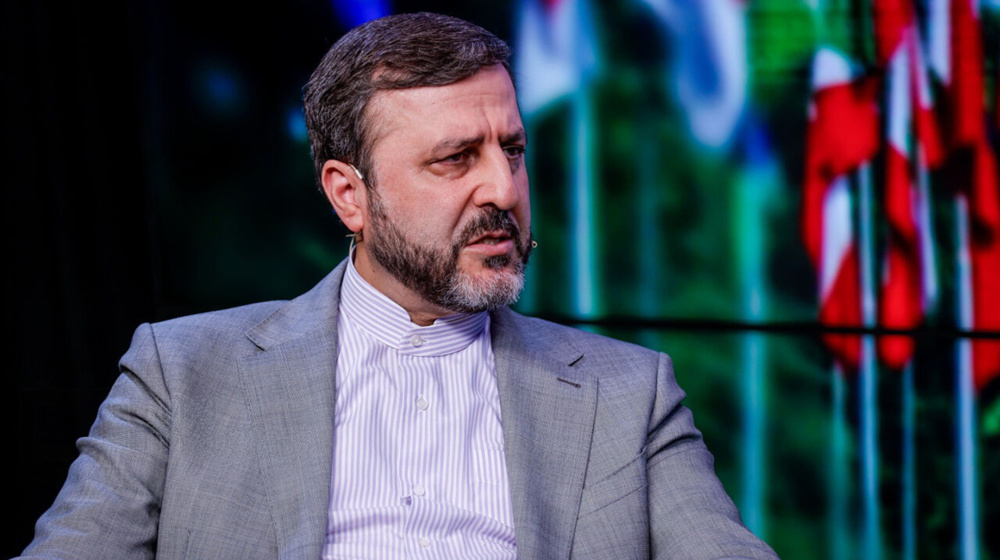
Gharibabadi says Iran cannot trust the United States at the diplomatic table, stressing that any future agreement with Washington must be backed by Tehran’s military strength and concrete guarantees against further violations of commitments.
Iran is fully prepared to pursue diplomacy, withstand economic pressure, or respond to military confrontation, Deputy Foreign Minister Kazem Gharibabadi says, stressing that Tehran is ready for all three scenarios as tensions with the United States continue.
In a special news interview with the IRNA news agency on Sunday, Gharibabadi said the Islamic Republic and all its institutions have prepared for three scenarios, he explained: first, readiness for the diplomatic track; second, readiness to counter the United States’ harsh sanctions policies, including maritime, land, and aerial blockades; and third, readiness to confront any potential military action or resumption of war by Washington.
He said the Islamic Republic had negotiated with Washington from a position of distrust and would maintain the same approach in any future diplomatic process.
He added that any future agreement with Washington must be backed by Tehran’s military strength and concrete guarantees against further violations of commitments.
Gharibabadi said American assurances or political statements acknowledging past mistakes would not provide sufficient guarantees that Washington would honor its commitments.
He said that Iran’s national strength was the ultimate guarantee behind any agreement, adding that Tehran had demonstrated its resolve by responding firmly to US violations of the Islamabad memorandum of understanding.
Gharibabadi said Iran had adopted a combined strategy in response to Washington’s actions, suspending its commitments concerning the Strait of Hormuz while launching extensive defensive and military measures against the aggressors and their supporters.
He stressed that diplomacy and military operations were working alongside each other rather than in opposition, adding that all of Iran’s diplomatic positions and initiatives were fully coordinated with developments on the ground.
“One hundred percent” of Iran’s diplomatic positions and actions were coordinated with its military strategy, he said.
Gharibabadi stressed that resolving the current situation requires preparedness for every scenario.
“When you are in a state of war, you cannot place all your eggs in the basket of diplomacy,” he said.
From a legal standpoint, Iran remains in a state of war. This status has clear implications: if the situation were not classified as such, defensive actions could be mischaracterized as aggression. Within a state of war, however, Iran’s measures are understood as part of legitimate ongoing defense.
He said the Ministry of Foreign Affairs continues active engagement in diplomacy and prepares solutions within the framework of state policy-making, ready for the right conditions.
On the military front, the nation’s formidable armed forces have readied themselves against any aggression. International reports have noted the production of new missiles with varying ranges and an increase in overall inventory, measures Gharibabadi described as natural and necessary as the armed forces strengthen capabilities.
On the economic front, the government has adopted a two-pronged approach against the comprehensive siege. Domestically, despite the undeniable impacts of war and rising prices, the priority has been ensuring the public faces no shortages of essential goods. After a year and a half of war, access to necessary commodities has remained smooth, a complete success compared to any other nation in wartime. Through active diplomacy and cooperation with neighboring countries, efforts continue to neutralize and confront the sanctions.
Gharibabadi rejected the notion that a war can be imposed on Iran without global costs. “It is impossible to impose a war on the Islamic Republic of Iran and assume that the costs and consequences will be borne solely by Iran,” he stated.
A war involving Iran has global repercussions extending beyond the military and security spheres to the world economy, financial markets, and international trade. Virtually every nation has sustained losses. Maritime shipping costs have surged, from insurance premiums and vessel charter rates to the need to reroute lanes, with knock-on effects including issues in chemical fertilizers. Some countries’ efforts to reduce reliance on the Strait of Hormuz and claim independence from the waterway will not fundamentally alter the nature of the problem or the approach to negotiations.
Iran does not wish for other nations to suffer harm from the closure of the Strait of Hormuz. “Our conflict is with the United States; the US is our adversary, yet in our diplomatic engagements with other countries, we always ground our discussions in logic,” Gharibabadi said.
Nations acknowledging economic damage know Iran did not initiate the war. It is illogical for the Strait to remain open to all while the Islamic Republic, the sovereign of the region, cannot export its own goods or import required commodities through the same waterway. Most nations acknowledge the validity of this reasoning and direct their criticism at the United States rather than Iran.
Regarding land borders, distinct from the US-imposed maritime blockade and the closed Strait of Hormuz, Iran’s land borders with neighbors remain open. Borders with Iraq, Turkey, and Pakistan are operational, as are those in the north with Turkmenistan, Armenia, and the Republic of Azerbaijan. Occasional technical issues at one or two points lead to brief closures of a few days before conditions normalize. High-level engagement continues with all these nations.
Air travel is similarly functional: flights to Iraq and Turkey continue, with operations to Najaf ongoing (though no direct flights to Baghdad currently), and connections maintained with a Caspian littoral state. American objectives in the aviation sector have failed due to regional engagement.
Moscow firmly opposes foreign presence in Caspian Sea
On the Caspian Sea, Iran and Russia share a common policy under the Convention on the Legal Status of the Caspian Sea. Although not yet fully in force (Iran has signed but not ratified it), a key provision bars foreign powers from gaining a foothold. Ratifying states must refrain from actions contrary to its spirit.
Gharibabadi said he has raised this with the Russian Ambassador; Moscow firmly opposes foreign presence, including any US efforts to leverage littoral states for economic pressure on Iran, a potential pretext for expanding influence.
Warnings have been conveyed to Caspian states, including via messages from the Foreign Minister. “The Caspian Sea is not a domain for foreign powers; rather, it is a sphere of security, defense, military, economic, commercial, and environmental interest for the littoral states themselves,” he affirmed. Tehran hopes the US will not succeed in using these countries for sanctions policies against Iran.
Qatar remains an active mediator between Iran and the United States, with Pakistan also engaged. Contacts between Iran and Qatar continue to pave the way for understanding. The Qataris are actively pursuing the necessary groundwork and maintain contact with both sides.
Gharibabad rejects decades-old US and Israeli nuclear claims
Addressing the nuclear file, Gharibabadi detailed US-orchestrated attacks on nuclear facilities during a 12-day war (targeting enrichment-related equipment) and a subsequent 40-day war (including facilities unrelated to enrichment). These constitute flagrant violations of international law, the UN Charter, the IAEA Statute, and relevant resolutions of the IAEA General Conference, Board of Governors, and UN Security Council affirming the inviolability of safeguarded nuclear facilities.
Prior to the attacks, Iran’s program demonstrated complete transparency: all obligated facilities were declared, and every targeted site was under Agency supervision with regular inspector presence. Approximately 70 percent of the IAEA’s global inspections were conducted in the Islamic Republic, with two-thirds of inspectors focused exclusively on Iran. During his tenure as Permanent Representative in Vienna, Gharibabadi remarked that the organization might as well be renamed the “Atomic Energy Agency for the Islamic Republic of Iran,” as loss of access to Iran would eliminate 70 percent of its operational activities.
He rejected decades-old claims by Washington and the Zionist regime of a military nuclear program. “For over three to four decades, they have alleged that Iran is pursuing nuclear weapons. Yet the very rationale behind nuclear weapons is to establish deterrence; it is logically inconsistent to possess such weapons, come under attack, and — while keeping the weapons secret — refrain from conducting any tests.”
The claim has never been substantiated. It was propagated by the Zionist regime, which is party to no treaties on biological, chemical, or nuclear weapons of mass destruction yet possesses a nuclear arsenal, and by the United States, which has a historical record of using such weapons against the people of Japan.
While Iran has responded on other fronts by targeting their interests and bases, a critical question remains regarding the IAEA’s role as an impartial body. Even setting aside the politically motivated nature of discussions in the 35-member Board of Governors, the Director General could have, at the very least, condemned these attacks, a step he failed to take.
Iran-Oman talks on new Hormuz arrangements
Gharibabadi also provided details of negotiations between Iran and Oman over new arrangements for commercial shipping through the strategic Strait of Hormuz, saying the two sides had made substantial progress and were close to finalizing an understanding.
He said the discussions had been underway for more than three weeks and covered not only shipping routes but also the future management of the waterway.
The talks were complicated by the resumption of military hostilities and what Tehran describes as a renewed US military aggression against Iran, as well as Washington’s violation of its commitments under the Islamabad memorandum.
Gharibabadi said the existing shipping arrangements, under which commercial vessels had used routes through Oman’s territorial waters for around six decades, no longer adequately addressed Iran’s national security concerns.
At Iran’s request, Oman had agreed to consider fundamental changes to the entry and exit routes through the strait.
The proposed arrangements also include the sovereignty of the two coastal states, maritime security, the establishment of a joint Iran-Oman coordination centre to manage shipping traffic and the collection of information about vessels seeking to transit the waterway.
Gharibabadi emphasized that the emerging understanding would not, by itself, mean the reopening of the Strait of Hormuz.
He said the proposed agreement was a new model based on present security conditions and Iran’s national interests, rather than a continuation of the arrangements that had governed maritime traffic for the previous six decades.
Under the proposed framework, the temporary northern route near Iran’s Larak Island and the southern route through Omani waters would be closed and replaced with a new corridor.
A significant portion of the new route would pass through Iran’s territorial waters, with other sections running through Omani waters.
Gharibabadi said the arrangement would allow Iran to exercise effective sovereignty over the strategic waterway while ensuring that commercial shipping could operate normally when regional security conditions permitted.
He stressed that Iran was not seeking to keep the strait closed permanently, but would take whatever measures were necessary to protect its national security in wartime or whenever it faced threats.
US must fulfill commitments before Hormuz can reopen
The Iranian official said the implementation of the new arrangements with Oman would depend on a separate set of requirements, most of which concerned Washington’s conduct.
He listed the US naval blockade, the resumption of military hostilities, the unresolved situation in Lebanon, the imposition of new sanctions, the reinstatement of sanctions that had previously been temporarily lifted and the suspension of negotiations over the release of Iran’s frozen assets among the outstanding issues.
Gharibabadi said the United States had violated its commitments under the Islamabad memorandum, while Iran had not breached its obligations.
He explained that the proposed arrangements with Oman were a bilateral process between the two coastal states and that Tehran did not recognize any right for outside powers to interfere in the management of the strait.
He said US intervention in the shipping routes, particularly the opening of a southern passage under American pressure on Oman, had violated the memorandum and contributed to the renewed military confrontation.
According to Gharibabadi, Iran had warned that it would not accept foreign interference in the waterway and that such actions would lead to renewed regional war.
He said the new shipping corridor would initially be temporary and could remain in place for two to four months or potentially longer, depending on developments.
The Iranian official also clarified that any decision to move to a second phase, including the possible reopening of the strait and arrangements concerning transit costs, would require a separate decision by Iran’s senior authorities.
He said Iran would not accept a situation in which it unilaterally reopened the waterway while the surrounding security conditions remained unchanged and Washington continued to violate its commitments.
Tehran receives US messages but denies negotiations
Gharibabadi rejected US President Donald Trump’s claims that negotiations between Tehran and Washington were underway, saying no talks with the United States had taken place in recent days.
He said the ongoing discussions over the Strait of Hormuz had been exclusively between Iran and Oman.
However, he confirmed that Tehran had received messages from Washington indicating that the United States was prepared to return to its commitments.
The Iranian official said the messages were being carefully examined and that no decision had yet been made on whether to enter a second phase of the process.
He said Tehran needed to assess whether Washington genuinely recognized that its previous approach had been wrong, whether it was seriously prepared to honor its commitments and whether it would refrain from violating them again.
Gharibabadi warned that Iran did not want to return to a situation in which an understanding was observed for two or three weeks before being followed by another breach of commitments and renewed military confrontation.
He said it was Washington’s responsibility to demonstrate its willingness to fulfill its obligations, while Iran retained the right to assess the credibility of any such assurances before making a decision.
Pakistan invitations remain under consideration
Gharibabadi also confirmed that invitations had been extended to Iran’s foreign minister and parliament speaker to visit Pakistan.
He said Tehran maintained exchanges with Islamabad at various levels, particularly following Pakistan’s role as a mediator in diplomatic contacts.
However, he said no final arrangements had been made for the proposed visits.