
Iran’s FM says trade, transportation, and energy should serve as the three strategic pillars of ECO cooperation.
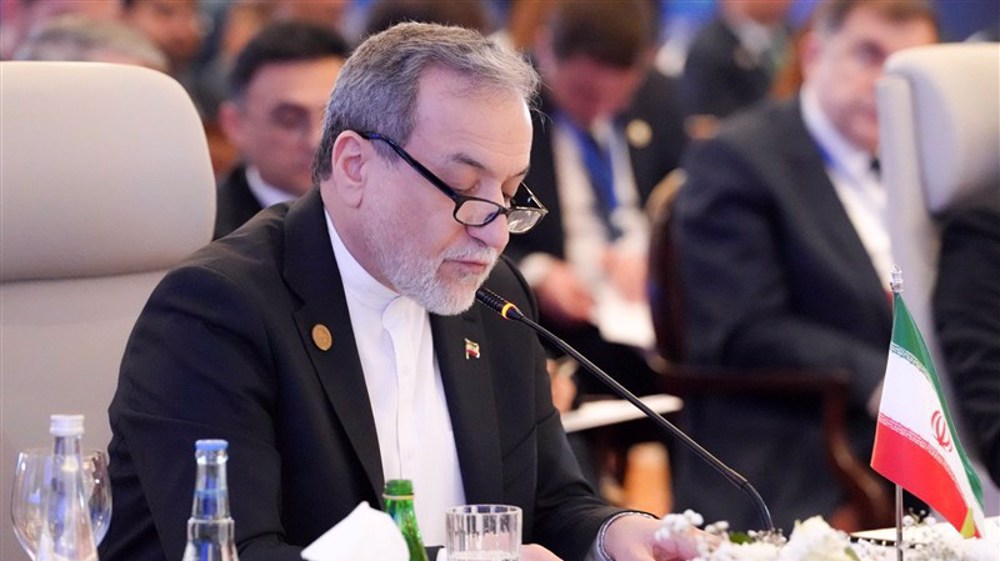
Iran’s Foreign Minister Abbas Araghchi speaks during the 30th Meeting of the Council of Ministers of the Economic Cooperation Organization (ECO) on November 16, 2026.
Iran’s Foreign Minister Abbas Araghchi says the region requires an independent security framework and a sustainable energy mechanism to protect supply chains and build collective resilience against geopolitical shocks.
Addressing the 30th Meeting of the Council of Ministers of the Economic Cooperation Organization (ECO) in Tehran on Monday, Araghchi said the growing impact of US and Israeli aggression on the energy sector has made stronger cooperation an urgent strategic necessity.
“Our region needs not only an independent security framework but also a reliable and sustainable regional energy mechanism to safeguard energy flows, ensure stable supplies, reduce external vulnerabilities and enhance collective resilience against geopolitical shocks and disruptions,” he noted.
Araghchi stressed that trade, transportation, and energy should serve as the three strategic pillars of ECO cooperation under current global and regional conditions.
“Strengthening connectivity, facilitating intra-regional trade and enhancing energy cooperation will reinforce our collective resilience, mitigate external vulnerabilities and foster a more integrated and self-reliant region,” he said.
He also announced Iran’s support for establishing a technical committee to revise the ECO Trade Agreement (ECOTA), emphasizing that a modern, inclusive, and more effective trade agreement could expand regional commerce, strengthen economic resilience, and serve the interests of people across the region.
Turning to regional security, the Iranian foreign minister reaffirmed Tehran’s commitment to international law, the UN Charter, and the peaceful settlement of disputes through diplomacy.
He said Iran has maintained its commitment to diplomatic engagement over the past two years, while condemning the United States for pursuing a different course through aggression, threats, targeted assassinations, economic pressure, and blockades, in violation of international law and the UN Charter.
Araghchi said insecurity in the Persian Gulf and developments surrounding the Strait of Hormuz stemmed from joint hostile policies and acts of aggression by the United States and the Israeli regime against Iran.
He stressed that Iran has consistently sought friendly and constructive relations with neighboring countries and has no inherent disputes with regional states.
“However, one principle speaks loud enough: the territories, airspace and facilities of the regional countries must not be used as platforms for launching attacks against each other,” he noted.
Araghchi also clarified that Iran’s legitimate defensive measures were directed exclusively at the military targets and bases of aggressors and should not be interpreted as actions against the people or governments of neighboring countries.
He called for an urgent, genuine, and inclusive regional dialogue, led and owned by countries in the region, to establish security arrangements based on non-aggression and the prevention of any third country from using another state’s territory or facilities to launch attacks against its neighbors.
The foreign minister further said that continued sanctions aimed at intensifying economic pressure on Iran and depriving its people of their fundamental rights have failed to weaken the Iranian nation’s resolve. Instead, he said, such measures have “strengthened their resolve to defend their legitimate rights and interests and resist excessive and unlawful demands.”
On Palestine, Araghchi described the situation in the occupied territories as one of the gravest moral and humanitarian crises of the present era, criticizing the international community’s failure to take meaningful action.
He stressed the need for practical measures and collective responsibility to end international silence and indifference toward the crisis.
Araghchi reaffirmed Iran’s commitment to strengthening cooperation within the ECO framework and said Tehran looks forward to hosting the organization’s 18th heads of state summit on December 4 in the Iranian capital.


