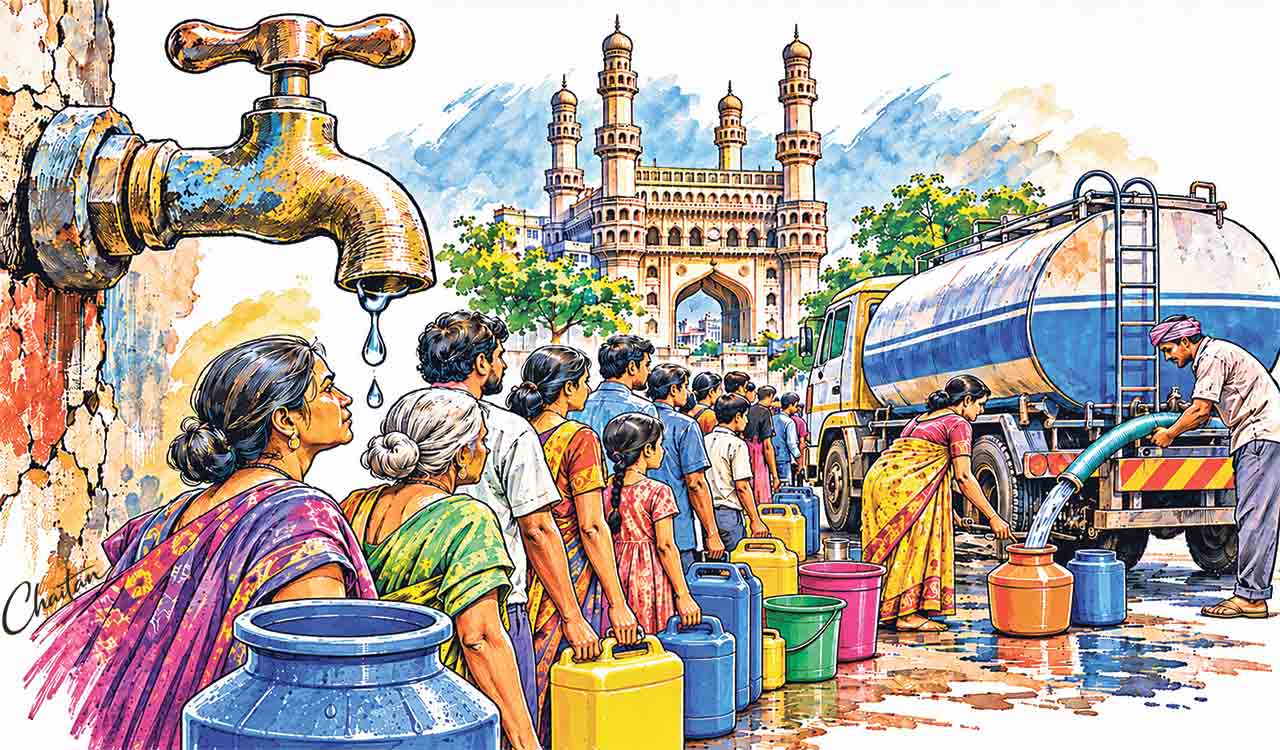
With nearly 35 per cent of supplied water lost through inefficiencies, Hyderabad needs a more efficient distribution network to strengthen its water security
Published Date – 15 November 2026, 11:49 PM
By Devana Varshith
Over the past month or so, there have been reports of an impending water crisis in Hyderabad. The reservoirs supplying the city are only about 25 per cent full, compared with 65 per cent in October last year. In September this year, water tanker bookings in the city reached around 1.48 lakh, compared with 47,000 in September last year. The reason appears evident: El Niño.
Telangana recorded a 17% rainfall deficit. Consequently, water storage in the Krishna basin was 72% lower, while that in the Godavari basin was 40 per cent lower compared with the same period last year. But does Hyderabad face water stress only during years of poor rainfall? Areas such as Kukatpally, Miyapur, Manikonda, Gachibowli and Madhapur face water shortages almost every year. Clearly, El Niño alone cannot explain this persistent problem.
Significant Advantage
In reality, Hyderabad has a significant advantage in terms of water availability. Two major rivers of South India, the Krishna and the Godavari, flow relatively close to the city. Currently, the Hyderabad Metropolitan Water Supply and Sewerage Board (HMWSSB) supplies more than 2,600 million litres per day (MLD), equivalent to around 200 litres per capita per day (LPCD). This exceeds the Union government’s urban water supply benchmark of 135 LPCD. It exceeds the supply levels of several major global cities, including London (140 LPCD), Amsterdam (135 LPCD) and Tokyo (170 LPCD), and is comparable to those of Paris (215 LPCD) and Dallas (204 LPCD).
Why, then, does Hyderabad continue to face shortages? The answer lies in inefficiencies in the distribution system. Around 35 per cent of the water supplied is lost through leakages, theft and other losses, collectively termed non-revenue water (NRW). The major causes of NRW include ageing pipelines, inadequate metering and delayed repairs. These losses can be significantly reduced, as demonstrated by several other cities.
Reducing non-revenue water from 35% to 15% could save Hyderabad approximately 520 MLD of water every day, enough to meet the daily requirements of nearly 39 lakh people
Puri in Odisha brought down its NRW from 47 per cent to 15 per cent by addressing such inefficiencies. Dhaka reduced its NRW from 40 per cent to 5 per cent, while Manila brought it down from 63 per cent to 13 per cent. Jamshedpur also achieved a significant reduction, from 36 per cent to 10 per cent. These examples show that substantial reductions in water losses are possible through effective management, even in middle-income countries.
Right Interventions
All these cities adopted similar interventions to reduce water losses. The case study of Puri offers useful lessons on how these measures can be implemented. The Government of Odisha launched the Sujal “Drink from Tap” Mission in 2019 to provide 24×7 water supply. The first step was to conduct a detailed water audit to measure how much water entered the distribution network, how much was lost and where the losses occurred.
Officials mapped the entire distribution network to identify old and defective pipes. Sensors were installed at regular intervals to remotely monitor water pressure and flow. Variations in flow between sensors can help identify sections with possible leakages, including underground leaks that might otherwise go unnoticed for months.
These were promptly addressed through repairs or pipeline replacements.
Second, leakages and theft at the consumer level were reduced through near-universal metering. An important step taken by Odisha was to standardise the process of installing new water connections. Earlier, after obtaining approval for a connection, consumers would hire local contractors or plumbers to tap into the main network.
This often resulted in poor-quality work and damage to distribution pipelines, creating leakage points. Constant water pressure can gradually enlarge these leaks, leading to further water losses. This system was changed so that connections were installed under government supervision, using qualified contractors and standard materials. This prevented damage to pipelines and minimised leakages.
Third, a dedicated NRW cell was established to continuously monitor losses and ensure that they were promptly addressed. All these measures reduced NRW in Puri from around 47 per cent in 2019 to 15 per cent by 2022. Planning, design and tendering took about two years, while implementation took another year. The project cost was approximately Rs 8,960 per capita. For a population of around 2.5 lakh, this translates to a total cost of roughly Rs 220 crore.
Colossal Loss
Turning to Hyderabad, at a daily supply of 2,600 MLD, an NRW level of 35 per cent means that around 910 MLD of water is lost every day. If Hyderabad manages to reduce NRW to 15 per cent, as Puri has achieved, daily losses would fall to around 390 MLD, saving approximately 520 MLD of water. Considering the benchmark of 135 LPCD, this recovered water could meet the daily requirements of roughly 39 lakh people, or about one-third of the city’s population. In other words, simply improving the efficiency of the existing distribution network could make a substantial quantity of water available.
Clearly, Hyderabad’s water crisis is not a problem of water availability but of water management and inadequate investment in its distribution network. Based on the per-capita expenditure incurred in Puri, the total investment required for Hyderabad is estimated at around Rs 12,000 crore, spread over two years. The State’s budget for FY 2026–27 exceeds Rs 3.2 lakh crore. An annual outlay of Rs 6,000 crore would therefore account for less than 2 per cent of the State budget. This is a modest sum to invest in improving an essential service in the State’s economic capital.
While other measures, such as lake restoration, rainwater harvesting and expanding sewerage infrastructure, are also important, the most immediate opportunity lies in improving the efficiency of the water distribution system. This is both technically feasible and economically viable. What remains is the political will and administrative efficiency to make it happen. Unless this structural problem is addressed, Hyderabad will continue to face water shortages, El Niño or not.
(The author is a Research and Advocacy Lead at a public policy think tank in Hyderabad. He holds a Postgraduate Diploma in Cities and Governance from the Tata Institute of Social Sciences)