
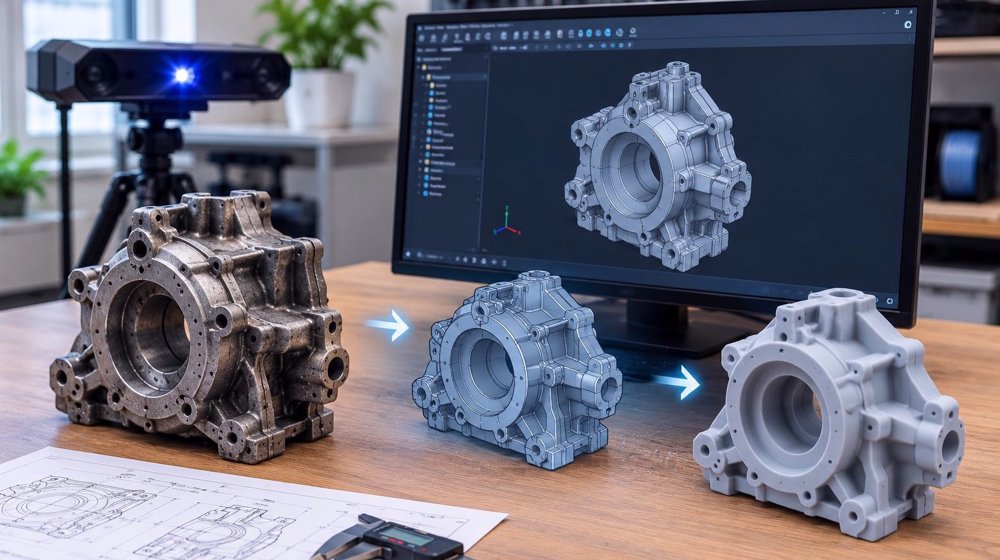
In Qazvin, an advanced manufacturing ecosystem combining reverse engineering, metal 3D printing, artificial intelligence, and university research is opening new frontiers for Iran’s domestic production of sophisticated industrial components and equipment.
In Qazvin, an industrial province northwest of Tehran, a new manufacturing initiative is bringing together three-dimensional scanning, reverse engineering, and advanced printing technologies to reproduce industrial components and develop sophisticated prototypes.
Developed through the provincial Science and Technology Park, the initiative aims to give domestic manufacturers access to engineering and production capabilities for components increasingly difficult to obtain from international suppliers.
Development began approximately two years before May 2026, when the park started establishing facilities intended to support mechanical, chemical, and eventually electronic product prototyping.
An important milestone came with the establishment of a mechanical prototyping center equipped with fifteen three-dimensional printers, developed through private-sector investment and subsequently incorporated into wider expansion plans.
The park has also been developing a larger prototyping complex, bringing mechanical, chemical, and electronic development under specialized manufacturing infrastructure designed to serve industrial companies.
At the center of the initiative is reverse engineering, through which existing components can be scanned, digitally reconstructed, and reproduced using appropriate manufacturing technologies, creating opportunities to manufacture specialized parts domestically.
The facility’s three-dimensional scanner captures the geometry of existing products, producing digital models that can subsequently support manufacturing, product redesign, and further engineering development.
Metal additive manufacturing, alongside Fused Deposition Modeling (FDM) and resin printing, provides different production methods depending on component materials, structural complexity, and the technical requirements of individual industrial applications.
FDM uses melted plastic filament deposited layer by layer to produce prototypes and plastic components, while resin printing hardens liquid photosensitive material using light to manufacture highly detailed objects.
For manufacturers struggling to obtain specialized replacement parts, these capabilities offer opportunities to reproduce components locally, potentially reducing procurement costs and dependence on external suppliers for selected industrial requirements.
According to park president Majid Galoei, Qazvin’s wider technological ecosystem includes 167 technology companies, 177 knowledge-based units, and more than 1,109 specialist employees, providing an established foundation.
These enterprises have reportedly developed more than 152 products, creating an existing network of technological companies and engineering expertise around which the new manufacturing infrastructure can develop.
Qazvin’s initiative builds upon capabilities Iranian engineering companies have developed over several years, particularly in metal additive manufacturing, specialized machinery, and sophisticated industrial equipment production.
An important achievement came from Isfahan-based Noura Laye Negar, which introduced Iran’s first industrial selective laser melting metal printer in December 2015, establishing an important domestic manufacturing capability.
The technology uses powerful lasers to melt successive layers of metallic powder, enabling engineers to manufacture intricate components for demanding industrial applications, including geometries difficult to achieve through conventional machining.
The company subsequently developed commercial metal printing equipment and manufacturing services, extending domestic capabilities beyond laboratory research into industrial production.
Other manufacturers have developed directed energy deposition systems for producing and repairing specialized components.
These developments draw upon Iran’s extensive university ecosystem, whose expertise spans metallurgy, materials science, mechanical engineering, computer modeling, and advanced production technologies.
Universities including Tehran, Sharif, and Amirkabir have developed research capabilities across these disciplines, providing scientific foundations for engineering projects involving sophisticated materials and demanding manufacturing processes.
Qazvin’s initiative introduces another dimension by seeking to connect industrial requirements with these distributed scientific resources through artificial intelligence, potentially changing how manufacturers identify and access technological expertise.
Hossein Saveh, the park’s deputy for technology, announced that an AI-powered platform is being prepared for the park’s website, with plans for launching it during Research Week.
Under the proposed system, industrial companies will register requirements for specialized machinery, components, or technologies they cannot independently design or manufacture within their existing production facilities.
The AI platform will process these requirements and help identify domestic companies, university researchers, and engineering specialists potentially capable of developing appropriate technological solutions.
The park intends to organize calls for proposals, bringing industrial customers and technology providers together around specific manufacturing requirements, connecting university research more directly with commercially relevant engineering projects.
This arrangement will mobilize scientific expertise distributed across Iranian universities and technology companies, giving manufacturers access to researchers and specialists capable of translating advanced knowledge into industrial applications.
The initiative also incorporates the revival of Fanbazar, an established technology marketplace intended to identify industrial requirements and facilitate commercial relationships between technological suppliers and manufacturing customers.
Iran’s National Technology Market Network reportedly operates 37 regional and specialized offices, facilitating approximately 3,155 billion tomans in technology transactions during the Iranian year 1403.
The industrial applications become clearer alongside Iran’s achievements in sophisticated machinery manufacturing, power generation, aerospace engineering, and petrochemical processing, where precision components and specialized equipment are essential.
In August 2025, MAPNA unveiled its domestically developed MGT-75 F-class gas turbine, a 222-megawatt machine incorporating advanced compressor technology, specialized turbine blades, and sophisticated cooling systems.
Manufacturing such equipment requires considerable expertise in metallurgy, precision engineering, thermal coatings, and materials science, demonstrating the sophistication of Iran’s existing industrial engineering capabilities.
In August 2026, Iranian specialists also commissioned a domestically manufactured 3.5-megawatt turboexpander equipped with magnetic bearings at the South Pars Gas Complex.
Developed through collaboration between refinery specialists and a domestic knowledge-based company, the equipment operates under demanding gas-processing conditions requiring sophisticated high-speed rotating machinery.
Aerospace manufacturing offers another important application, particularly in specialized engine components, where advanced alloys, dimensional accuracy, and demanding testing requirements determine manufacturing quality.
Iranian authorities have reported domestic production of selected components for Boeing and Airbus aircraft engines, although this does not amount to manufacturing complete internationally certified aircraft engines.
Medical manufacturing presents further opportunities through titanium and cobalt-chromium implants, where additive manufacturing enables patient-specific geometries and specialized structures for demanding surgical applications.
These developments are taking place as Washington intensifies restrictions affecting Iran’s access to sophisticated technologies, specialized equipment, and international industrial supply chains.
On November 7, Washington announced Task Force Iron Gate, intended to restrict movements of advanced technologies through Iranian land borders and the Caspian Sea, extending enforcement beyond maritime restrictions.
For Iranian manufacturers, reverse engineering consequently offers an important means of addressing selected equipment and component requirements when original manufacturers or international suppliers become increasingly difficult to access.
Its economic value extends beyond reproducing existing components, encompassing the engineering knowledge, digital models, and manufacturing expertise necessary to develop and adapt specialized industrial products domestically.
Qazvin’s emerging facilities bring these capabilities into a common institutional setting, connecting industrial requirements with scientific research, artificial intelligence, and advanced manufacturing.