
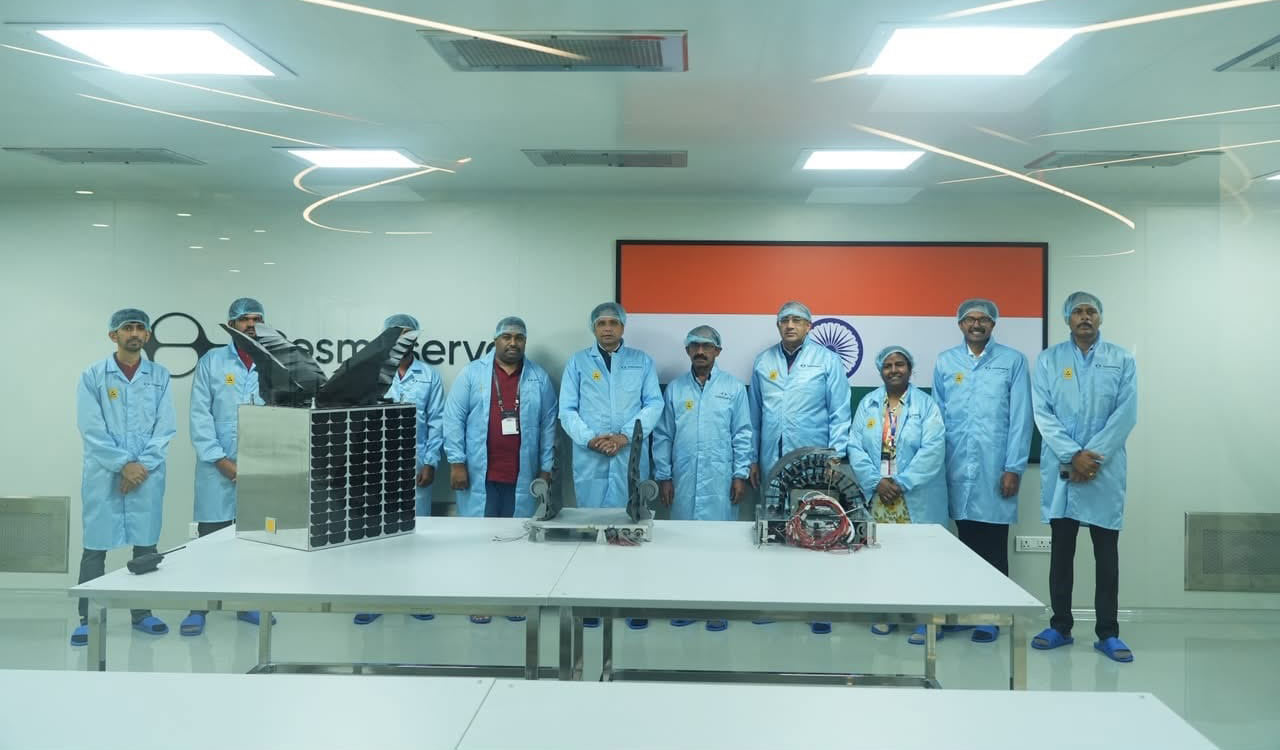
Cosmoserve Space has unveiled Base 1 in Hyderabad, India’s first private space servicing facility, to support satellite repairs, refuelling and debris removal. Its dual-spacecraft architecture aims to service up to 100 satellites while reducing costs through indigenous manufacturing.
Published Date – 5 November 2026, 06:43 PM
Hyderabad: Cosmoserve Space unveiled Base 1, India’s first private and the world’s sixth facility equipped with space vision effect and microgravity simulation. The facility brings full-stack space servicing capabilities under one roof. Base 1 brings together the infrastructure needed to design, build, test and operate various functionalities required for satellite servicing and space debris recovery.
Beyond removing space debris, it will also support satellite servicing, including in-orbit repairs and refuelling. Cosmoserve currently sources close to 60 percent of its mission components locally. The company aims to develop more critical technologies in-house through Base 1 and strengthen domestic manufacturing capabilities. This will help reduce dependence on imported components such as optics, avionics and space-grade electronics.
After inaugurating the facility on Thursday, Industries Minister D Sridhar Babu said, “Facilities like Cosmoserve’s Base 1 show exactly why Hyderabad is leading the country in space innovation. We are now home to over 30 spacetech companies, including India’s first spacetech unicorn and few more soonicorns,”
Chiranjeevi Phanindra, Founder & CEO of Cosmoserve Space, said “Today we opened a facility where we can design, build, test and fly our missions under one roof. Debris is becoming the limiting factor for every nation’s space ambitions, including India’s. Base 1 is where we build the capability to keep orbits usable for Gaganyaan, the Bharatiya Antariksh Station and every satellite that follows.” In July 2026, Cosmoserve flew its first payload, Mission Embrace, aboard Skyroot Aerospace’s Vikram-1 rocket.
Space debris challenges
Space debris is one of the biggest challenges facing the global space industry. Of the approximately 28,000 satellites in orbit, nearly 10,000 are dead or non-operational. Beyond these inactive satellites, Earth’s orbit is crowded with an estimated 68,000 debris objects smaller than 10 cm, 1.5 million fragments measuring 1 cm to 2 cm, and nearly 230 million tiny pieces ranging from 1 mm to 1 cm.
Even fragments just a few millimetres wide can pose serious risks to operational satellites, spacecraft and missions such as the International Space Station (ISS), given the high speeds at which they travel. Around 660 collisions and explosions have been recorded in space, generating nearly 58,000 tracked debris fragments.
As orbital congestion increases, so does the demand for space debris removal and satellite servicing. With an estimated 1.3 million new satellites expected to be launched over the next decade, active debris removal and in-orbit servicing are becoming increasingly critical to ensuring the long-term sustainability of the global space economy.
To address this, Cosmoserve has developed a proprietary Dual Spacecraft Architecture, moving beyond the conventional one-to-one recovery model, where a dedicated spacecraft services a single satellite, to a more cost-efficient two-to-many approach. Under this model, a larger Orbital Service Station acts as an in-space logistics hub carrying fuel, equipment and spare parts, while a smaller Autonomous Service Vehicle travels to multiple satellites to capture, dock with, diagnose, repair or remove them from orbit.
The architecture is designed to enable just two spacecraft to service up to 100 satellites, potentially bringing servicing costs down from around 10 million USD to below 1 million USD per satellite.
By developing these capabilities in Hyderabad, Cosmoserve aims to make orbital servicing more affordable through local manufacturing and engineering. Cosmoserve’s upcoming milestones include testing its robotic capture systems in microgravity flights, re-flying Mission Embrace and conducting a full-scale space debris capture demonstration in 2027.