
While data-driven governance has improved rural development tracking, it fails to capture lived realities
Published Date – 13 April 2026, 11:04 PM
By Dr Sonal Mobar Roy
Contemporary rural development in India is increasingly articulated through the grammar of quantification and scale. How many person-days were generated under the Mahatma Gandhi NREGS, how many households were reached, how many assets were created, and how many villages were covered — are all answered in digits.
The numbers fly by, darting through dashboards, review sessions, and policy discussions, offering a reassuring sense of progress and expansion. These metrics enable evaluation of scale, tracking of results, and comparison across regions. In an administrative structure that spans large geographical areas and diverse populations, this type of measurement is not just useful; it is essential.
Over the past decade, the strengthening of data systems has significantly improved governance, especially at the grassroots. The contemporary embrace of data-centric governance has reconfigured the scale and visibility of development practice.
Real-time monitoring, digital platforms, geotagging, and integrated reporting systems have enhanced transparency, enabled timely decision-making, and supported large-scale implementation. Programmes today are more visible, more trackable, and more accountable than ever before. And yet, field realities gently but persistently remind us that development exceeds what numbers can capture.
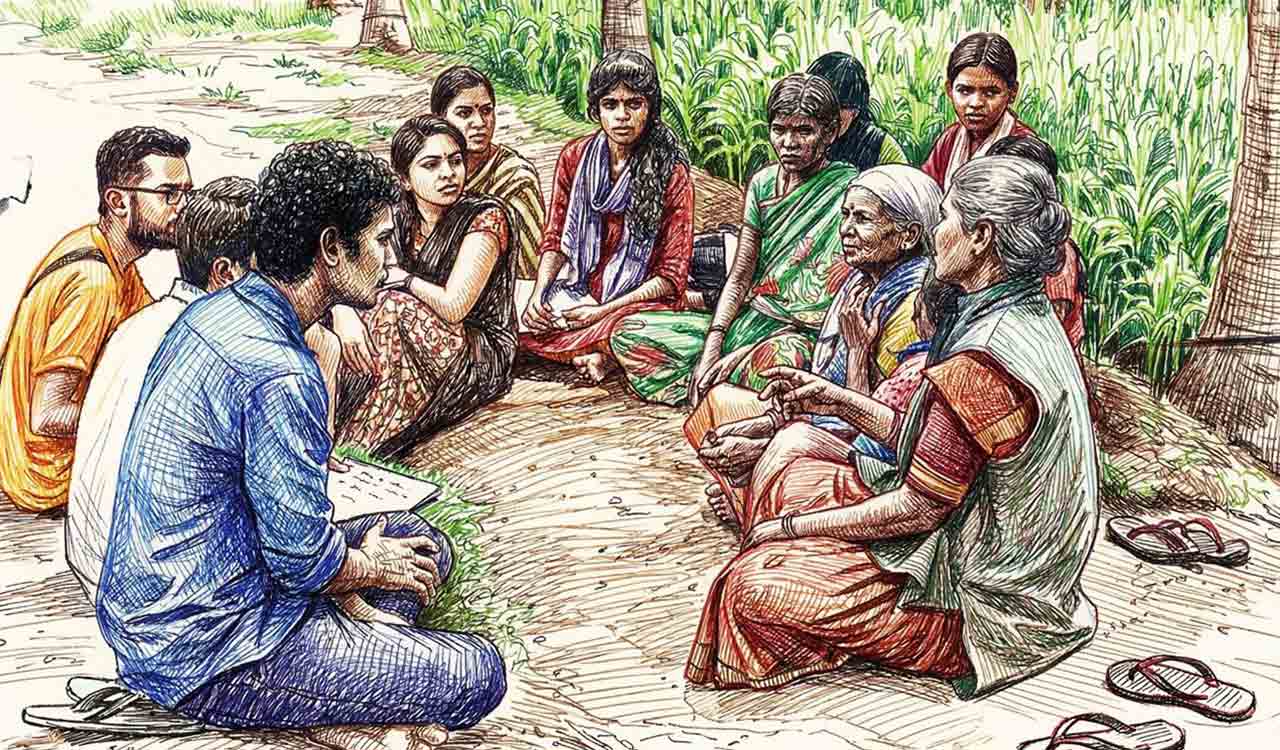
The dynamics of this process are evident in workplace conversations, the silences and uncertainties of Gram Sabha meetings, the subtle but significant adjustments made by frontline workers to overcome obstacles, and the everyday interactions through which people access their rights. These aspects, often overlooked by traditional evaluation methods, significantly shape how programmes are experienced and how long their effects last. While numerical data can show progress, they often fail to capture the complete essence of lived experience.
Social Life of Programmes
It is here that qualitative approaches become particularly valuable. While quantitative data helps us understand what is happening, it is less able to explain how and why these processes unfold in specific contexts. Methods such as interviews, field observations, case studies, and ethnographic engagement bring into view the underlying processes that shape observable outcomes.
Take rural employment programmes, for instance. Administrative data can reliably capture participation levels, expenditure, and asset creation. However, it tells us much less about why participation varies across regions, how local social dynamics influence access to work, or how workers themselves experience the programme’s reliability and usefulness. These are not secondary concerns; they are central to understanding how the programme actually functions in practice.
Likewise, in the domains of natural resource management and water conservation, quantitative measures can be utilised to assess the extent of constructed infrastructure or the expanse of land under treatment. Nevertheless, the sustained success and efficacy of these interventions often depend on factors such as community stewardship, indigenous ecological knowledge, and collaborative maintenance practices. These aspects are within social frameworks that are optimally explored through qualitative research.
Quantitative systems help us see how far programmes have travelled while qualitative approaches help us understand what that journey has meant on the ground
What qualitative methods offer, therefore, is not an alternative to data but a necessary complement to it. They allow us to enter what may be called the ‘social life of programmes’, and to examine how policies are interpreted, adapted, negotiated, and embedded within everyday realities. These findings highlight that implementation is not just a technical task; instead, it is a relational process shaped by trust, communication, and the specific context.
Importantly, qualitative insights also provide a constructive lens for strengthening programmes. By illuminating on-ground dynamics, they help identify opportunities for refinement, adaptation, and responsiveness, contributing to more context-sensitive governance.
Grounded Practice
This scenario prompts a critical examination of how evidence is interpreted within the realm of development initiatives. When quantitative measures are prioritised, there is a tendency to assume a complete understanding of their significance. However, in a country like India, marked by complex social structures and diverse contextual factors, understanding rarely stems solely from numerical data.
Development is nurtured through active participation, meticulous examination, considered interpretation, and candid dialogue. It is crucial to acknowledge that not all important aspects are readily quantifiable, and conversely, not everything that is easily measurable is necessarily significant. This is where qualitative methods are particularly useful.
These perspectives highlight the interconnectedness of various elements: the state and its people, the relationship between institutions and social groups, and the ways local conditions shape policies. They emphasise that development goes beyond just providing services. It includes how these services are perceived, understood, and integrated into daily life.
Fortunately, a growing acceptance of integrating different ways of knowing is seen in both academic and policy areas. The increasing use of qualitative methods shows that, while scalability and efficiency are important, they must be combined with a thorough understanding of the subject.
The next phase necessitates a more deliberate application of this equilibrium. Practitioners can operationalise this by allocating resources to document field observations, integrating narrative perspectives into programme evaluations, and prioritising expertise from frontline personnel and communities. Researchers must engage consistently with real-world contexts and convert these insights into formats suitable for policy formulation.
At its best, rural development must remain both wide in its reach and grounded in its understanding. Quantitative systems help us see how far programmes have travelled. Qualitative approaches help us understand what that journey has meant on the ground. Together, they offer a more complete and human-centred view of development.
This perspective captures not only outcomes but also methodologies used and participants’ subjective experiences. In essence, although quantitative data can demonstrate the occurrence of development, the comprehensive significance of this process is fully grasped through an examination of the individual experiences of those directly involved.
(The author works at the National Institute of Rural Development and Panchayati Raj [NIRDPR], Hyderabad. Views are personal)