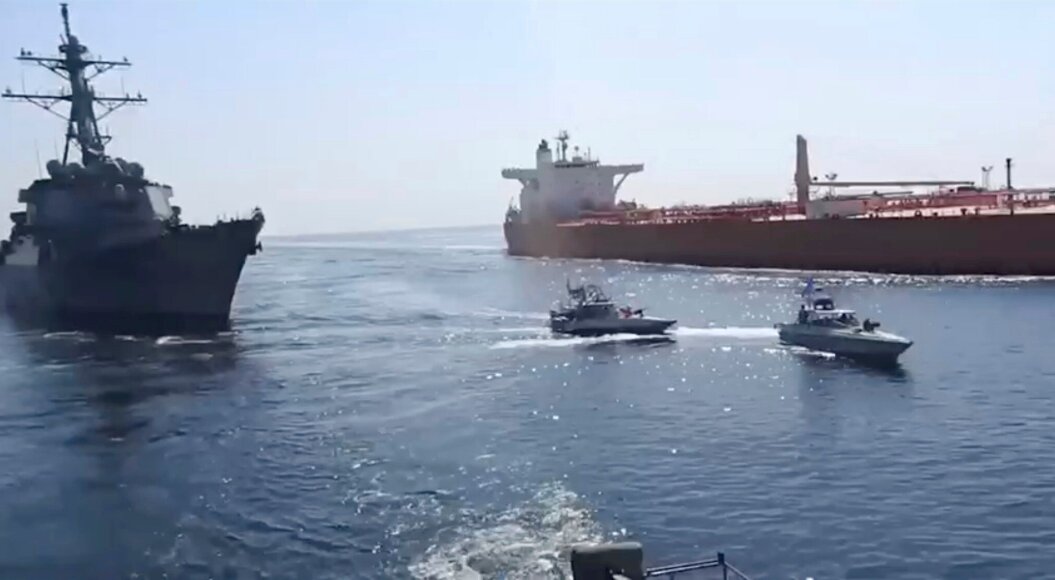
Donald Trump’s sudden decision to announce the blockade of the Strait of Hormuz is in fact the continuation of a costly and failed path that began on the battlefield, reached a dead end at the negotiating table, and has now reached a stage somewhere between war and peace. A stage that is neither a ceasefire nor an all-out war, but rather a kind of “controlled pressure” with uncontrolled risks.
The story began when America’s efforts to change the equation against Iran failed one after another. In the first step, direct military pressure and limited clashes could not achieve Washington’s declared goals. In the second step, the diplomatic path and the Islamabad Talks also led to no tangible results. Now, a third option is apparently on Washington’s table: a naval blockade and an attempt to turn the Strait of Hormuz into a leverage tool against Iran itself.
At first glance, this decision may seem clever because the Strait of Hormuz is one of the world’s most vital energy chokepoints, and any disruption there will have immediate and far‑reaching consequences for global markets. But the main issue is precisely here: this tool, as much as it can be used against Iran, also has the capacity to backfire and strike the United States and its allies.
The strategy of a naval blockade, contrary to simplistic thinking, is not a low‑cost action. Continuous control of such a sensitive waterway requires a permanent military presence, vast resources, and enduring tensions. That means the US must enter an exhausting situation whose end is unpredictable. Experience has shown that entering such arenas, especially in a complex region like the Persian Gulf, usually leads to prolonged and costly conflicts rather than quick gains.
On the other hand, this action will, in practice, lead to a rise in energy prices on global markets. The Strait of Hormuz is the main artery for a significant portion of the world’s oil, and any disruption there will immediately drive up prices. This price increase will not only put pressure on the economies of consumer countries such as China, Japan, and Europe, but will also directly harm the US economy. In such circumstances, Washington, by its own hand, imposes additional economic pressure on its allies – allies who are supposed to accompany it on this path.
But perhaps the most important weakness of this strategy is its security dimension. A naval blockade in the Strait of Hormuz can quickly turn into a series of scattered confrontations, ship seizures, and even limited clashes. This situation gradually raises the level of tension and increases the likelihood of sliding toward a wider war. In effect, the Strait of Hormuz will change from an economic corridor into a permanent flashpoint – where any minor incident can become a major crisis.
Meanwhile, Iran will not be left with its hands tied. Experience has shown that Tehran, when faced with pressure, seeks to create a counter‑balance. This counter‑balance can take various forms – from limited naval actions to expanding the scope of the crisis to other sensitive points in the region. In other words, if pressure increases in the Strait of Hormuz, there is a possibility that the scope of tension will spread to other major energy chokepoints and affect the entire global supply chain.
Another important point is the legal and political dimension of this action. Trying to establish a new precedent in managing the Strait of Hormuz means entering a complex international dispute. Many countries, especially major economic powers, will react to any change in the status of this sensitive waterway. Thus, the US will enter into a challenge not only with Iran but also with a set of international actors.
Ultimately, what turns this strategy into a “naive notion” is its internal contradiction. America tries, by increasing pressure, to force Iran to retreat and surrender in the negotiations, but that very pressure can create conditions that spiral out of everyone’s control. In other words, a tool meant to help manage the crisis itself becomes an amplifier of the crisis.
Negotiation, as it is said, is the continuation of war by other means. But this statement has an important precondition: that the parties still have the ability to control the battlefield. If the battlefield goes out of control, then negotiation loses its function. Trump’s decision to blockade the Strait of Hormuz lies precisely on the edge of such a situation, where excessive pressure not only fails to extract concessions but can also ruin the entire game.
For this reason, this action, more than being a sign of strength, may be a sign of deadlock – a deadlock that has driven Washington toward options whose costs are far greater than their possible benefits. In such circumstances, there is a serious possibility that the blockade of the Strait of Hormuz, instead of pressuring Iran, will become a factor that increases pressure on the United States itself and its allies – a path whose beginning is Washington’s decision, but whose end is not in its hands.
MNA