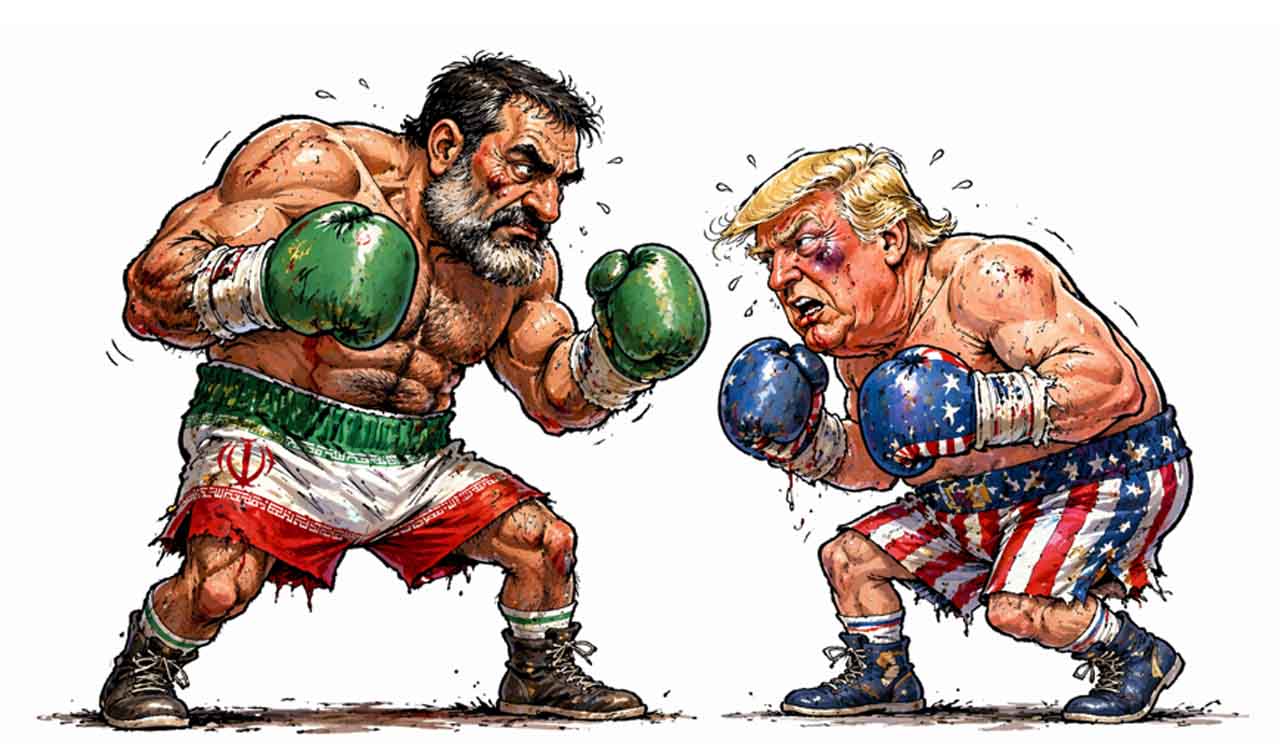
The Iran war has delivered no decisive winner — only a stark reminder of the limits of force, the resilience of states, and the power of perception in modern conflict
Published Date – 9 April 2026, 10:03 PM
By Brig Advitya Madan (Retd)
Forty days into the Iran conflict, the dust has not settled — but the contours of a transformed geopolitical landscape are already visible. What was expected to be a decisive assertion of American and Israeli military superiority has instead evolved into a complex demonstration of resilience, miscalculation, and shifting power equations in West Asia.
The first and most striking takeaway is this: regime change did not happen. At best, there has been a temporary adjustment within the system — not a transformation of it. The Iranian state remains intact, and in many ways, more entrenched. This underscores a fundamental lesson often ignored in modern warfare — the difference between the destruction of military capability and the destruction of political will. The United States succeeded, to an extent, in degrading Iran’s military infrastructure. It did not, however, break the resolve of the Iranian state or its people.
Indeed, the war appears to have produced the opposite effect. Iranian society, fractured by years of economic hardship and social unrest, has rallied in the face of external pressure. The regime has emerged more hardened, more vigilant, and arguably more legitimate domestically than before the conflict began.
The Strategic Winners
Among external actors, China stands out as a quiet but significant beneficiary. By closely observing the conflict, Beijing has gained valuable insights into American military doctrine, response thresholds, and operational limitations — without expending any resources of its own. For a power with global ambitions, this is strategic capital of the highest order.
Iran, too, can claim a form of victory. Despite extensive strikes — reportedly targeting thousands of sites — its core capabilities remain intact. Its enriched uranium stockpile has not been eliminated. Its long-range strike potential has not been fully neutralised. Crucially, its control over the Strait of Hormuz remains intact — though now redefined.
The transformation of Hormuz from a zone of free passage into one of conditional or “paid” passage marks a profound shift. During the conflict, the disruption of shipping lanes demonstrated Iran’s ability to weaponise geography. Even the temporary imposition of costs on global trade has long-term implications. Oil markets have become more volatile, and Iran has shown that it can convert instability into economic leverage.
Erosion of US Credibility
If one theme dominates the 40-day report card, it is the erosion of US credibility. For decades, the United States positioned itself as the primary security guarantor in the Gulf. This war has shaken that perception. Gulf Cooperation Council (GCC) states have watched closely — and uneasily — as American bases in the region became targets rather than shields. The inability to fully protect partners, coupled with the visible strain on US air defence systems and interceptor stockpiles, has raised serious doubts.
Equally damaging has been the rhetoric. Statements hinting at the destruction of entire civilisations have undermined the moral authority that the United States has long claimed in international affairs. The gap between professed values and operational conduct has rarely been so stark.
Military dominance doesn’t ensure political success. Coercion doesn’t guarantee compliance. In today’s interconnected world, war’s impact extends far beyond the battlefield
Moreover, Washington’s strategic coherence appears frayed. The objectives of the United States and Israel have not always aligned. While Israel has pursued maximalist goals —targeting Iran’s regime and long-term capabilities — the United States has appeared more cautious, particularly as the risks of escalation grew.
In the end, it was Washington that seemed more eager for a ceasefire. The prospect of ground operations — fraught with uncertainty and potential losses — likely contributed to this recalibration. Domestic political considerations, including electoral timelines, may also have played a role.
Triumph of Asymmetry
Another defining feature of this conflict has been the effectiveness of asymmetric warfare. Iran’s strategy of imposing costs — rather than seeking outright battlefield dominance —has proven resilient. Despite significant damage to its infrastructure and military assets, Iran has demonstrated the ability to sustain pressure. Attacks on US assets in the Gulf, disruptions to shipping, and the strategic use of low-cost systems against high-value targets have highlighted a critical imbalance: advanced militaries are not always best equipped for prolonged, cost-intensive conflicts.
The war has also exposed vulnerabilities in supply chains. The depletion of interceptor stockpiles and the strain on defence manufacturing capacities point to a broader issue — the sustainability of high-intensity warfare in an era of constrained resources.
Fragile Ceasefire, Persistent Crisis
The ceasefire, while welcome, is best understood as a pause rather than a resolution. The underlying issues remain unresolved. Iran’s nuclear programme continues to be a point of contention. Trust between the parties is virtually non-existent.
Even the ceasefire itself reportedly came with conditions — central among them the reopening of the Strait of Hormuz. This underscores how critical maritime stability is to global economic security.
The risk of renewed escalation remains high. A more hardened Iranian regime, combined with unresolved strategic tensions, creates a volatile equilibrium. Any miscalculation could reignite the conflict.
Regional Reordering
The war is already triggering geopolitical churn in West Asia. Traditional alignments are under strain, and new ones are likely to emerge. Gulf states, once firmly anchored in the American security architecture, are reassessing their options. Some, like Saudi Arabia and Oman, have benefited economically from higher oil prices, while others — such as Iraq, Kuwait, and Qatar — have faced disruptions.
Pakistan’s role as a mediator has been notable but limited — more akin to a diplomatic conduit than a decisive actor. Its engagement does not fundamentally alter regional balances, nor does it pose any immediate concern for India. What is more significant is the broader question of trust. The perception that the United States may no longer be a reliable security partner will have lasting consequences. It opens space for alternative partnerships— and for powers like China and Turkey to expand their influence.
Moment for Strategic Voice
For India, the conflict presents both challenges and clarity. Despite its complex relationships with the United States, Iran, Israel, and the Gulf, India has managed to maintain balance. There is no immediate cause for concern, but there is a clear need for vigilance.
More broadly, the conflict highlights the need for the Global South to articulate a more unified voice. The selective application of international norms and the persistence of hegemonic behaviour have eroded trust in the global order.
As Prime Minister Narendra Modi has emphasised, this is not an era of war. Yet, that principle must be upheld collectively — not selectively.
Power, Perception, Limits of Force
The 40-day Iran war has not produced a decisive victor. Instead, it has revealed the limits of military power, the resilience of state structures, and the growing importance of perception in modern conflict.
The United States emerges weakened — not in absolute capability, but in credibility. Iran emerges battered, yet unbroken — and perhaps more assertive. China emerges better informed and strategically advantaged.
Above all, the war serves as a cautionary tale. Military superiority does not guarantee political success. Coercion does not ensure compliance. And in a deeply interconnected world, the consequences of conflict rarely remain confined to the battlefield.
The ceasefire may hold — or it may not. But the lessons of these 40 days will endure far longer.
(The author is a retired Army officer)