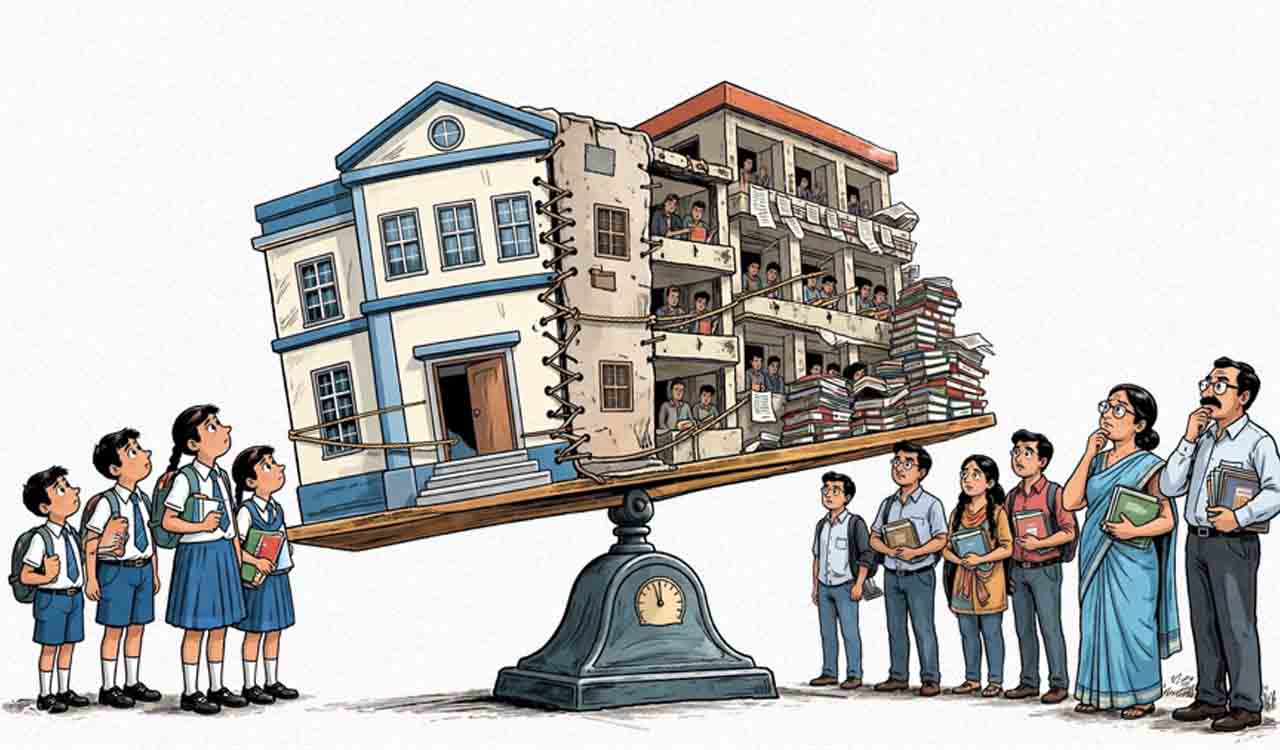
Telangana’s plan to merge intermediate with school education must balance interests, ensure fair teacher roles, and curb inequities
Published Date – 8 April 2026, 11:12 PM
By Dr Sreeramulu Gosikonda
Education is more than instruction; it is a social institution that shapes aspirations, reproduces inequalities, and reflects collective values. Telangana’s decision to merge intermediate education with school education is a bold step aligned with the 5+3+3+4 structure of NEP 2020. The current 10+2 (intermediate) model separates grades 11–12 under a different board, creating stress for students, financial strain for parents, and administrative burdens.
However, this reform must be examined sociologically, considering equity, commercialisation, human resource management, and lived experiences. As Durkheim noted, education sustains cohesion, while Bourdieu showed it reproduces inequalities — rushed change risks undermining both stability and fairness.
Site of Inequality
Intermediate education in Telangana is heavily privatised. Data from 2022–23 show 66% of the 10.96 lakh junior college students are in private institutions, while only 34% are government-run or aided colleges. Nearly 95% are concentrated in MPC, BiPC, and CEC streams, narrowing aspirations to engineering, medicine, and commerce, while other courses remain marginalised. This reflects Bourdieu’s concept of cultural capital, where certain streams are seen as prestigious and others devalued.
Corporate colleges reinforce this hierarchy by charging exorbitant fees for IIT-JEE and NEET coaching, excluding rural and marginalised students. Smaller town colleges face declining enrolment, deepening stratification. Thus, intermediate education has become a site of commercialisation, inequality, and cultural reproduction, privileging elite pathways while limiting broader opportunities.
Continuity, Equity, and Belonging
The Integration of Intermediate education with school education offers continuity and stability by allowing students to remain in familiar environments with known teachers, reducing stress and dropout risks while fostering belonging. It provides financial relief for parents by sparing them the burden of costly private colleges, making education more accessible.
Schools can ensure holistic development by integrating sports, counselling, and extracurricular activities into senior secondary levels, countering the hyper-competitive coaching culture. Expanding government schools to Classes 11 and 12 democratises opportunities, curbing private dominance and promoting equity. At the same time, efficient use of teachers and infrastructure across Classes 9–12 maximises resources. These advantages align with NEP 2020’s vision of a unified schooling system and Durkheim’s view of education as a force for social integration and equality.
Teacher Roles, Hierarchies
The reform raises complex challenges around qualifications, promotions, and service rules. Government schoolteachers, including school assistants, language pandits, physical education staff, and junior lecturers, must adapt to revised pay structures, which should also apply to private institutions to ensure uniformity.
Many high school teachers lack postgraduate degrees, while junior lecturers often lack BEd and TET qualifications. Giving them 4–5 years to qualify is pragmatic but leaves transitional gaps, exposing the tension between professionalisation and accessibility.
Education is a social institution whose pace must be respected. Without strict provisions to curb commercialisation, it risks being commodified, undermining equity and quality
Junior lecturers may see teaching lower classes as a demotion, while school assistants teaching senior classes may treat it as a promotion. This inversion unsettles hierarchies and status, making careful management essential to balance quality with fairness.
Pay disparities further complicate matters: equalising salaries without reducing junior lecturers pay implies raising school assistants’ salaries, with fiscal implications. Ensuring justice is vital, as perceptions of devaluation could harm morale, echoing Weber’s emphasis on legitimacy and Marx’s concern with equitable recognition of labour.
Institutional Gaps, Fiscal Challenges
Telangana’s Unified Service Rules, introduced after State reorganisation, sought to integrate cadres across management types, but integrating intermediate with school education exposes gaps that must be addressed. Recruitment, transfers, promotions, and benefits require harmonisation to prevent resentment among teachers. Expanding government schools to senior secondary levels also means extending mid-day meals to Classes 11 and 12 and upgrading laboratories, libraries, and sports facilities—investments that reflect the State’s redistributive role in supporting marginalised students.
A key safeguard is regulating permissions for senior secondary schools based on population density, ensuring expansion is need-driven rather than profit-driven. Functionalist sociology reminds us that institutions must grow in proportion to social needs, not market pressures. Private schools and junior colleges may adapt by upgrading or expanding, but they too face challenges in staffing and fee regulation. Without strict provisions to curb commercialisation, education risks being commodified, undermining equity and quality.
Students at the Heart of Reform
While institutional challenges are significant, the reform’s greatest promise lies in its impact on students. If implemented thoughtfully, it can transform student experiences by introducing a uniform curriculum that better prepares them for national exams, reducing stress through fewer board assessments, and offering counselling to broaden career horizons beyond engineering and medicine. With commercialisation curbed, students gain space for sports, arts, and social engagement—realising Paulo Freire’s vision of education as liberation.
Immediate implementation risks chaos: parents have already paid (Intermediate) first year fees, and institutions are unprepared. Education reforms need careful, phased planning — not abrupt execution. A phased timeline is more realistic:
- 2026–27 AY: Continue existing system; draft merger guidelines; invite Phase 1 applications.
- 2027–28 AY: Add class 11 in eligible schools or class 9 in junior colleges.
- 2028–29 AY: Add class 12 in schools or class 10 in junior colleges; full 9–12 cycle begins.
- 2029–30 AY: Complete one cycle; evaluate challenges; enforce compliance before Phase 2.
- 2030–31 AY: Phase out intermediate board; allow backlog students to finish exams.
This gradual approach balances reform with stability, reflecting the sociological principle that social change must be evolutionary, not unexpected, to avoid disruption.
Towards Inclusive Schooling
Senior secondary schooling is not new — Kendriya Vidyalayas, Navodaya Schools, and Model Schools in Andhra Pradesh and Telangana already demonstrate its success. Telangana can adopt NCERT’s framework for curriculum and diverse subject choices at grades 11 and 12. A committee of teachers, lecturers, retired professors, and administrators should prepare a report within three months on training, qualifications, salary harmonisation, fee regulation, infrastructure, and phased strategies.
Strict fee regulation is vital to prevent commercialisation. Merging intermediate with school education is the need of the hour, promising affordability and holistic development; yet its success hinges on careful planning, institutional adjustments, and sociological sensitivity.
Telangana’s reform, aligned with NEP 2020, is ambitious and progressive, but its durability rests on dialogue among teachers, parents, students, and administrators. Education is not merely an administrative system; it is a social institution whose pace must be respected. Managing this transition responsibly requires balancing interests, ensuring fairness in teacher roles and service rules, and curbing inequities.
Only through collective ownership and phased execution can the reform strengthen equity and stability. If implemented thoughtfully, Telangana’s model can set a national benchmark for inclusive senior secondary schooling, reimagining education as a true public good.
(The author is Assistant Professor, Department of Sociology, Banaras Hindu University, Varanasi)