Rising tensions between Pakistan and Afghanistan’s Taliban risk strengthening militant networks instead of eliminating them
Published Date – 8 April 2026, 12:02 AM
By Spouzhmai Akberzai, Amit Kumar
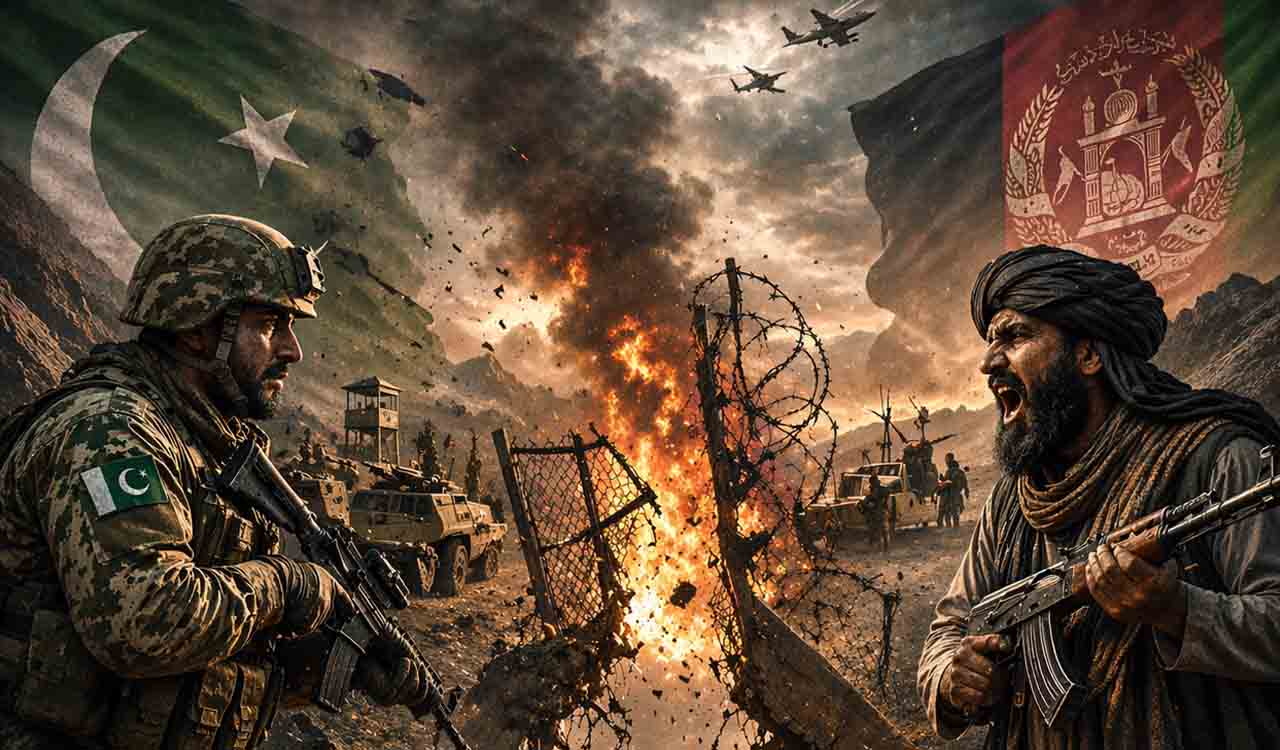
A new round of fighting between Pakistan and Afghanistan’s Taliban is being sold in Islamabad as counterterrorism. Following Pakistani airstrikes and cross-border retaliation on 26 February 2026, Pakistan’s defence minister described the situation as “open war”. Kabul calls the strikes a violation of sovereignty and denies that it shelters the Tehreek-e-Taliban Pakistan (TTP).
Yet wars of this kind rarely eliminate militant networks. They redistribute fighters, shift operational spaces, reorganise hierarchies, and create new opportunities for recruitment and illicit finance. A Taliban-Pakistan war risks generating the very militancy it is meant to suppress. What, then, are the consequences of such a conflict and who ultimately stands to lose what?
Who Loses
The recent past substantiates this concern. After the collapse of Pakistan’s ceasefire with the TTP in late 2022, militant violence surged sharply. Through 2023 and 2024, hundreds of Pakistani security personnel were killed in attacks across Khyber Pakhtunkhwa and Balochistan. Despite repeated operations, the TTP demonstrated the capacity to regroup and adapt.
Escalation across the Afghan border may satisfy domestic pressure for action, but it also narrows the Taliban’s political room to act openly against the TTP. In wartime, any visible Taliban crackdown on fellow militants can be framed internally as capitulation to Pakistan. That reduces the likelihood of sustained enforcement.
The Taliban also face costs that are less visible but strategically significant. A border confrontation stretches manpower and intelligence capacity. Units redeployed to frontier districts are units withdrawn from internal security duties. Governance capacity thins. That creates an opportunity for Islamic State Khorasan Province (ISKP), which has long sought to portray the Taliban as both incapable of securing Afghanistan and compromised by pragmatism.
Pakistan and the Taliban must establish discreet channels to enforce verifiable limits on cross-border militancy, as public ultimatums risk escalation while quiet coordination offers a path to compliance
According to recent UN Security Council and International Crisis Group reports, ISKP’s attack tempo declined between 2023 and 2025 due to sustained Taliban pressure. Yet the same reports noted that the group retains recruitment networks and cross-border facilitation channels. A prolonged confrontation with Pakistan could reopen operational space.
Disaffected fighters, foreign militants relocated away from sensitive border regions, including Uyghur elements, and other transnational jihadists could find new incentives to regroup under ISKP’s banner. Even limited erosion of Taliban oversight can alter the militant balance.
The same logic applies on the Pakistani side. War on the western frontier diverts military attention and intelligence bandwidth. When national focus shifts outward, internal vulnerabilities widen. The TTP gains propaganda oxygen, framing strikes as aggression and projecting resilience through retaliatory attacks.
The Baloch insurgency also calculates opportunity. Baloch militant groups have repeatedly targeted Chinese interests, including attacks on the Karachi University Confucius Institute in 2022 and assaults on infrastructure linked to the China-Pakistan Economic Corridor. Escalation with Afghanistan risks diluting Pakistan’s capacity to protect such assets while reinforcing narratives of state overextension.
The smuggling economy acts as an accelerant. War does not simply open space for narcotics and arms flows. It fuses militant and criminal economies. Displacement reduces monitoring along the Durand Line, expands cross-border corridors, and raises the value of protection networks.
Drug routes, weapons trafficking, fuel smuggling and human movement become intertwined revenue streams. In such environments, ideological boundaries blur. A facilitator who moves licit goods one week can move explosives the next. Militant resilience becomes embedded in illicit finance rather than solely ideological mobilisation.
Who Loses What?
Pakistan bears the most immediate pain. Escalation risks further erosion of security control at home. If militant attacks intensify despite cross-border strikes, perceptions of state authority weaken. The Taliban lose something different. They lose governance capacity. Border mobilisation constrains intelligence oversight and complicates efforts to discipline armed factions. Wartime nationalism may bolster legitimacy, but it reduces the freedom to act pragmatically.
If this war was meant to solve militancy, it risks multiplying it. De-escalation is necessary but insufficient. Institutional management is required. Pakistan and the Taliban need a discreet channel to pursue verifiable constraints on cross-border militant activity. Public ultimatums harden positions, but quiet enforcement mechanisms create room for compliance.
Regional actors should also step up to form a minilateral stabilisation framework for structured dialogue. A joint border verification mechanism would allow incident monitoring without escalation. Coordinated monitoring cells at key crossings could improve information flow on militant transit. Financial intelligence cooperation targeting narcotics and smuggling revenue would strike at the economic foundations of militant resilience.
Absent such measures, ceasefires will pause kinetic confrontation but not reverse ecosystem expansion. The region may discover that a war launched in the name of counterterrorism has simply rearranged the militants’ orientation into something more diffuse, more networked, and more difficult to contain.
(Spouzhmai Akberzai is a researcher focused on gender, peace, and security in Afghanistan and South Asia. Amit Kumar is a Research Fellow (Contract) at Rabdan Academy (UAE), an incoming Visiting Research Fellow at University of South Wales (UK), and Subject Matter Expert at Centre for Joint Warfare Studies, India)