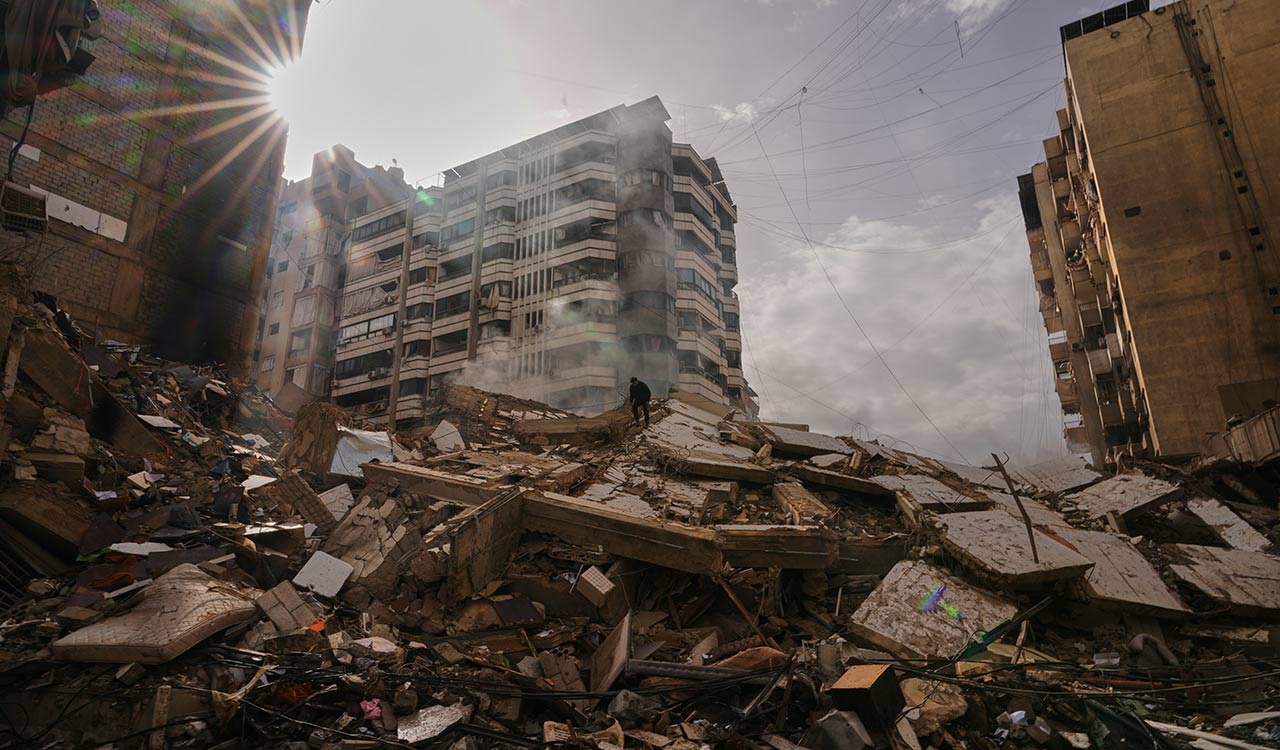
Tensions escalated in West Asia as Iran launched attacks on Israel and Gulf nations, while US strikes hit Iranian infrastructure. Disruptions in the Strait of Hormuz slashed oil traffic, raised global prices, and prompted international talks on restoring maritime security
Published Date – 3 April 2026, 11:00 AM
Dubai: There was little sign Friday of the war in West Asia winding down as Israel said it faced incoming fire from Iran while Kuwait and Bahrain reported being under attack.
Iran said eight people were killed while celebrating the close of Persian New Year near a major bridge hit by a US strike.
Tehran continued to demonstrate its ability to strike its neighbours even as US President Donald Trump claimed the threat from the country was nearly eliminated and cheered the collapse of the bridge on Thursday, reportedly the tallest in the Middle East.
Iran decried the strike on the bridge, which also injured 95 people celebrating Nowruz Day, when Iranians gather for picnics and other celebrations outdoors on the last day of Nowruz, the Persian New Year.
“Striking civilian infrastructure only conveys the defeat and moral collapse of an enemy in disarray,” Iran’s Foreign Minister Abbas Araghchi wrote Thursday in a post on X.
Iran’s attacks on Gulf states, along with its chokehold on the Strait of Hormuz, have disrupted the world’s energy supplies with effects far beyond the Middle East. That has proved to be Iran’s greatest strategic advantage in the war. Britain held a call with nearly three dozen countries about how to reopen the strait once the fighting is over.
Trump has insisted the strait can be taken by force – but said it is not up to the U.S. to do that. In an address to the American people Wednesday night, he encouraged countries that depend on oil from Hormuz to “build some delayed courage” and go “take it.” Before the U.S. and Israel started the war on Feb. 28 with strikes on Iran, the waterway was open to traffic and 20% of all traded oil passed through it.
Iran continues to strike Israel and Gulf countries
Iran responded defiantly to Trump’s speech, in which the American president claimed U.S. military action had been so decisive that “one of the most powerful countries” is “really no longer a threat.” A spokesman for Iran’s military, Lt. Col. Ebrahim Zolfaghari, insisted Thursday that Tehran maintains hidden stockpiles of arms, munitions and production facilities.
He said facilities targeted so far by U.S. strikes are “insignificant.” Trump, in his address, said U.S. “core strategic objectives are nearing completion.” Iran state media reported the attack on the B1 bridge, which was still under construction, citing authorities in Alborz province.
Trump posted footage on social media showing what he said was the collapse of Iran’s biggest bridge and threatening, “Much more to follow.” It was not immediately clear if the footage Trump shared was the B1 bridge.
In Lebanon – where Israel has launched a ground invasion against Iran-backed Hezbollah militants – Israeli strikes killed 27 people over 24 hours, the Health Ministry said.
More than 1,900 people have been killed in Iran during the war, while 19 have been reported dead in Israel. More than two dozen people have died in Gulf states and the occupied West Bank, while 13 U.S. service members have been killed.
More than 1,300 people have been killed and more than 1 million displaced in Lebanon. Ten Israeli soldiers have also died there.
Nearly three dozen nations talk about securing the Strait of Hormuz
Iranian attacks on about two dozen commercial ships, and the threat of more, have halted nearly all traffic in the waterway that connects the Persian Gulf to the open ocean.
Since March 1, traffic through the strait has dropped 94% over the same period last year, according to the Lloyds List Intelligence shipping data firm. Two ships are confirmed to have paid a fee, the firm said, while others were allowed through based on agreements with their home governments.
Saudi Arabia piped about 1 billion barrels of oil away from the Strait of Hormuz in March, according to maritime data firm Kpler, while Iraq said Thursday that it had started to truck oil across Syria to avoid the strait.
The 35 countries that spoke Thursday, including all G7 industrialized democracies except the US, as well as the United Arab Emirates and Bahrain, signed a declaration last month demanding Iran stop blocking the strait.
Thursday’s talks were focused on political and diplomatic measures, but British Foreign Secretary Yvette Cooper said military planners from an unspecified number of countries will also plot ways to ensure security once fighting ends, including potential mine-clearing work and “reassurance” for commercial shipping.
No country appears willing to try to open the strait by force while the war is raging. French President Emmanuel Macron, while on a visit to South Korea, called a military operation to secure the waterway “unrealistic.” But there is a concern that Iran might limit traffic through the waterway even after U.S. and Israeli attacks cease.
Oil prices rise again even as Trump suggests the war could end soon
The conflict is driving up prices for oil and natural gas, roiling stock markets, pushing up the cost of gasoline and threatening to make a range of goods, including food, more expensive.
Oil prices remained elevated, however, at $111.54 for a barrel of U.S. crude, having soared following Trump’s address. That’s up about 50% from Feb. 28.
Though the oil and gas that typically transits the strait is primarily sold to Asian nations, Japan and South Korea were the only two countries from the region joining Thursday’s call about the strait. The supply of jet fuel has also been interrupted, with consequences for travel worldwide.