
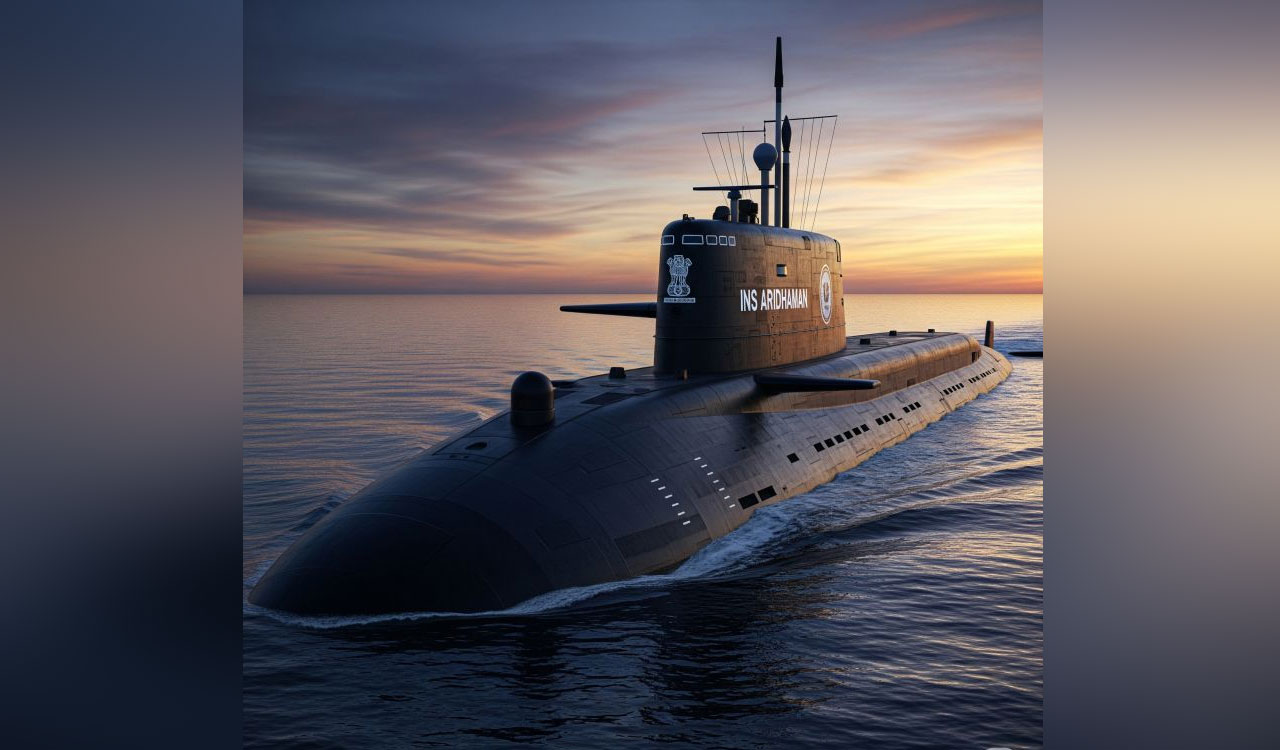
India commissioned its third nuclear-powered ballistic missile submarine INS Aridaman, strengthening its nuclear triad. The induction enhances strategic strike capability amid evolving security challenges, while also highlighting progress in indigenous defence and underwater nuclear capabilities
Published Date – 3 April 2026, 08:51 PM
New Delhi: India on Friday commissioned its third indigenously built nuclear-powered ballistic missile submarine, INS Aridaman, significantly bolstering the naval component of the nation’s nuclear triad, authoritative sources said.
There is no official word yet on the commissioning of the boat, which comes amid a rapidly evolving regional security environment.
India’s nuclear-powered ballistic missile submarine (SSBN) programme is a closely guarded project. INS Arihant was the first boat under the SSBN project, followed by another boat, INS Arighat.
INS Arihant is India’s first home-made nuclear submarine. It was launched in July 2009 and was quietly commissioned in 2016. The navy commissioned its second indigenous SSBN, INS Arighaat, in August 2024. SSBN stands for ship submersible ballistic nuclear or nuclear-powered ballistic missile submarines.
The SSBN programme is a key element of India’s nuclear deterrence capability.
The induction of INS Aridaman is seen as a major milestone in enhancing India’s strategic strike capabilities.
India is among a select group of countries that possess nuclear-powered submarines. The countries that have such assets are the US, Russia, the UK, France and China.
INS Aridaman has been commissioned after months of sea trials. It is learnt that Defence Minister Rajnath Singh and Navy Chief Admiral Dinesh K Tripathi attended the commissioning ceremony held at a frontline naval base in southern India.
“It’s not words but power, ‘Aridaman’,” Singh said in a cryptic social media post in Hindi this morning.
While India has proven air and land-launched nuclear capabilities, it is now looking at ramping up its underwater nuclear prowess.
It is learnt that the focus will now be on a fourth nuclear-powered submarine. While India has proven air and land-launched nuclear capabilities, it is now focusing on boosting its underwater nuclear prowess.
In December, Admiral Tripathi had confirmed that a new nuclear-powered ballistic missile submarine will be commissioned into service soon.
India has been a leading voice in pitching for universal nuclear disarmament aimed at the complete elimination of atomic weapons.
In 1998, India conducted Pokhran-II nuclear tests, triggering strong reactions from many countries.
Following the tests, India maintained that it carried them out to have ‘credible minimum deterrence’ and that it will follow the approach of “no first use”.
In 2003, India officially came out with its nuclear doctrine that clearly elaborated on the ‘no first use’ policy.
Earlier in the day, the Indian Navy’s new warship INS Taragiri was commissioned in the presence of Singh at Visakhapatnam.
In his address at the commissioning ceremony, Singh described INS Taragiri as not merely a warship but a symbol of India’s growing technological prowess, self-reliance and formidable naval power.
“This ship is capable of high-speed transit and can remain deployed at sea for extended periods. It is equipped with systems designed to monitor enemy movements, ensure its own security and, if necessary, deliver an immediate response,” he said.
“It features modern radar, sonar and missile systems, such as BrahMos and surface-to-air missiles, which further augment its operational prowess,” he added.