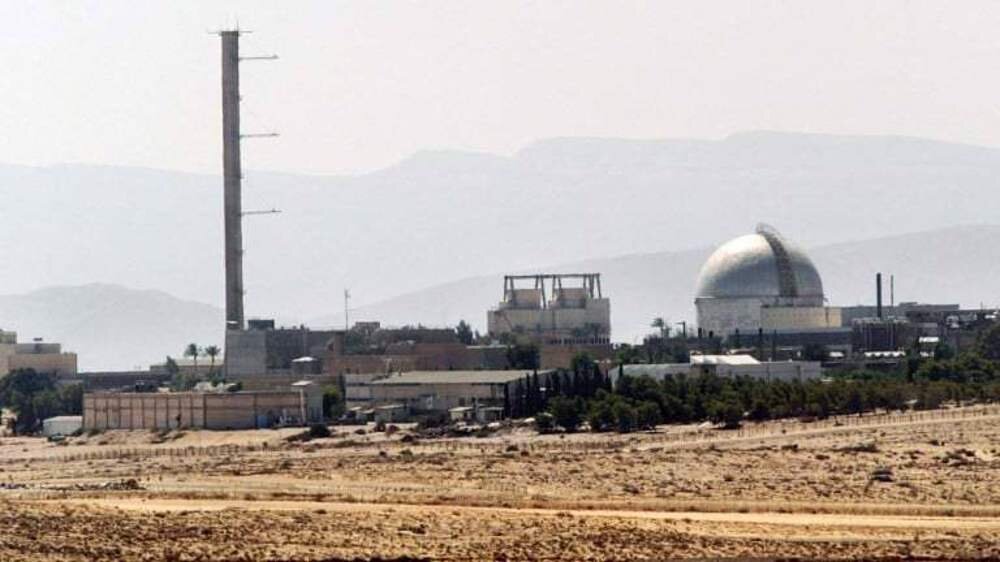
If tonight’s Iranian strike on Dimona is to be analyzed accurately and professionally, the starting point must be the target itself — a location long regarded as one of the most confidential and strategically sensitive sites of the Israeli regime. Dimona is not merely an ordinary industrial or military facility; it is widely known as the core of Israel’s nuclear program, where the backbone of the regime’s claimed deterrence capability has taken shape. For that reason, any threat or damage directed at it directly challenges one of Tel Aviv’s most fundamental pillars of power.
The next layer of analysis concerns the defensive shield surrounding the site. Over recent decades, Israel has invested billions of dollars and relied on some of the most advanced Western technologies to build a multilayered air defense network — from Iron Dome to longer-range interception systems designed to detect and destroy aerial threats at multiple stages. These systems have consistently been presented as symbols of Israel’s technological and security superiority. Yet the passage of an effective strike through such a shield — regardless of the scale of actual damage — carries a strategic message of its own: no defense system is impenetrable, especially when confronted by the determination and capability of a serious actor.
Dimona’s geographic location further amplifies the significance of the event. The site is located in a desert area in the south of the occupied territories, and its considerable distance from surrounding borders was deliberately chosen to shield it from direct threats. In other words, Israeli security planners assumed that by moving such facilities deep into the interior, they had created a security margin that would make access nearly impossible. When a target with such characteristics enters the operational sphere, it suggests that traditional security equations no longer function as they once did.
This strike also did not occur in a vacuum. The current regional environment is defined by direct confrontation and mounting military pressure by the United States and Israel against Iran. In that context, Iran’s action cannot be viewed merely as a tactical reaction; it constitutes a response in the midst of an active confrontation. What distinguishes it is that the response was defined not on the periphery, but in the opponent’s strategic depth — an area that until recently few believed could be reached. This reflects a shift in the level of confrontation from the margins to the center.
Finally, the repeated claims made by Donald Trump cannot be overlooked. He has repeatedly spoken with certainty about the “destruction” or “paralysis” of Iran’s missile capabilities — assertions that often resembled psychological warfare more than realistic assessment. What occurred tonight is presented as a practical response to those narratives. A capability said to have been neutralized has now appeared in a real operational setting — not in a test or demonstration, but during an active confrontation.
For any professional observer, the broader conclusion is clear: the chosen target, its level of protection, its geographic depth, and the timing of the operation all indicate that this was not an ordinary action. It represents a multilayered message — directed simultaneously at Tel Aviv, Washington, and regional public opinion — conveying that the balance of power, contrary to years of official narratives, is not one-sided, and that any assessment built on the assumption of Iran’s weakening remains disconnected from realities on the ground.
MNA