In the 21st century where women are leading in sectors as defence, space, aviation and multinational companies, gender inequality continues to persist in Telangana schools, with a girl child in a family being sent to the government school and boy to a private institution
Published Date – 14 March 2026, 11:14 PM
Hyderabad: In the 21st century, where women are leading in sectors such as defence, space, aviation and multinational companies, gender inequality continues to persist in Telangana schools, with many families preferring to send a girl child to a government school and a boy to a private institution.
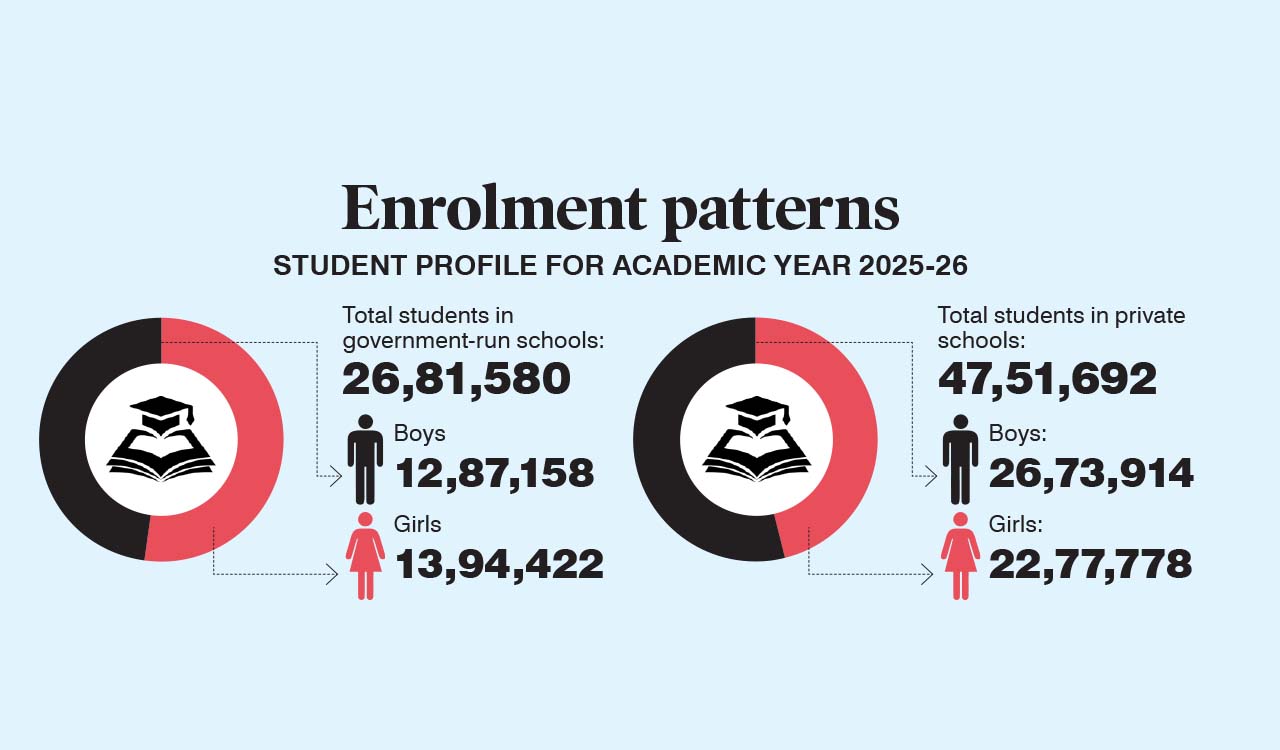
This gender inequality has come to the fore in the enrolment patterns for the academic year 2025–26. As per the statistics available with the Education department, in government schools, girls account for 37.98 percent, while boys’ enrolment stands at 32.49 percent. This pattern shifts in private schools, where 67.51 percent of the students are boys compared with 62.02 percent girls.
The boys’ enrolment in government-run schools stood at 12,87,158, while 13,94,422 girls are enrolled. In private schools, 26,73,914 boys joined, compared with 22,77,778 girls on the rolls. Overall, 76,35,115 students — including 39,61,072 boys and 36,72,200 girls — are on the rolls during the academic year 2025–26.
“Parents prefer to enrol their girl child in government schools as they apparently do not like to spend much on her education. Further, they fear for her safety and hence do not send her to private schools located far away. This is particularly seen in rural areas. However, girls are primarily responsible for the good results achieved by government schools in the SSC Public Examinations,” said a government school headmaster.
Further, the enrolment data shows that parents appear to have lost faith in government-run schools, which accounted for just 32 percent (8,58,106) of children, while 68 percent (33,67,150) are in private schools for primary education. A similar trend is seen in the secondary grades.
One of the main reasons for eroding trust in government schools has been attributed to the lack of infrastructure such as classrooms and the availability of teachers for each grade.
In addition, teaching and learning are taking a back seat due to the heavy administrative workload and training activities for teachers. This has been affecting the quality of education, leading to dissatisfaction among parents, who are enrolling their wards in private institutions despite hefty fees.