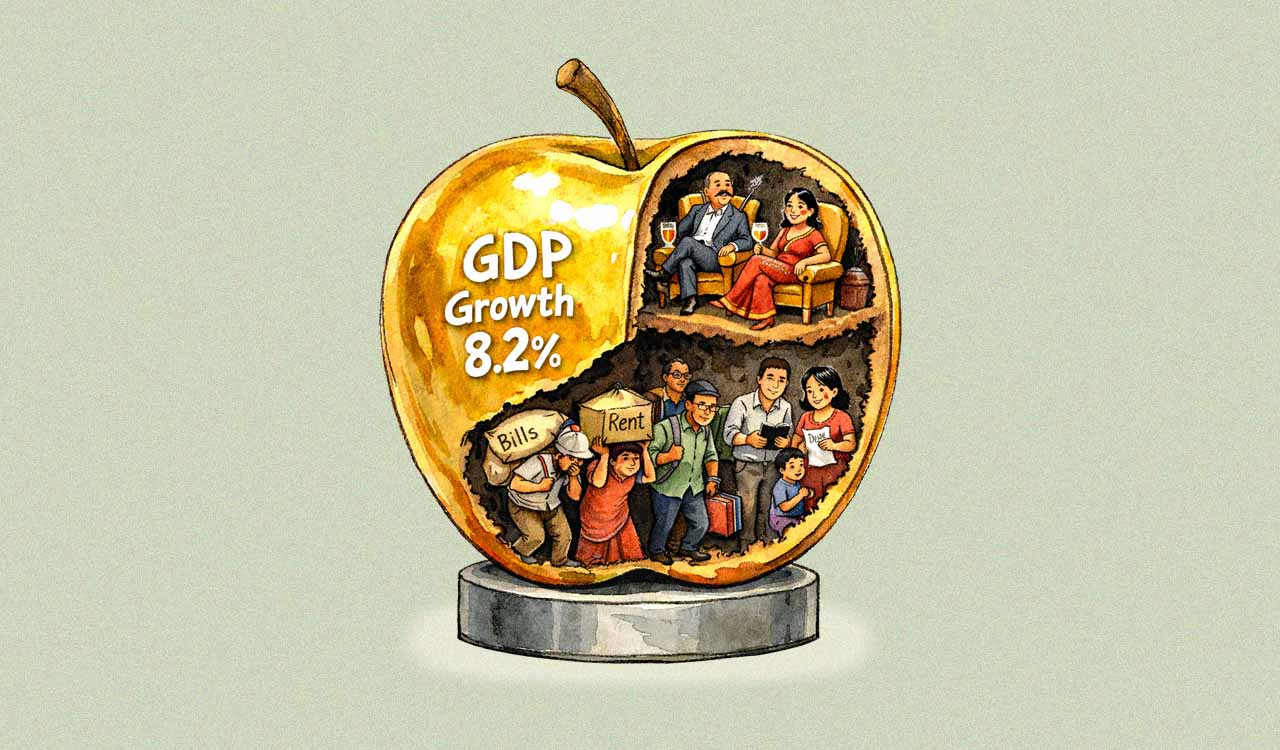
India’s GDP growth may look impressive, but rising inequality, wage gaps and weak job quality reveal a deeper crisis for the working class
Published Date – 10 March 2026, 09:54 PM
Dr Subhashree Banerjee, Vani Vyshnavi Jupudi
India calls its GDP growth the “Goldilocks moment”, a label meant to signal economic growth and global power. With growth of 8.2% in Q2 (July-September, 2025), inflation at 1.33% and an unemployment rate of 4.7%, India presents itself as a fast-growing nation that has achieved fourth position in global economic rankings, surpassing Japan. However, both real and nominal GDP growth show only a small gap, raising questions about the nature of these growth measures.
The comparison is misleading when it relies solely on total GDP because per capita income does not accurately reflect the living standards of residents. According to the IMF’s estimates, Japan’s GDP per capita is approximately $34,700, compared with $2,800 for India. This shows that although the economy’s overall performance is stronger, lower segments of society continue to live in substandard conditions.
Income Gaps
To understand the situation, we need to examine the distribution of income as it reveals who captures the gains and who continues to suffer during the so-called Goldilocks moment. The World Inequality Report 2026 states that India’s top 10% of the population controls 58% of the national income, while the bottom 50% receives only 15%. Even when the economy grows fast, most people do not feel better off because the largest share of the income goes to the big companies and wealthy households. The top 1% alone owns 39.5% of the country’s wealth.
This is not merely a moral concern. It leads to three clear outcomes: people spend less due to tight finances, little or no savings, and rising difficulty in affording everyday essentials. These pressures affect working-class families through housing, healthcare, and education costs. The system produces a persistent “inequality of access”, which proves more challenging to resolve than income inequality because people require access to convert economic growth into sustainable financial stability.
Women Workers
From a gender perspective, official labour market indicators suggest that women face significant obstacles in finding work. Rural female labour force participation increased from 35.2% in June 2025 to 39.7% in November 2025. The urban female labour force participation rate remained stable at 25.5% during this period. The unemployment rate decreased from 5.2% in October 2025 to 4.7% in November 2025 (PLFS, 2025), but these figures reveal little about job stability, adequate compensation or formal employment status.
Earnings data from the salaried sector also show that gender wage disparities persist. The average monthly earnings for regular salaried employees during April to June 2024 reached Rs 18,200 for rural men but only Rs 12,396 for rural women, and Rs 26,105 for urban men but Rs 19,879 for urban women (PLFS, 2025).
With wealth concentrated among the top earners, weak social protection and gender wage gaps, the country’s economic boom risks leaving large sections of the working class behind
Despite improvements in human capital, such as the literacy rate rising from 74% in 2011 to 80.9% in 2023–24, inclusion remains uneven. Vocational training programmes do not match the scale of the workforce, exposing a significant skills gap. According to recent PLFS data, only 4.1% of people aged 15–59 had received formal vocational or technical training in 2023–24. Moreover, most learning occurs through informal sources (30.6%), which lack certification and therefore do not lead to better pay or greater bargaining power.
Tackling Challenge
Addressing this challenge requires macroeconomic policies targeted at the lower segment of society. First, the government should treat wage floors as enforceable institutions by strengthening the national floor wage framework and building inspection and grievance systems capable of reaching informal workplaces.
Second, the base year of the inflation index should be revised every five years so that inflation estimates remain credible and real wages can be adjusted accordingly. This would help ensure that the rising prices do not erode the consumption capacity of poorer households. Third, workers need stronger protection through better portable social security, simpler registration, and stricter accountability to prevent delayed payments and contract abuse.
Fourth, strengthening Direct Benefit Transfer (DBT) systems could provide support to the vulnerable section of society. Lower-income households face greater income volatility, and DBT can supplement earnings, stabilise consumption and protect household welfare, thereby encouraging labour force participation. Finally, India’s expanding digital economy has the capacity to deliver income support quickly and transparently. What is missing is the use of these tools to strengthen workers’ bargaining power and improve real earnings for those who currently bear the costs of growth.
Better work incentives and income support or pro-work support by the government, such as wage insurance, can act as a safety net for the vulnerable section and translate into improved livelihoods. India’s growth narrative may appear fascinating, but the real question is whether it reflects the full reality. This story remains incomplete until real wages rise, job quality improves, and inequality narrows.
(Dr Subhashree Banerjee is Assistant Professor, Department of Economics, and Vani Vyshnavi Jupudi is student, Department of International Studies, Political Science, and History, Christ University, Bengaluru)