The government should urgently ban this dangerous herbicide and support farmers by promoting safer and sustainable weed-control alternatives
Published Date – 10 March 2026, 01:12 AM
By Boianapalli Vinod Kumar
A heartbreaking incident recently confronted a doctor named Dr Mahesh Reddy from Karimnagar district. A 25-year-old woman farmer from the district, after a quarrel with her husband, consumed a weedicide in a moment of emotional distress. Her relatives noticed it immediately and rushed her to Dr Reddy.
What thoughts crossed her mind when she consumed the poison are unknown, but the moment she saw the doctor, she seemed to realise the value of life. She broke down in tears and pleaded, “Doctor sir, I have two small children. What will happen to them if I die? I beg you, please save me.”
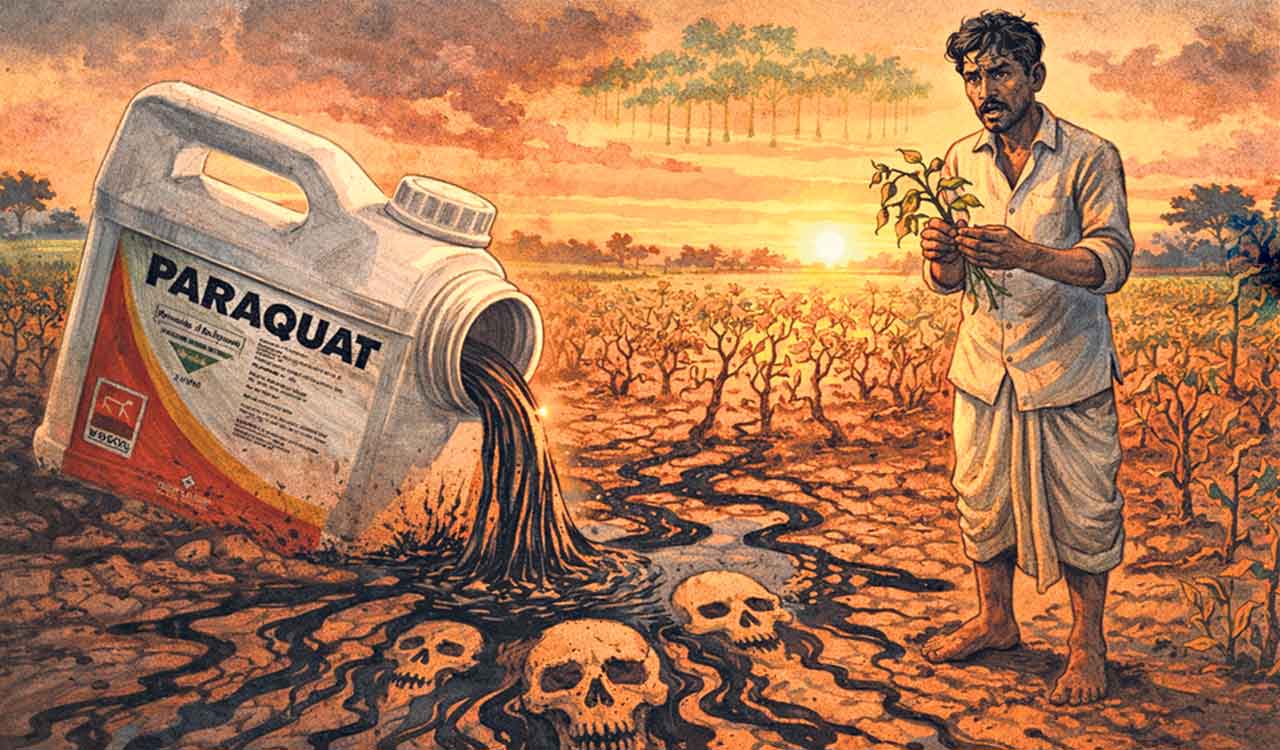
But what could the doctor do? The substance she consumed was not an ordinary weedicide — it was paraquat, a highly toxic chemical with no antidote. Sadly, the doctor says this is not an isolated incident. Such cases occur two or three times every week. This is deeply disturbing.
Determined to prevent such tragedies and save lives, the doctor has been travelling across the undivided Karimnagar district, conducting awareness meetings for farmers. He is educating them about the dangers of paraquat and informing them that there is no antidote once it is consumed.
Doctors who conduct post-mortem examinations in Karimnagar and Warangal, as well as a professor at Gandhi Hospital, have confirmed that paraquat is indeed a poison without an antidote. According to my study, 10 to 20 people in each district of Telangana die every month after consuming weedicides. Among those who attempt suicide, around 80% consume this type of chemical.
Herbicides and Their Impact
Paraquat, glyphosate, and pendimethalin are herbicides used to eliminate weeds in crop fields. These chemicals destroy weeds rapidly or cause them to dry out completely. Because they are easily available and allow farmers to control weeds without hiring labourers, the use of these herbicides has increased significantly in recent years.
However, their harmful effects extend beyond weeds, posing serious risks to human health and the environment. Unfortunately, many farmers are unaware of these dangers. These chemicals remain in the soil for a long time, damaging soil fertility. Over time, the soil becomes degraded, crop yields decline, and eventually the land may become unsuitable for cultivation. When heavy rains occur, water from agricultural fields carrying these chemicals flows into ponds and lakes, contaminating surface water and groundwater.
In addition, farmers often spray these chemicals without proper safety precautions, putting their lives at risk. Another extremely alarming issue is that people attempting suicide are increasingly using these herbicides —particularly paraquat — as a means. Because it is easily accessible and highly toxic, doctors often find it nearly impossible to save patients who consume it in a moment of emotional distress.
How Dangerous is Paraquat?
Paraquat is so toxic that even a single spoonful can lead to death. There is no antidote. Once it enters the body, it severely damages the lungs, kidneys, and liver. Breathing becomes extremely difficult, and the victim often dies after severe suffering. During spraying in fields, the chemical can also enter the body through the skin or respiratory system. Without proper protective equipment (PPE kits), long-term exposure can cause chronic respiratory diseases, skin burns, loss of nails, and reduced vision.
Around 2,000 people in Telangana are estimated to die each year after consuming paraquat. Recognising its dangers, States such as Kerala, Odisha, and Punjab have already banned the chemical
According to several international studies, people exposed to paraquat have a significantly higher risk of developing Parkinson’s disease, a neurological disorder that gradually affects movement and mobility. Because of these serious risks, more than 70 countries have already banned paraquat.
Traditional Weed Control Methods
Before chemical herbicides became common in India, farmers relied on environmentally friendly and highly effective traditional methods of weed control. Manual removal of weeds with the help of labourers, although costly, ensured that crops were not harmed. Ploughing between rows with bullocks or small ploughs helped loosen the soil and improve aeration for plant roots.
Allowing sheep to graze in fields after harvest or in orchards helped remove weeds naturally while also providing feed for livestock. Intercropping, crop rotation, and mulching are also natural weed-management techniques. These methods not only controlled weeds but also improved soil fertility and generated rural employment. However, with increasing mechanisation in agriculture, these practices have gradually declined. In the past, farmers collected grass from field bunds to feed their cattle. Today, many farmers no longer keep livestock. Grass has little economic value, labour is scarce, and therefore farmers increasingly depend on herbicides whenever weeds appear.
Concerns Raised by Scientists
Environmentalists and health experts have long raised concerns about herbicides. They warn that these chemicals may contaminate agricultural produce as well. Glyphosate, the most widely sold herbicide in the world, was classified by the World Health Organization as a “probable carcinogen.” As a result, restrictions have been imposed on its use in India. In Telangana, there is an unofficial ban or strict control over glyphosate use.
Pendimethalin is another herbicide used to prevent weeds from germinating before crops emerge. Its use has increased significantly with the expansion of paddy cultivation in Telangana. However, it is highly toxic to aquatic organisms such as fish, frogs, and earthworms. Excessive spraying destroys beneficial microorganisms in the soil and damages soil fertility.
Need for Government Action
In 2020, the central government issued a draft notification proposing a ban on 27 pesticides and herbicides, including paraquat. However, a complete ban has not yet been implemented. While many developed countries have banned paraquat, its continued use in India amounts to playing with people’s lives. Just as food security is important, public health security is equally vital.
Therefore, the government should immediately impose a complete ban on the production, sale, and use of paraquat. At the same time, farmers should be educated about natural weed-control methods and provided with equipment such as brush cutters.
It is estimated that around 2,000 people die every year across the State after consuming paraquat. Recognising its dangers, States like Kerala, Odisha, and Punjab have already banned this lethal chemical. After discussing the issue with agricultural and medical officials, I have also spoken about the dangers of paraquat in the media over the past few days and urged the government to ban this deadly chemical.
Recently, the Telangana State committee of the Indian Medical Association (IMA) also urged the State government to ban paraquat. I hope the government will take prompt action in this direction and protect people’s lives.

(The author is a former Member of Parliament and former Vice-Chairman, Telangana State Planning Board)