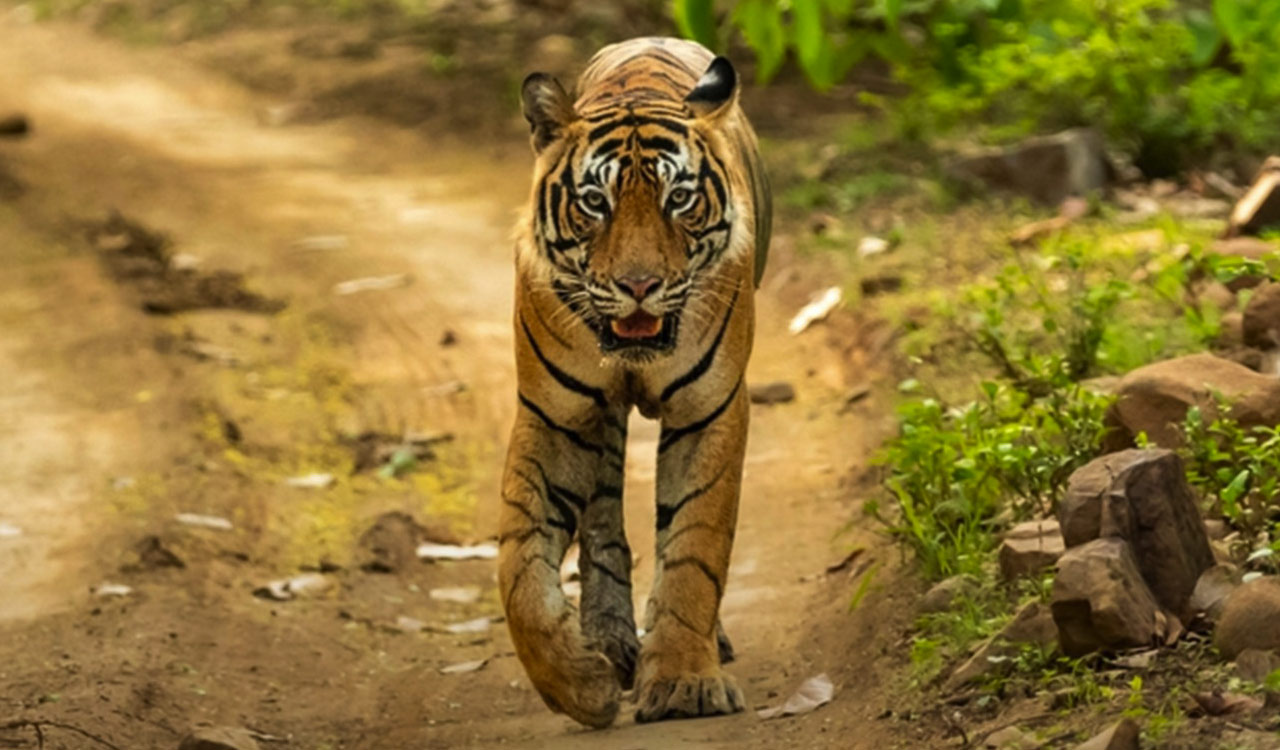
Tadoba National Park in Maharashtra is known for its thriving tiger population, but the reserve is also home to many other fascinating animals such as deer, gaur, sloth bears, wild dogs and leopards that attract wildlife enthusiasts and safari visitors
Published Date – 8 March 2026, 06:44 PM
Tadoba National Park: There was a time when the extinction of tigers was predicted in India; the number of the big cats at this national park had reduced to just 30 a decade ago. Conservation efforts reversed the trend, and today Tadoba and its neighbouring areas have 200 tigers.
While most tourists come to Tadoba to spot tigers, the park is a playground for many other animals who can also thrill safari-goers. Here is a look at the most prominent animals of Tadoba:
DEER: The deer family includes sambar deer, spotted deer and barking deer. Male deer possess antlers that reach full size during the mating season and are shed annually. These antlers may be branched and are composed entirely of bone without keratin, the material found in our hair and fingernails.
Sambar deer have a unique way of warning others about danger. On detecting a threat, the first response is not to run away but to seek cover or to move into a wide open area to get a clear view of the potential danger. Their reaction involves raising their tail in an alert position. If they find the threat to be real, they stamp their front feet and give out a loud “honking” alarm call. It is a sure confirmation of a tiger’s presence, just as the spotted deer’s barking is.
Barking deer, also known as the muntjac, emit a sound similar to a dog’s barking. It is considered one of the oldest known deer species in the world. When it moves, the barking deer displays a spring-like gait. It holds the distinction of having the smallest chromosome number among mammals.
ANTELOPES: Antelope species of Tadoba are mainly the blue bull and the four-horned antelope, or chausingha. Antelopes are characterised by their permanent horns, which are not branched like deer antlers but assume unique and unusual shapes. These horns consist of bone covered with keratin.
INDIAN GAUR: Often mistaken for a buffalo, the Indian gaur is not related to it. With a male weighing up to 1,000 kilograms, the Indian gaur is the largest member of the bovine family. While females and calves are not as dark as the males, all of them have white sock-like markings on their feet. They assemble in a strong matriarchal society where an older female leads the group, and males mainly associate during the breeding season.
SLOTH BEAR: They climb trees in search of their favourite honey, and their claw marks are often seen on the trunks of these trees. Unlike other animals whose four paw marks are similar, bears have longer and flatter hind feet, leaving human-like marks on the mud. Their front feet leave marks similar to those of carnivores. The reason is that, like humans, bears can stand on their hind feet, and evolution has given those feet a different shape for adaptability.
ASIATIC WILD DOG: Distinguished by their reddish hue and furry tails, these dogs, known as dhole, communicate with whistles in their pack. Males raise one hind leg or both to do a handstand and urinate to mark their territory. They are small in size, so they operate in groups and are courageous enough to face and even steal kills made by tigers and leopards.
LEOPARD: The spotted, mid-sized cat is found over large parts of India, from the Himalayas to the Western Ghats. As per the latest count, Tadoba has 127 leopards. But being shy and dwelling on trees, they are not seen often. Leopards and panthers are the same.
Besides these animals, there are scores of bird species, butterflies, spiders and reptiles in Tadoba.
PILLARS OF TADOBA: Not to be missed are stone pillars shaped a bit like Egyptian obelisks, found at regular intervals throughout the forest. They are believed to have been built during British colonial times as directional guides in what was then an extremely thick jungle. Each pillar has a notch on top indicating the direction to the next pillar, thus marking a route out of the forest.
How to reach: Take a flight or train to Nagpur. It is an easy three-and-a-half-hour drive to Moharli Gate via Chandrapur.