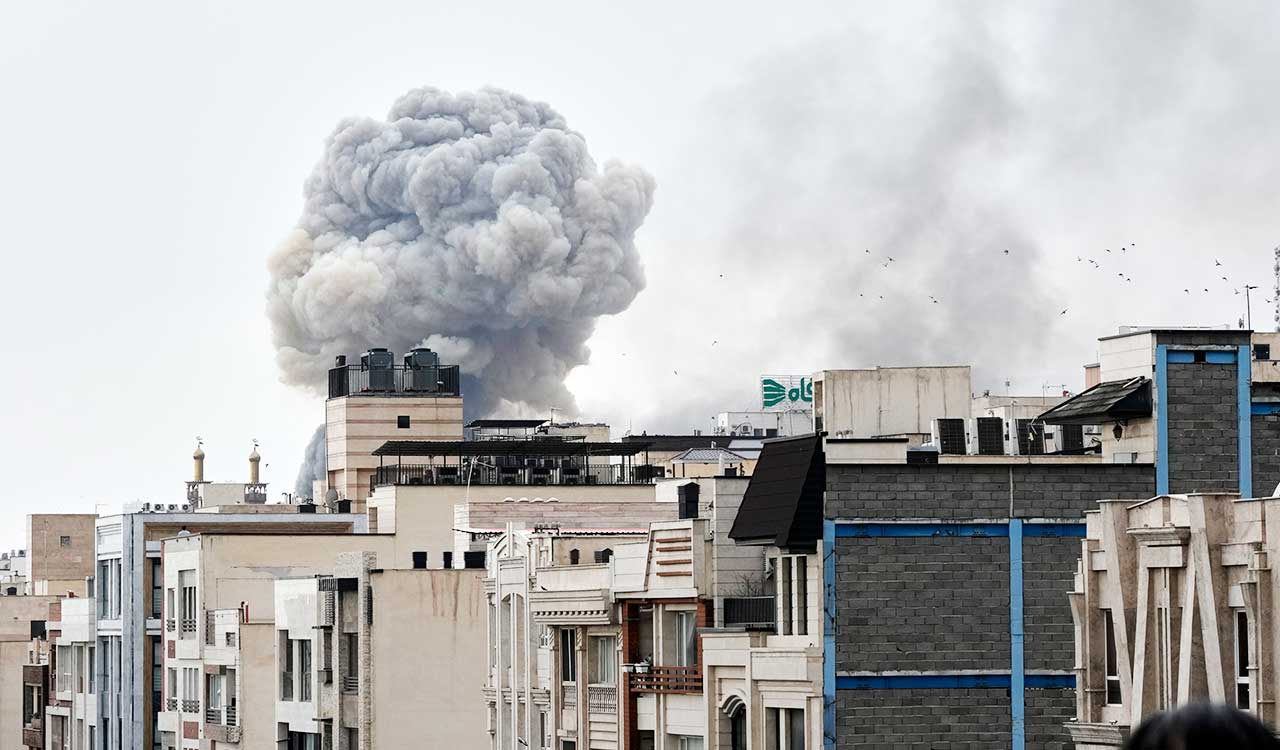
The conflict between Iran, Israel and the United States intensified dramatically as missile and drone strikes spread across West Asia. Iran and allied groups targeted Israel, Gulf states and US military sites, while US-Israeli forces launched heavy airstrikes inside Iran
Published Date – 3 March 2026, 12:15 AM
Dubai: Iran and allied armed groups fired missiles at Israel, Arab states and US military targets around the region on Monday, while Israel and the United States pounded Iran as the war expanded to several fronts. Kuwait mistakenly shot down three American warplanes over its skies.
The intensity of the attacks on both sides, the killing of Iranian Supreme Leader Ayatollah Ali Khamenei, and the lack of any apparent exit plan indicated the conflict would not end any time soon. It already has far-reaching consequences across the region and beyond: Previously safe havens in West Asia like Dubai have seen incoming fire; hundreds of thousands of airline passengers are stranded around the globe; oil prices shot up; and US allies pledged to help stop Iranian missiles and drones.
If attacked, Iran has long threatened to drag the region into total war, including targeting Israel, the Gulf Arab states and the flow of crude oil crucial for global energy markets. All these things came under attack on Monday.
QatarEnergy, in fact, said it would stop its production of liquefied natural gas because of the conflict, taking one of the world’s top suppliers off the market. It offered no timeline for restoring its production.
The chaos of the conflict became apparent when the US military said Kuwait had “mistakenly shot down” three American F-15E Strike Eagles during a combat mission while attacks from Iranian aircraft, ballistic missiles, and drones were underway. US Central Command said all six pilots ejected safely and are in stable condition.
At least 555 people have been killed in Iran so far by the US-Israeli campaign, the Iranian Red Crescent Society said, and more than 130 cities across the country have come under attack. Eleven people have been killed in Israel and 31 in Lebanon, according to authorities there.
Lebanon’s government said Hezbollah’s overnight attack against Israel was “illegal” and demanded the group hand over its weapons. Lebanese Prime Minister Nawaf Salam said only the state can decide whether to go to war or peace, and called on the Lebanese military to prevent the firing of projectiles and detain anyone involved.
In Kuwait, fire and smoke rose from inside the US Embassy compound.
On Monday afternoon, multiple airstrikes hit Tehran, Iran’s capital, while top Iranian security official Ali Larijani vowed on X that “we will not negotiate with the United States”. In Iraq, a pro-Iranian militia claimed responsibility for a drone attack targeting US troops at the Baghdad airport, the day after it said it fired at a US base in the city of Irbil in the north, and Cyprus said a drone attack targeted a British base on the Mediterranean island nation.
Israel and the US bombed Iranian missile sites and targeted its navy, claiming to have destroyed its headquarters and multiple warships.
Regional oil infrastructure
World markets were rattled by the fighting, and oil prices soared.
Saudi Arabia’s Ras Tanura oil refinery came under a drone attack on Monday, with defences downing the incoming aircraft, a military spokesman told the state-run Saudi Press Agency.
Ras Tanura, near the city of Dammam in eastern Saudi Arabia, is one of the world’s largest oil refineries with a capacity of over half a million barrels of crude oil a day. It was temporarily shut down as a precaution after the attack, Saudi state television reported.
Oman said a bomb-carrying drone boat exploded against a Marshall Islands-flagged oil tanker in the Gulf of Oman on Monday, off the coast of the sultanate’s capital of Muscat, killing one mariner. The state-run Oman News Agency said the dead crew member was from India.
Earlier in the day, debris fell on Kuwait’s Ahmadi oil refinery, injuring two workers, after drones were shot down, the state-run KUNA news agency reported.
Iran’s decision to expand its attacks to major regional oil infrastructure adds a new element to the war gripping West Asia, directly targeting the lifeblood of the area’s economy.
“The attack on Saudi Arabia’s Ras Tanura refinery marks a significant escalation, with Gulf energy infrastructure now squarely in Iran’s sights,” said Torbjorn Soltvedt, an analyst at the risk intelligence company Verisk Maplecroft.
Hezbollah fires on Israel
As the attacks on Iran continued, Hezbollah said it fired missiles from Lebanon into Israel early Monday in response to the killing of Iranian Supreme Leader Ali Khamenei and “repeated Israeli aggressions.” There were no reports of injuries or damage, and Israel said that it had intercepted one projectile while several fell in open areas.
Israel retaliated with strikes on Lebanon, killing at least 31 people and wounding 149 others, according to Lebanon’s Health Ministry. About two-thirds of the dead were in the country’s south.
Lebanon’s government said it was holding an emergency meeting after Hezbollah’s attack on Israel triggered the Israeli airstrikes.
Iranian proxies join the fray
Hezbollah’s launch of missiles at Israel was the first time in more than a year that the militant group has claimed an attack. Israel said Hezbollah had “joined the campaign” alongside Iran as it retaliated with strikes on Beirut, Lebanon’s capital.
Associated Press journalists in Beirut were jolted awake Monday by a series of loud explosions that shook buildings and caused windows to shatter. Warplanes could be heard flying low overhead.
“The strikes continue,” said Maj. Gen. Rafi Milo, head of Israel’s Northern Command. “Their intensity will increase.” The Iraqi Shiite militia Saraya Awliya al-Dam claimed a drone attack on Monday targeting US troops at the airport in the Iraqi capital, Baghdad, further widening the retaliation over the killing of Khamenei. It had claimed a drone attack on Sunday against a US air base in Irbil, in Iraq’s north.
The group is one of a number of Shiite militias operating in Iraq. The US and Iraq did not immediately comment on the claims.
In the Persian Gulf, Iran’s retaliatory strikes pushed the conflict into cities that have long marketed themselves as regional safe havens. Three people were reported killed in the United Arab Emirates, and one each in Kuwait and Bahrain.
In the United Arab Emirates, authorities said most Iranian missiles and drones were intercepted. But some either got through or fell as debris, causing the deaths and significant damage. Bahrain and Kuwait said Iranian strikes in both countries hit civilian targets outside the US bases where Iran had pledged to retaliate.
WHO calls for protection of civilians
Tehran’s streets have been largely deserted with people sheltering during airstrikes. The paramilitary Basij force, which has played a central role in crushing recent protests, set up checkpoints across the city, according to witnesses.
In the northern Iranian city of Babol, a student, speaking anonymously over concerns of retribution, told the AP that armed riot police were on the streets Saturday night and into the early hours of Sunday after the death of Khamenei.
“We don’t know whether to be happy about the elimination of the criminals who oppress us or to remain silent in the face of the US and Israel’s war against the country and its interests and the terror that is taking place,” he said.
In Israel, rescue services have confirmed several locations have been hit by Iranian missiles, including Jerusalem and a synagogue in Beit Shemesh, where nine people were killed and 28 wounded, bringing the overall death toll in the country to 11.
The World Health Organisation called on Monday for sparing civilians and healthcare facilities in the Middle East amid the escalating conflict.
“The protection of civilians and health care must be absolute,” Hanan Balkhy, regional dietitian at WHO, wrote on social media. “All parties must … ensure medical facilities remain protected.”