
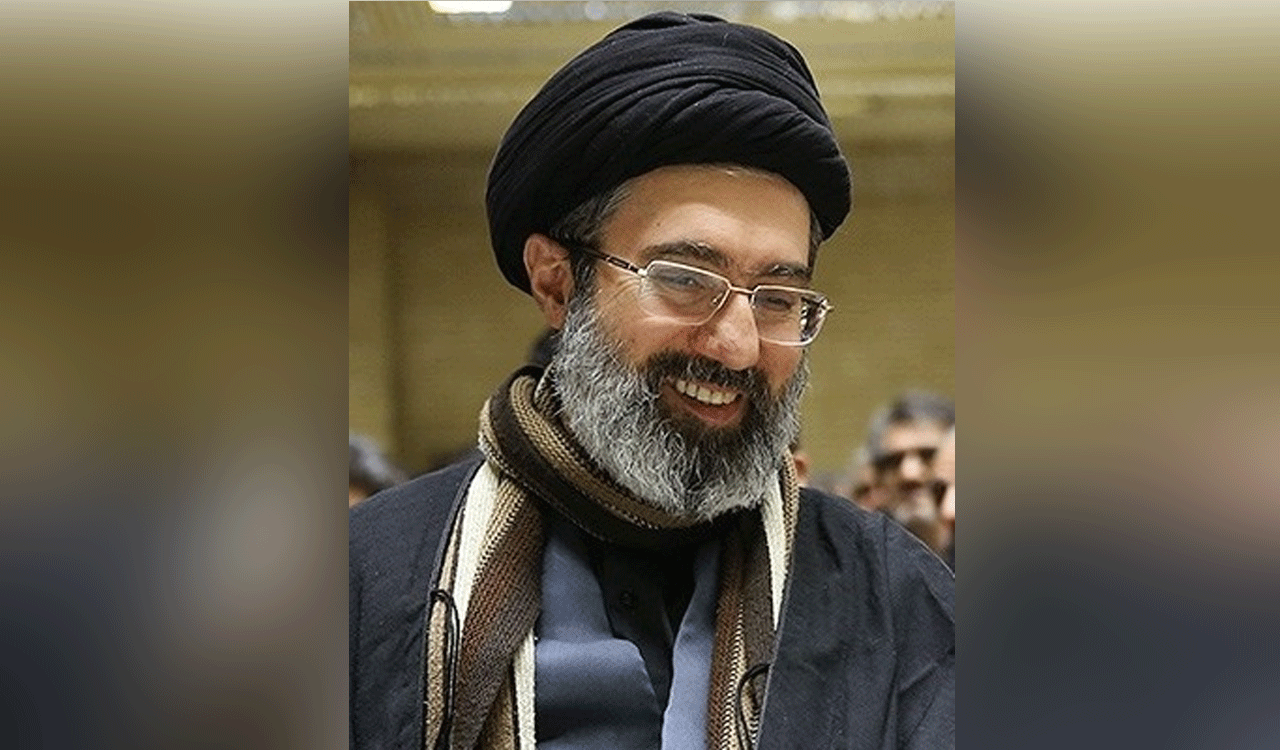
Iran’s leaders are preparing to choose a new supreme leader after the killing of Ayatollah Ali Khamenei. A provisional council is guiding the country, while several clerics and political figures have emerged as top contenders for the powerful post
Published Date – 2 March 2026, 11:27 PM
Tehran: Iran’s leaders are scrambling to replace Supreme Leader Ayatollah Ali Khamenei, who ruled the country for 37 years before he was killed in a surprise US and Israeli bombardment.
It’s only the second time since the 1979 Islamic Revolution that a new supreme leader is being chosen. Potential candidates range from hardliners committed to confrontation with the West to reformists who seek diplomatic engagement.
The supreme leader has the final say on all major decisions, including war, peace and the country’s disputed nuclear programme.
In the meantime, a provisional governing council composed of President Masoud Pezeshkian, hardline judiciary chief Gholamhossein Mohseni Ejei and senior Shiite cleric Ayatollah Ali Reza Arafi is guiding the country through its biggest crisis in decades. Foreign Minister Abbas Araghchi said on Sunday that a new supreme leader would be chosen early this week.
The supreme leader is appointed by an 88-member panel called the Assembly of Experts, which by law is supposed to quickly name a successor.
The panel consists of Shiite clerics who are popularly elected after their candidacies are approved by the Guardian Council, Iran’s constitutional watchdog.
Khamenei had major influence over both clerical bodies, making it unlikely the next leader will mark a radical departure.
Here are the top contenders.
Mojtaba Khamenei
Mojtaba Khamenei, the son of Khamenei and a mid-level Shiite cleric, is widely considered a potential successor. He has strong ties to Iran’s paramilitary Revolutionary Guard but has never held office. His selection could prove awkward, as the Islamic Republic has long criticised hereditary rule and cast itself as a more just alternative.
Ayatollah Ali Reza Arafi
Arafi is a member of the provisional governing council. The senior Shiite cleric was handpicked by Khamenei to be a member of the Guardian Council in 2019, and three years later he was elected to the Assembly of Experts. He leads a network of seminaries.
Hassan Rouhani
Hassan Rouhani, a relative moderate, was president of Iran from 2013 to 2021 and reached the landmark nuclear agreement with the Barack Obama administration that US President Donald Trump scrapped during his first term.
Rouhani served on the Assembly of Experts until 2024, when he said he was disqualified from running for re-election. He criticised it as an infringement on Iranians’ political participation.
Hassan Khomeini
Hassan Khomeini is the most prominent grandson of the founder of the Islamic Republic, Ayatollah Ruhollah Khomeini. He is also seen as a relative moderate but has never held government office. He currently works at his grandfather’s mausoleum in Tehran.
Ayatollah Mohammed Mehdi Mirbagheri
Ayatollah Mohammed Mehdi Mirbagheri is a senior cleric popular with hardliners who serves on the Assembly of Experts.
He was close to the late Ayatollah Mohammad Taghi Mesbah Yazdi, a fellow hardliner who wrote that Iran should not deprive itself of the right to produce “special weapons”, a veiled reference to nuclear arms.
During the COVID-19 pandemic, Mirbagheri denounced the closure of schools as a “conspiracy”. He is currently the head of the Islamic Cultural Center in Qom, the main centre for Islamic teaching in Iran.