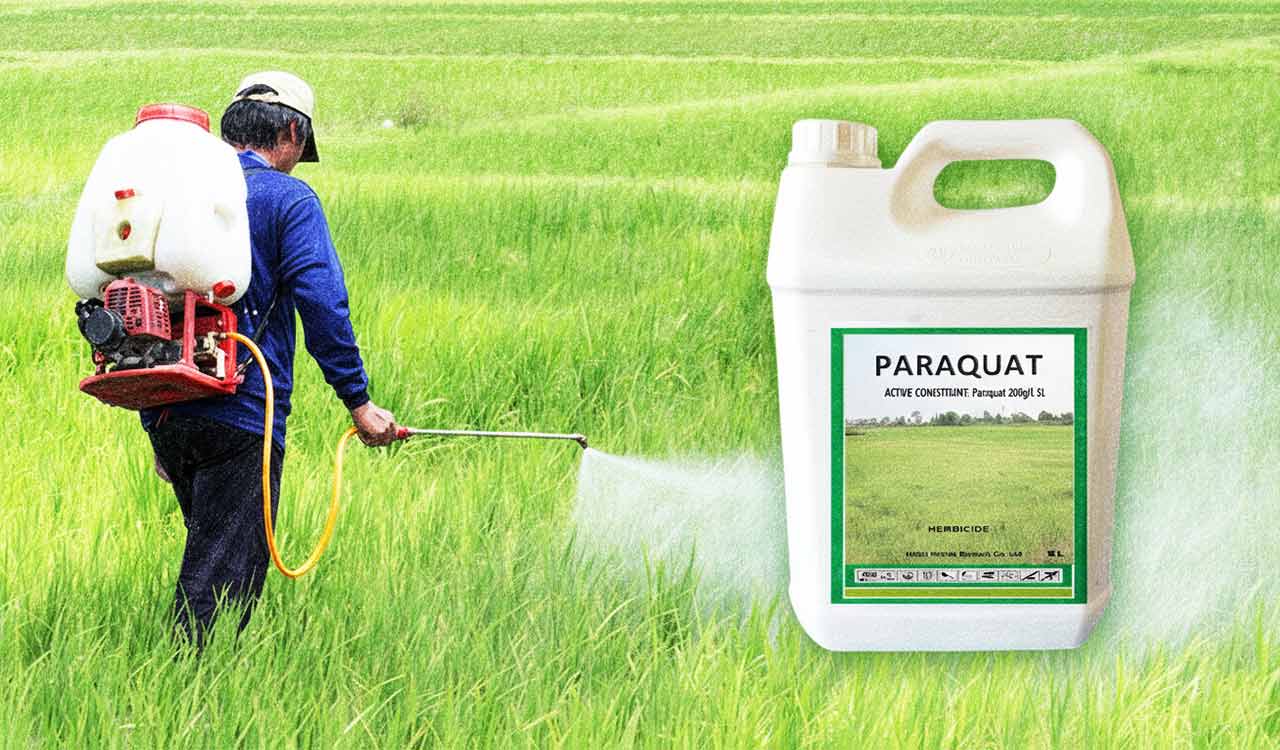
Despite bans in nearly 70 countries, the toxic weedkiller remains legal in India, raising alarm over poisoning deaths and the risk of Parkinson’s
Published Date – 27 February 2026, 10:19 PM
By Kattamreddy Ananth Rupesh
In a significant move underscoring growing public health concerns, the Telangana High Court has issued notices to both the Central and State governments seeking a clear position on the continued use of the toxic herbicide paraquat, which remains legal in India despite being banned in many countries due to its extreme lethality.
The court’s directive, issued following a Public Interest Litigation highlighting hundreds of deaths annually linked to paraquat poisoning, calls for government responses on whether restrictions or a ban should be considered to prevent further loss of life and promote safer alternatives in agriculture. An evolving grassroots movement is now taking shape in Telangana, led by a section of the medical community and supported by the principal opposition party Bharat RashtraSamithi (BRS).
First synthesised in 1882 by Austrian chemists Hugo Weidel and M Russo, paraquat’s herbicidal properties were not recognised until 1955 by scientists at Imperial Chemical Industries (ICI) in the UK. The ICI began commercial production in 1962 under the brand name Gramoxone. Paraquat, a methyl viologen compound, exists as a stable salt in the form of paraquat dichloride, which serves as the parent compound for various formulations. It is a non-selective herbicide widely used by farmers to eliminate weeds, as it is inexpensive and highly effective compared to labour-intensive and economically demanding natural weed control methods used in various crops.
The Case For Ban
Paraquat is highly toxic to humans because of its ability to generate reactive oxygen species (free radicals) inside cells, leading to widespread organ damage. Since it accumulates in lung tissue, prolonged exposure can result in lung fibrosis. Skin contact with paraquat can cause severe burns and corrosion.
The primary route of exposure in cases of self-poisoning is ingestion, while accidental exposure can occur through skin contact or inhalation. Long-term inhalational and dermal exposure has also been linked to Parkinson’s disease. This connection has led to a major class-action lawsuit in the United States, where affected individuals are seeking justice for health complications allegedly caused by paraquat exposure.
As the Telangana High Court seeks answers from the government, India faces a difficult balance between agricultural dependence and human safety
The mortality profile of paraquat has led to its ban in nearly 70 countries. The European Union Court has also issued an order banning the substance due to these health concerns. The primary reason for the strong regulation of paraquat is its extreme lethality; even a small amount of the compound can be fatal. Medical management is limited to supportive care, as there is no antidote, unlike treatments available for other common poisonings, such as anti-venom for snake bites or atropine and oximes for organophosphate poisoning.
Paraquat and Parkinson’s Disease
The association between paraquat exposure and the development of Parkinson’s disease has been a highly controversial topic, sparking debate across industry, academia, media and finally several courts in the USA. Unfortunately, the company manufacturing paraquat has been accused of manipulating data and resorting to unfair practices to convince regulators that the substance is safe. The company claimed to have added an emetic (a substance that induces vomiting) to prevent the body from absorbing paraquat if accidentally ingested. However, the amount included was far lower than what is needed to effectively induce vomiting in humans.
Additionally, crucial toxicity data were kept hidden to secure approval for the product’s sale. The company allegedly misled regulators and the public about paraquat’s safety. Interestingly, even China has banned paraquat following the precautionary principle, but it still manufactures for export. The same is true for several countries that have banned the product.
Paraquat is classified as a highly hazardous pesticide by the World Health Organisation. Organisations like Pesticide Action Network India (PAN India) and the Centre for Pesticide Suicide Prevention (CPSP), India, have been advocating for its ban for years due to the risks it poses to agricultural communities’ occupational health as well as its use as a method of suicide. Recently, paraquat has even become a tool for murder in India, with the Kerala Sharon Raj incident being just the tip of the iceberg.
Despite its recognition as a highly hazardous pesticide and a criminal poisoning tool, paraquat continues to be used in India, raising significant concerns for both public health and the agricultural community. It would be shortsighted to assume that the state is unaware of this. The Government of India has attempted to address the risks by banning a few substances and through the proposed Pesticide Management Bill of 2025, which is still pending in Parliament. However, the legacy of pesticides like paraquat being registered without adequate safety data under the Insecticides Act of 1967 complicates efforts to restrict their use.
Practicalities on Ground
The organisations pushing for a ban on paraquat often fail to account for India’s agricultural reality. Shifting to natural farming suddenly, as some suggest, is not a viable option for a country where agriculture is deeply reliant on such chemicals, especially post-green revolution. The disastrous example of Sri Lanka, which faced economic collapse after a sudden shift to organic farming, highlights the risks of such an abrupt change.
India must carefully balance public health concerns with the economic realities of a pesticide-dependent agricultural sector, ensuring a gradual and sustainable transition toward safer alternatives. Although agriculture predates herbicides like paraquat, we cannot deny our heavy reliance on it due to its cost-effectiveness and efficacy.
The growing misuse of paraquat for suicide and its use as a weapon for homicide in various regions of India, including remote tribal areas, cannot be solely attributed to those abusing it. The argument that pesticides are not meant for human consumption cannot be claimed as a simple defence. The crux of the issue also lies in the continued availability of this highly toxic substance. Sadly, there is a lack of research within the Indian neurology community on the link between paraquat and Parkinson’s disease, a significant issue widely studied elsewhere.
It is undeniable that paraquat presents a severe threat to both public and social health. The state must urgently act to regulate and limit access to it, putting in place effective alternatives and safeguards, rather than allowing such a dangerous chemical to remain widely accessible.

(The author is Assistant Professor of Forensic Medicine, Government Medical College, Ongole)