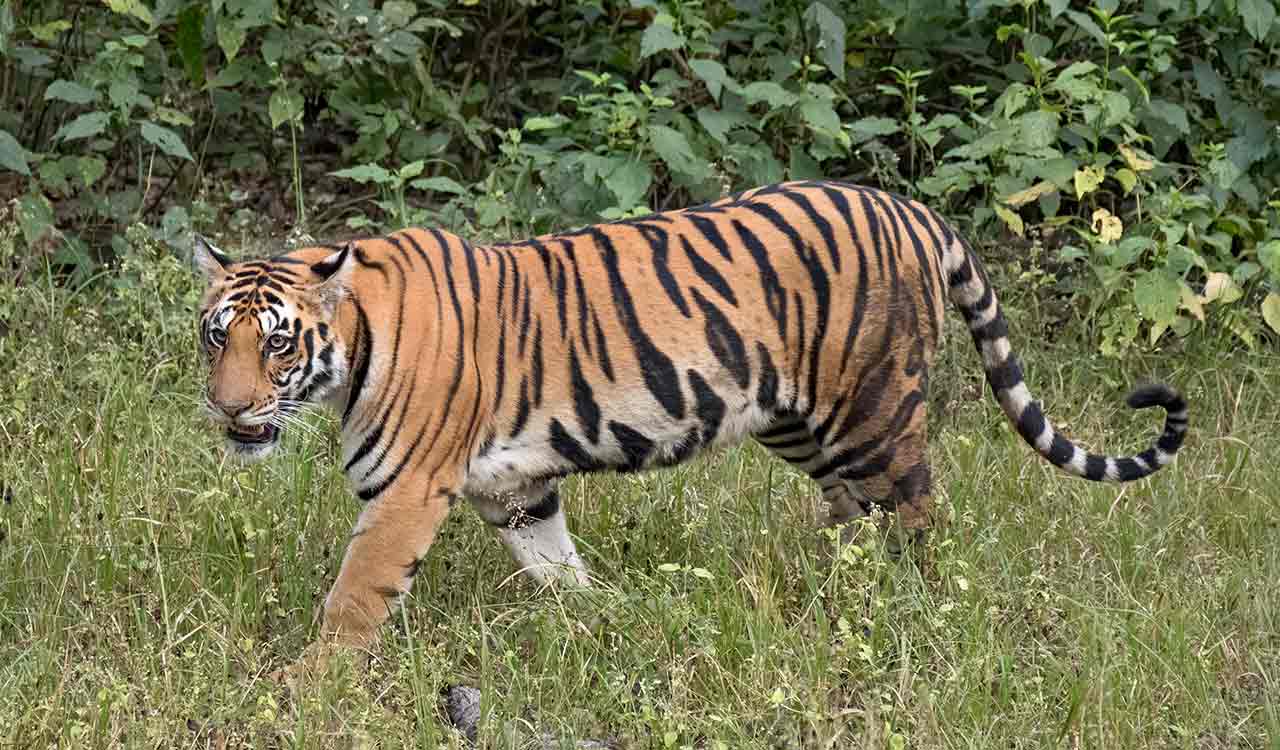
A wandering tiger in Siddipet has prompted forest officials to attempt tranquilisation and relocation for human and animal safety. Despite previous trap attempts, experts are setting up camera traps and following NTCA guidelines to capture and radio-collar the tiger.
Published Date – 15 February 2026, 06:22 PM
Hyderabad: With the wandering tiger creating panic in villages in the Siddipet district for over a week and safety of the animal at risk, the forest department has decided to tranquilise the tiger and relocate it to a forest.
The veterinarians and wildlife experts, along with forest officials, are making efforts to tranquilise the tiger in the forest. On two instances, in the last week, the forest officials and the veterinarians set up traps and waited for the tiger to come. Nevertheless, the big cat did not turn up.
“Again, we will be giving it a try today. Live camera traps are set up at a spot in the reserve forest. The teams will lie in wait for the tiger,” said an official.
Chemical immobilisation involves use of drugs to restrict an animal’s movement by inducing a state of insensibility and stopping deliberate and coherent movement. The technique is considered suitable for ‘tigers in conflict’, as it allows capture of select individuals, enables selection of time of capture, and causes minimal stress to the animal.
“Generally, giving anaesthesia is not a problem. Comprehensive planning is done by experts, including a biologist, a wildlife manager and veterinarians, before the operation,” said Imran Siddiqui, Wildlife Biologist.
For the operation, the joint teams have to strictly follow the “Standard Operating Procedure” laid down for the purpose by the National Tiger Conservation Authority (NTCA). The guidelines specify the procedure to be adopted to ensure the safety of the tiger, the composition of the team deployed to track and capture the tiger, the drugs and darts to be used to sedate the animal in case of chemical immobilisation, the safety aspects of the team involved in the operation and tiger’s relocation to forest after putting a radio collar.
Prior to the operation, aspects such as the physiological and emotional status of the animal, length of the procedure, the environmental conditions, terrain/escape cover, equipment availability, drug appropriateness, and most importantly, the safety of the operator/ team are to be considered.
“After the tiger is captured, it is to be radio collared and released in the forest. So it is compulsory to sedate the animal; it is a common practice now,” added Imran.
According to the forest officials under Sections 11 and 12 of the Wildlife Protection Act, intervention such as tranquilisation, capture, or relocation can be undertaken only when there is a proven threat to human life or property. “In the case of tiger moving around Yadadri Bhuvanigiri, Siddipet and Jangaon, the cages were set up at several places; the tiger could not be trapped. It is killing cattle and there is a threat to humans and a risk to tiger as it is moving in fields with live electricity supply lines. Hence, we are trying to tranquilise it and relocate it to a safer place,” said an official of forest department.
Relocating the tiger is another challenge as the officials have to ensure it is not released into another tiger’s territory, which could again lead to tiger-tiger conflict.