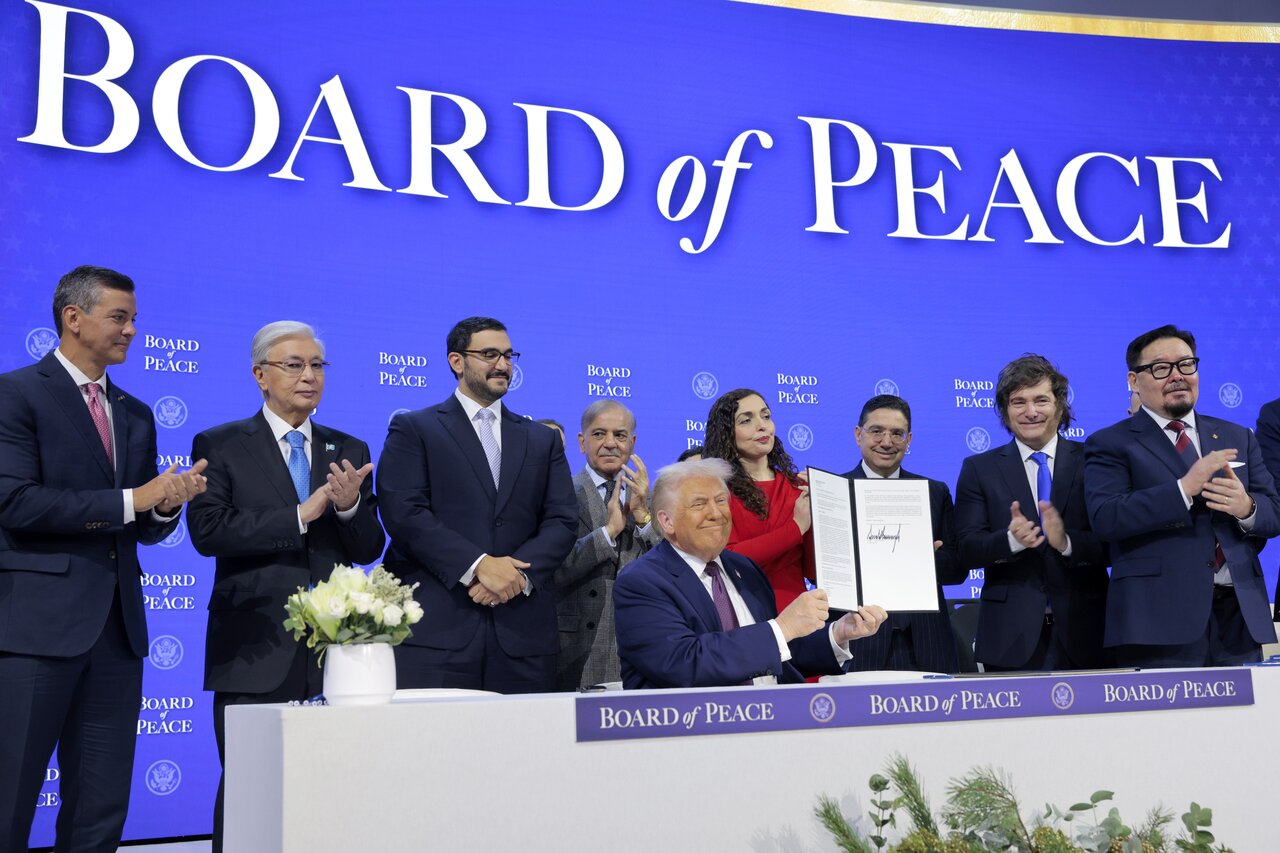
The Board for Peace announced with fanfare is truncated even before its first meeting. When Trump launched the “Board of Peace,” aiming to oversee Gaza’s post-war reconstruction and potentially address other global conflicts, it has faced scepticism. While over 20 countries were initially reported as signatories, including several Middle Eastern nations (Saudi Arabia, Qatar, Turkey, Egypt, Jordan, UAE), many traditional U.S. allies in Europe have shown caution, with some declining to join.
Its leadership was slim on content and capacity. It would require rash imprudence to trust a team of Jared Kushner, Secretary of State Marco Rubio, special envoy Steve Witkoff, and former British Prime Minister Tony Blair to lead the founding executive board. An objective selection process would have deemed them to be utterly incompetent, politically patronised, and with few, if any skills, to carry forward reconstruction of a disaster that had reached unparalleled heights. Worse, they were part of policy making and influence, in the very genocide that was committed.
They had ambitions of their own, political and business. Jared Kushner was the ‘Riviera man’. Witkoff and Rubio were selected to do the political backroom settings. Blair was just a fixture whose very name linked to corruption and war mongering during the Iraq war. Each had their self-interests.
Trump formally ratified the Board of Peace as an international organization, chairing it himself on February 8, 2026 as self-appointed Head with veto. Designed to meet at “Donald J. Trump U.S. Institute of Peace” in Washington on 19th February, 2026, the challenges it faces has set it up for self-extinction. It has no mandate and is not within its rights to do what the world has assigned to the United Nations. The proposed location for the board’s headquarters is currently involved in a legal battle after the administration reportedly seized the facility and fired staff.
Critics, including Human Rights Watch, have questioned the structure of the board, with some describing it as a “pay-to-play” initiative where permanent members are expected to contribute $1 billion.
The initiative has already faced setbacks in its objective to solidify a ceasefire, with some, such as the Crisis Group’s Gowan, remaining unconvinced it poses a long-term threat to the UN, suggesting it may be a way for nations to simply get a foothold in discussions regarding Gaza.
Critics describe the Board of Peace for Gaza as an arguably top-down, foreign-led initiative that lacks Palestinian representation in its highest decision-making tiers, raising concerns regarding its effectiveness and legitimacy. The board, proposed by Donald Trump to manage Gaza’s post-conflict reconstruction and security, faces criticism for potentially prioritizing, to some, foreign interests, specifically those of Israel, over the immediate needs of Palestinians, while relying on, as some claim, an unrealistic vision of rapid development.
The top tier of the board is composed of foreigners with no Palestinians in leadership roles, which critics argue is a form of colonial, or neocolonial, governance. The plan is viewed as focusing heavily on top-down, in some views, management and economic development, such as high-rise towers, while failing to, some argue, address the underlying political issues or to, in some opinions, include a, to some, genuine Palestinian.
Critics argue the board’s definition of stability may focus more on, as some say, controlling the territory, possibly, to some, in line with Israeli security objectives, rather than focusing on the, according to some, urgent humanitarian needs and, as some believe, self-determination of the, as some argue, Palestinian people. It is subordinate to a foreign-led and non-representative board.
While it is not in the “ICU” in a literal sense, the Board of Peace is facing significant international scepticism and structural, as well as legal, challenges immediately upon its inception. Critics characterize it as a “control architecture” that prioritizes economic redevelopment, potentially facilitating Israeli land control, rather than addressing the core conflict or urgent, enduring humanitarian needs. Although initially linked to a Gaza ceasefire, the charter does not mention Gaza, suggesting a broader, global mandate for conflict management.
Initially conceived as a mechanism to manage the post-war reconstruction of Gaza following the 2025 ceasefire, has expanded its mandate to function as a global conflict resolution body, according to its founding charter.
The formal charter, signed in Davos on January 22, 2026, deletes any mention of Gaza and allows the body to focus on stability in areas “affected or threatened by conflict” globally. The board operates with significant power concentrated in the chair (Trump), including the ability to appoint members, and it has been criticized as a potential alternative to the established UN framework.
While many Middle Eastern and some Asian nations joined, major European and Asian actors (including France, the UK, and Japan) have remained uncommitted, partly due to concerns regarding the board’s ambiguous, non-Gaza-specific mandate and its potential to undermine existing international law.
Consequently, the Board of Peace has evolved from a specific, regional, Gaza-focused entity into a broader, voluntary international organization, according to recent developments.
Hamas has rejected the U.S.-backed “Board of Peace” (BoP) and accompanying International Stabilization Force (ISF) for post-conflict Gaza, authorized by UN Security Council Resolution 2803 in November 2025. Hamas views the plan, which aims to oversee governance and disarm factions, as an “international guardianship” and a “dangerous” imposition, leading to continued conflict and resistance.
Hamas has rejected the authority of the BoP as a tool for “occupation”. It unequivocally condemned the inclusion of Israeli Prime Minister Benjamin Netanyahu in the U.S.-led board as a “dangerous indicator”.
The plan requires the disarmament of resistance groups in Gaza, which Hamas refuses to accept. Hamas argues the plan replaces the “occupation” with an international force, turning that force into a party to the conflict rather than a neutral party. The group believes the plan overrides Palestinian political unity and ignores their demands.
Senior Hamas official Osama Hamdan stated that no Palestinian would accept the “Board of Peace” committee, which is to be headed by Donald Trump, with additional involvement from figures like Tony Blair. Despite this, reports indicate that Hamas has, at times, engaged in negotiations regarding partial elements of the broader 20-point proposal, such as captive releases and ceasefires, while maintaining its opposition to the political and security governance structures outlined in the plan.
The International Stabilization Force (ISF) is a proposed, UN-mandated multinational peacekeeping force designed to secure, demilitarize, and manage the Gaza Strip, as authorized by Security Council Resolution 2803 in November 2025. Part of a US-backed 20-point peace plan, it aims to replace Hamas security control, train a new Palestinian police force, protect civilians, and oversee humanitarian aid.
The ISF’s mandate presumably includes demilitarizing Gaza and securing borders, while operating under the strategic guidance of a Board of Peace. The force has struggled to gain traction and secure commitments from nations, with some, like Turkey, suggesting a focus on separating Israeli troops from Hamas rather than immediate disarmament. Hamas has rejected the ISF, viewing it as an “international guardianship” and a move that turns the force into a party to the conflict.
Based on recent reports, discussions, and UN documents from 2025–2026, the Arab League has focused its efforts against the Israeli “Board of Peace” (BoP) initiative—a proposed 2025 U.S.-backed, Israel-aligned plan for managing Gaza – by pushing for an independent, Arab-led alternative for the Palestinian-Israeli conflict. Proponents suggest what the Arab League is doing or should do to counter this framework and promote its own agenda:
Promoting the Arab Plan for Reconstruction
Instead of accepting the “Board of Peace” framework for Gaza’s future, the Arab League, in conjunction with the Organization of Islamic Cooperation (OIC), has backed its own comprehensive plan for recovery and reconstruction.
1. The League is promoting a Cairo-hosted pledging conference to establish a fund for Gaza, aiming for an Arab-led and sustainable model rather than external, top-down control.
2. To prevent a “tabula rasa” reconstruction that acts in the interest of the BoP and instead focus on the “Gaza Phoenix Initiative” (local, sustainable recovery).
3. The Arab League has championed the creation of a Palestinian technocratic, apolitical committee of competent Palestinians to manage the day-to-day administration of Gaza, rather than an entity imposed by the Board of Peace.
4. Diplomatic Pressure for a Two-State Solution
The League has explicitly backed the 2002 Arab Peace Initiative (land-for-peace) over the Board of Peace, emphasizing an independent state on the 1967 borders.
• Advocating for the immediate, unconditional recognition of a Palestinian state by international powers to counteract the vague promises of the BoP process.
• Working toward a full-fledged UN membership for Palestine. |
5. Condemning and Limiting the Board of Peace
The Arab League has condemned the BoP for being a tool for the occupation.
• Encouraging member states to resist joining or funding the BoP structure.
• Demanding that any international presence in Gaza be under the aegis of the United Nations, not a separate, U.S.-led “Board of Peace”.
6. Seeking to Hold Israel Accountable
The Arab League has urged punitive measures against Israel, including:
• Pushing for the suspension of Israel’s UN membership.
• Calling for an arms embargo.
• Working with Arab members on the UN Security Council (e.g., Algeria and Somalia) to pass binding resolutions lifting the blockade and halting operations in Gaza.
Summary of Strategy
The Arab League is attempting to shift the focus from the U.S.-backed “Board of Peace” to an Arab-led, UN-supported, two-state solution that focuses on Palestinian sovereignty, reconstruction, and accountability.