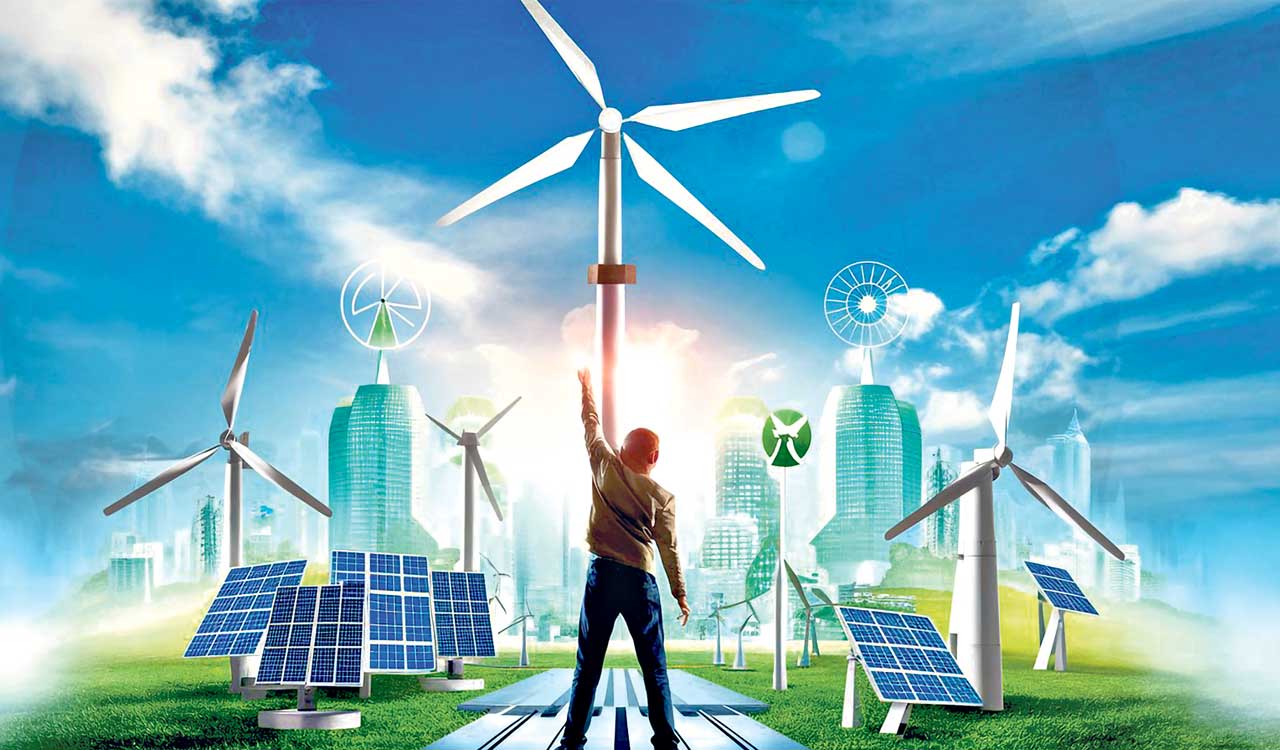
Budget 2026 strengthens India’s clean energy ambitions, but its weak emphasis on climate accountability raises concerns
Published Date – 13 February 2026, 11:47 PM
By Tamali Chakraborty, Subhajoy Mahanta, Barun Kumar Thakur
Energy is one of the most important resources, and its current transition will define its future. Having crossed a decade-long drive towards clean energy, India has now entered a mature phase, where it is not only thinking about how to scale renewables but also how to integrate them efficiently through good governance.
The Budget 2026-27 strengthens renewable energy funding, supports local manufacturing through duty rationalisation, energy storage, and grid infrastructure. Renewable energy is positioned not merely as a substitute for fossil fuels but as a core solution to climate and ecological challenges. While the Budget highlights important advances in clean and green energy, it remains uncertain whether these measures are sufficient to reinforce the long-term sustainability of the energy transition.
Backbone of Energy Strategy
Total allocations for the renewable energy sector have risen to Rs 32,914.7 crore, reinforcing its role as a core pillar of national planning. The objective of installing rooftop solar systems in 10 million households by 2027 links decentralised generation with affordability and consumer participation. By December 2025, around 24% of the target had been achieved, covering 2.39 million households.
The Budget signals intent to accelerate this momentum, with rooftop solar penetration expected to reach 50-60% by the end of the next fiscal. Support for agricultural solarisation has also been strengthened with the PM-KUSUM allocation nearly doubling from Rs 2,600 crore to Rs 5,000 crore, underscoring the role of agri-solar in reducing diesel use and easing grid pressure in rural areas.
The Budget reiterates its focus on enabling the framework needed to support renewable energy technologies. On the manufacturing side, the removal of the basic Customs duty on sodium antimonate, an essential input for solar glass, directly reduces manufacturing costs. This measure is complemented by the reduction of the effective duty payable on solar modules to 20%. This addresses the longstanding issue of duty inversion that has plagued the solar segment.
A genuine green transition requires renewable expansion to align with environmental safeguards, grid readiness, and institutional accountability
To encourage recycling, the Budget provides an exemption from Customs duties on lithium-ion battery waste and scrap. Energy storage receives a more prominent role, marking a conceptual shift. Battery Energy Storage Systems (BESS) are no longer treated as optional supplements but as system-critical infrastructure. The Viability Gap Funding scheme reflects this shift. The first tranche, approved in March 2024, provided Rs 3,760 crore for 13,220 MWh of storage capacity. The second tranche, in June 2025, allocates Rs 5,400 crore to support an additional 30 GWh of BESS capacity.
These measures are expected to integrate storage into future power tenders, especially for grid-scale applications. Extending basic Customs duty exemptions for lithium-ion cell manufacturing to BESS improves project bankability. Expanding renewable generation without adequate storage leads to curtailment, grid instability, and greater reliance on fossil fuels. The Reformed Linked Distribution Scheme has been allocated Rs 18,000 crore for optimal grid operations, while Rs 600 crore has been earmarked under the Green Energy Corridor for developing 6,000 km of transmission infrastructure.
Clean Energy Transition
The Budget also expands the clean energy narrative by strengthening low-carbon non-renewable sources and supply chains. Basic Customs duty exemptions for select nuclear power equipment have been extended until 2035. A dedicated Nuclear Energy Mission targets 100 GW of capacity by 2047, with Rs 200 lakh crore allocated for R&D in small modular reactors (SMRs), including the indigenous development of at least five SMRs by 2033. Funding for the National Green Hydrogen Mission has been raised to Rs 600 crore, largely to support electrolyser manufacturing, hydrogen production, R&D, pilot projects, and skill development.
Investment in Rare Earth Corridors in Kerala, Odisha, Tamil Nadu, and Andhra Pradesh, as part of the Rare Earth Permanent Magnets Scheme, has been proposed. An outlay of Rs 7,280 crore over seven years is estimated, with the capacity to add 6,000 tonnes per year to India’s permanent magnet manufacturing capacity. This is a significant move, especially considering that India consumes 4,000–5,000 tonnes per year, all of which are currently imported.
Further, fundamental Customs duty has been fully exempted for capital goods imported for critical mineral processing. However, experts have raised concerns that without clear legal, environmental, and other regulatory frameworks, the corridors will remain aspirational. The critical issue is environmental impact. Coastal regulations, community impacts, and environmental factors will determine the sustainability of mineral-centric strategies.
Environmental Blind Spots
The fiscal plan delivers clear advantages: it reinforces policy continuity, boosts domestic manufacturing, recognises system-wide needs for storage and grid infrastructure, and expands the clean energy mix to include hydrogen, nuclear, and critical minerals. These signals reassure investors and manufacturers. However, the environmental narrative remains notably weak. The silence is telling, especially as air quality across Delhi and the NCR deteriorated sharply during the winter of 2025–26, with repeated “very poor” and “severe” AQI readings above 300 — underscoring the need to link renewable expansion more directly to pollution reduction and public health outcomes.
While the Budget proposes a Rs 20,000-crore plan for carbon capture, utilisation, and storage technologies in heavy industries, it makes no explicit reference to air pollution, environmental governance, or climate adaptation. The other environment-related allocations include modest proposals of Rs 1,091 crore for pollution control, Rs 170 crore for the National Mission for a Green India, and Rs 2.50 crore for a new afforestation component. Climate expenditures remain fragmented with no unified climate budget. This gap matters. Renewables continue to be framed primarily as growth enablers for manufacturing, data centres, and energy security, rather than as means to strengthen ecological resilience and public health.
Expanding renewable energy alone cannot offset continued coal use or rising energy demand, and clarity on India’s 2070 net-zero mission is missing. As India moves towards 500 GW of non-fossil capacity, the challenge is no longer ambition but alignment. Whether Budget 2026-27 marks a genuine green transition will depend on how well renewable energy implementation aligns with environmental outcomes, grid preparedness, and institutional accountability. A budget signals intent; the transition is defined by what follows.

(Dr Tamali Chakraborty teaches Economics and Subhajoy Mahanta is a Postgraduate student at Indian Institute of Management Visakhapatnam. Dr Barun Kumar Thakur teaches Economics at FLAME University, Pune. Views are personal.)