Official data and national reports show that Telangana contributed over 21.8 per cent of India’s rise in cultivated area between 2014 and 2023. Driven by major irrigation projects, the BRS government’s policies boosted farming, rural jobs and migrant inflows
Published Date – 9 February 2026, 09:05 PM
Hyderabad: Despite sustained attempts by the Congress to belittle the K Chandrashekhar Rao government’s agrarian push, official data placed before Parliament and reflected in multiple national-level reports firmly contradict that narrative. Telangana alone accounted for nearly 21.8 per cent of India’s total increase in cultivated area between 2014 and 2023, underscoring the scale of agricultural expansion achieved during the BRS regime through large-scale irrigation and tank rejuvenation initiatives.
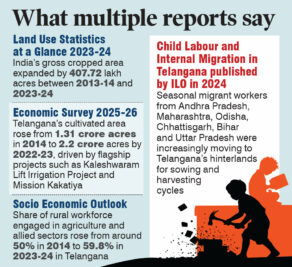
According to the latest Land Use Statistics at a Glance 2023-24 cited in the Rajya Sabha, India’s gross cropped area expanded by 407.72 lakh acres between 2013-14 and 2023-24, rising from 49.74 crore acres to 53.81 crore acres. Of this national increase, Telangana alone contributed about 89 lakh acres, translating to 21.8 per cent of the total expansion, which is an unprecedented share for a single State.
The recent Economic Survey 2025-26 also attributed Telangana’s surge primarily to sustained investments in irrigation. The State’s cultivated area rose from 1.31 crore acres in 2014 after State formation to 2.2 crore acres by 2022-23, driven by flagship projects such as the Kaleshwaram Lift Irrigation Project and Mission Kakatiya, which restored thousands of tanks. These interventions sharply reduced dependence on rain-fed farming and enabled multi-cropping across large tracts.
While the net area sown remained largely stable at 34.34 crore acres in 2023-24 at the national level, the sharp rise in gross cropped area pointed to intensified cultivation and improved irrigation coverage. Telangana’s experience mirrors this trend, with better water access allowing farmers to take multiple crops and align cropping patterns with local resources, as noted in the Economic Survey.
The expansion also reshaped rural employment during the BRS era. The Socio-Economic Outlook 2024 showed that Telangana posted a Labour Force Participation Rate (LFPR) of 66.5 per cent in 2022-23, well above the all-India average of 61.6 per cent. The share of the rural workforce engaged in agriculture and allied sectors rose from around 50 per cent in 2014 to 58.4 per cent in 2022-23 and then to 59.8 per cent in 2023-24, reflecting the sector’s renewed vitality after years of distress prior to 2014.
Another report titled “Child Labour and Internal Migration in Telangana”, published by the International Labour Organisation in 2024, also pointed to Telangana’s increased agrarian pull. According to the report, seasonal migrant workers from Andhra Pradesh, Maharashtra, Odisha, Chhattisgarh, Bihar and Uttar Pradesh were increasingly moving to Telangana’s hinterlands for sowing and harvesting cycles, drawn by assured irrigation and multi-crop practices, which were less prevalent in their home States.
Taken together, official data show that Telangana’s agriculture-led expansion during the BRS years was not incremental but transformative, accounting for more than a fifth of India’s growth in cultivated area and reshaping rural livelihoods through sustained irrigation-driven policy.